






Most companies treat onboarding as a day-one event — a stack of paperwork, a laptop, a quick tour, a welcome lunch. Then the new hire gets handed off to figure out the rest by watching whoever sits closest. That hand-off is where ramp-up quietly breaks.
The first weeks decide whether someone turns into a confident contributor or an early resignation, and the difference rarely comes down to talent. It comes down to whether there was a plan. Organizations with a strong onboarding process see 82% higher new hire retention and 70% higher productivity — not because they hire better people, but because they hand new people a path instead of a desk.
This is the new hire onboarding checklist that turns a chaotic first day into a deliberate first 90 days — every phase from the signed offer to full ownership — and how to run it inside Trainual so it happens the same way for every hire, without anyone chasing it down.
Why does onboarding decide whether a new hire stays?
Because new hires form lasting judgments in their first days, and a weak start is hard to reverse. When the first weeks are disorganized, people question the decision to join — and many leave before they were ever productive. A structured onboarding process is the single biggest lever on early retention and time to productivity.
The cost of a cold start is measurable. The average new hire takes 8 months to reach full productivity, and a structured program shortens that by replacing guesswork with a sequence. Skip the structure and the risk runs the other way — roughly 20.5% of new hires leave within their first 90 days, most of them before they ever paid back the cost of hiring them. The teams that keep people don't onboard harder. They onboard on a plan.
What should a new hire onboarding checklist cover?
Five phases, in order: preboarding before day one, a structured first day, a deliberate first week, a foundation-building first 30 days, and a handoff to real ownership across days 31-90. Each phase has a small set of must-dos. Run them in sequence and ramp-up stops depending on who the new hire happens to sit next to.
The checklist below is the whole arc on one page. The sections after it walk through each phase in detail, including what to do inside a single system so the same steps repeat for every hire.
What needs to happen before day one?
Everything that would otherwise eat into the first day. Send and collect the paperwork, set up accounts, equipment, and tool access, and share a short welcome note with the first-day plan. Preboarding signals the company is run well before the new hire has done a thing — and it frees day one for people, not logistics.
A new hire who arrives to a working laptop, the right logins, and a clear plan starts the relationship on solid ground. Handle the policy acknowledgments and e-signatures ahead of time so they aren't burning the first morning on forms. Provision the tools your team uses and connect them through your HRIS, Slack, and SSO integrations so access is waiting, not requested. None of this is dramatic — it's just the difference between a new hire who feels expected and one who feels like a surprise.
What does a strong first day look like?
Structure, not a fire hose. Walk through the day's schedule, introduce the team and name one point person, and set up a first real task the new hire can finish. The goal is momentum and belonging — proof that there's a plan — rather than cramming every policy and tool into eight overwhelming hours.
The most common first-day mistake is volume: a dozen logins, a binder of process docs, and three back-to-back intro meetings that all blur together. Pick a single, completable task instead. Naming one point person matters as much as the task — it gives the new hire somewhere to take questions that isn't "interrupt whoever looks least busy." That clarity is the same principle behind defining roles and responsibilities across the team: when someone is clearly accountable, things move.
What should the first week cover?
The role itself, in a deliberate order. Assign a role-based path so responsibilities are introduced in sequence, cover the core tools and policies the job needs, and set the first measurable milestone. By the end of week one the new hire should know what they own, where to find answers, and what good looks like.
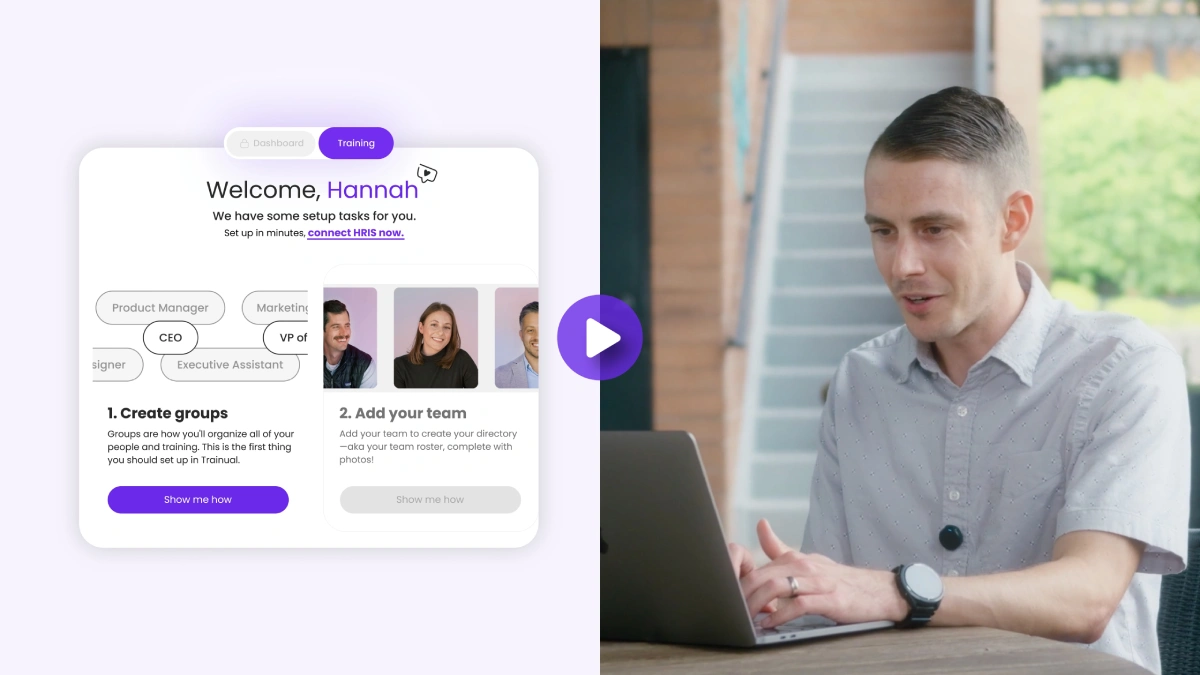
This is where structured onboarding earns its keep. Instead of a manager improvising what to cover, role-based training paths introduce the job in the right order — foundational context first, then the specific workflows the role runs. Point the new hire at a searchable knowledge base so "how do I do this?" becomes a search, not an interruption. And make sure the processes they're learning are written to be used: a good standard operating procedure is the difference between a path that teaches and a path that confuses. (If yours tend toward the latter, how to write a SOP that people actually use is worth a read.)
What should the first 30, 60, and 90 days include?
A move from supported to self-sufficient. Days 1-30 build foundational skills and end with a check-in. Days 31-60 hand over real workflows with a safety net. Days 61-90 transfer full ownership and close with a review. Spreading onboarding across 90 days — not 90 minutes — is what makes the early investment hold.
The check-ins are the part most teams skip, and they're the cheapest insurance you'll buy. A 30-day conversation catches a quiet gap before it becomes a confidence problem; a 90-day review decides what comes next while there's still time to course-correct. For a closer look at structuring that first month, how to onboard a new hire in their first 30 days goes deeper, and reducing new hire time to productivity covers the levers that compress this arc. Remote hires need the same phases with extra intent — there's no hallway osmosis to fall back on, so onboarding remote employees leans even harder on a written, searchable plan.
How do you make onboarding consistent for every new hire?
Put the checklist inside a system instead of a manager's memory. When the role-based path, the policies, the tools, and the milestones all live in one place, onboarding runs the same way every time — whoever the new hire is and whoever the manager is. Consistency is what turns a good first hire into a repeatable one.
This is the whole point of running onboarding on a single source of truth rather than across a calendar invite, a shared drive, and three people's recollection. The path assigns itself by role. Policies carry their own acknowledgments. The AI Assistant lets a new hire ask a plain-language question and get the documented answer back — so the searchable knowledge base absorbs the questions that used to route to a busy senior teammate. That last point is the quiet ROI: structured onboarding is also how you stop losing institutional knowledge when senior employees leave, because the answers live in the system instead of in someone's head.
The results show up fast when the steps stop being optional. When Trailstone Insurance moved onboarding into one searchable system, they cut ramp time by 60% — from three to five days down to about a day and a half — by letting new hires self-serve answers instead of interrupting the team. They're not alone; companies cutting onboarding time with Trainual tend to share the same move, and HR leaders specifically feel the difference most, since they're usually the ones holding the process together by hand. If you want the full build, the definitive guide to LMS onboarding automation for HR leaders walks through automating the whole arc.
Quick wins to start this week
You don't need a full rollout to feel the difference. A few focused moves build the habit and make your next hire's first weeks measurably better.
Quick win #1: Write the first-day schedule for your next hire
Block out hour by hour what their first day looks like, including the one task they'll finish. Even a rough version beats improvising at 9 a.m.
Quick win #2: Move paperwork to preboarding
Send the forms, accounts, and tool access requests before day one. Reclaim the first morning for people instead of logins.
Quick win #3: Assign one point person
Name a single go-to for the new hire's first two weeks. Tell both of them. Watch how many "who do I ask?" moments disappear.
Quick win #4: Turn your top three "how do I…" questions into searchable answers
Write down the three questions every new hire asks and put the answers somewhere they can search. You'll stop answering them in person within a month.
Quick win #5: Put a 30-day check-in on the calendar now
Schedule it the day the offer is signed, before the month gets away from you. The earliest catch is the cheapest one.
Ready to see how Trainual works?
👉 Book a demo and see how Trainual turns a scattered first day into a repeatable 90-day onboarding plan.
Want a sneak peek?
👉 Read customer stories from teams who've cut onboarding time without adding headcount.
Frequently asked questions
What should a new hire onboarding checklist include?
Five phases in order: preboarding (paperwork, accounts, equipment, and a first-day plan before day one), a structured first day, a deliberate first week built around a role-based path, a foundation-building first 30 days, and a handoff to real ownership across days 31-90. Each phase has a short list of must-dos, and a 30-day and 90-day check-in keep it on track.
How long should onboarding last?
Plan for 90 days, not a week. Most companies compress onboarding into the first few days, but full productivity takes months, and the strongest programs spread the work across the first quarter — foundations in the first 30 days, applied responsibility through day 60, and full ownership by day 90. Short onboarding feels efficient and quietly costs you in turnover and ramp time.
What's the difference between onboarding and orientation?
Orientation is one piece of onboarding. Orientation is the early administrative welcome — paperwork, tools, the lay of the land — and it's usually over within a day or two. Onboarding is the whole arc that follows: learning the role, building skills, taking on responsibility, and reaching independence over weeks. Treating orientation as the entire process is the most common onboarding mistake.
What should happen before a new hire's first day?
Preboarding handles everything that would otherwise eat into day one. Send and collect paperwork, set up accounts, equipment, and tool access, and share a short welcome note with the first-day plan. A new hire who arrives to a working laptop, the right logins, and a clear schedule starts the relationship trusting that the company is run well.
How do you onboard remote employees?
Run the same five phases with more intent, because there's no hallway learning to fall back on. Lean on a written, searchable plan: a role-based path the new hire can follow on their own time, a knowledge base they can self-serve from, and scheduled check-ins that replace the casual desk-side conversations a remote hire never gets. The structure that helps in-office hires is the structure remote hires can't do without.
How do you measure whether onboarding is working?
Track time to productivity, early retention, and new hire confidence. Time to productivity tells you how fast people reach full output; early retention (especially through the first 90 days) tells you whether the start is holding; and a simple 30- and 90-day check-in tells you, in the new hire's own words, where the plan has gaps. Measure those three and you'll see what to fix before it costs you a person.