





wo people start the same role on the same Monday. Same experience, same title, same pay band. The only real difference is where they landed: one company runs on a system, and the other runs on whoever happens to remember how things work.
Follow both of them through their first year, from day one to their first performance review, and a gap opens up. By the time they sit down for that review, the gap has very little to do with talent. It comes down to what each company gave them to work with.
A year is the right window to watch. Gallup has found that new employees typically take around 12 months to reach their full performance potential in a role. Everything in that first year either speeds them up or slows them down.
Let's call them Riley and Sam. Riley joins a company without a system. Sam joins one with a system that connects training, day-to-day operations, and performance.
TL;DR
- New hires take about 12 months to reach full performance, so the system around them in year one shapes how their first review goes.
- Onboarding (training) sets expectations. Role-based training paths and a searchable handbook replace "shadow Sarah for a week."
- The day-to-day (operations) measures against those expectations. Weekly updates, visible goals, 1:1s with agendas, and scorecards create a record without extra work.
- Review time (performance) closes the gap. Reviews draft from a year of real work instead of a manager's memory, so nothing is a surprise.
- To start: document roles and onboarding, add a weekly update habit, give feedback in the moment, then connect it all in one place.
Stage 1: Onboarding sets the expectations
Onboarding decides how fast a new hire learns what good looks like, and most companies leave it to chance. Only 12% of employees strongly agree their organization does a great job of onboarding, according to Gallup.
Riley's first week: a tour and a stack of docs
Riley gets a tour, a laptop, and a folder of docs that were last updated two years ago. The plan for week one is "shadow Sarah." Sarah is great, but she's also doing her own job, so Riley learns the version of the process Sarah remembers on a busy Tuesday.
By Thursday, Riley has a dozen questions and asks maybe two of them. Nobody wants to be the new person who keeps interrupting.
Sam's first week: a path built for the role
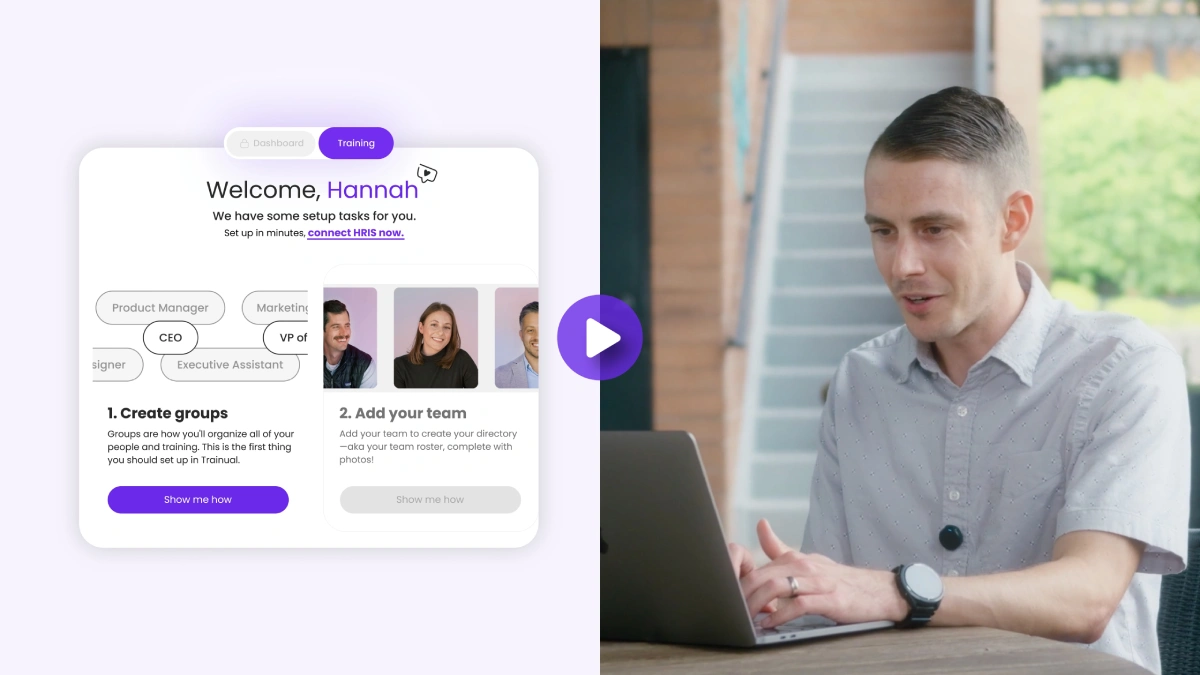
Sam logs in to a training path built for the role. It covers how the company works, what the role owns, and the processes Sam will run first, in the order Sam needs them. Each piece is assigned and tracked, so Sam's manager can see progress without asking.
When Sam has a question at 4:45 on a Wednesday, the answer is in a searchable handbook, not in Sarah's head. Sam gets the documented answer in seconds and keeps working.
Why the first week matters so much
New hires decide fast whether they made the right call. A first week built on scattered docs and borrowed time tells them the company is figuring it out as it goes. A first week with a clear path tells them someone planned for their success before they showed up.
The hesitation to ask is real, too. As StrongMind's CPO put it in their Trainual story, new hires are often "afraid to ask questions within their first week." When the answers are searchable, they don't have to ask.
In Trainual, this is the training suite: onboarding and training paths by role, documentation and SOPs, roles and responsibilities, and AI knowledge search for instant answers.
Stage 2: The day-to-day measures progress
After onboarding, the question changes from "What am I supposed to do?" to "How am I doing?" Without a system, nobody has a reliable answer, including the manager.
Riley's months 2 through 11: a gut feeling
Riley's goals live in a spreadsheet on the manager's drive. Riley has seen it once. Team meetings run long and end without clear owners, so the same issues come back the next week. When someone asks Riley's manager how Riley is doing, the honest answer is a gut feeling.
Nobody here is bad at their job. The information just lives in five places, or nowhere.
Sam's months 2 through 11: four habits in one place
Sam's day-to-day runs on four habits that all live in the same system:
- Updates: Every week, Sam shares wins, blockers, and what's next. The work is visible without Sam having to sell it.
- Goals: Sam knows the target, sees how it ladders up to the team's goals, and tracks progress without waiting to be asked for a status.
- Meetings: 1:1s have agendas and action items, and open items carry into the next meeting, so nothing gets lost.
- Scorecards: The few metrics that matter for Sam's role are tracked week over week, so trends show up early.
The paper trail nobody had to create
This is the part that pays off later. All four habits produce a record without anyone trying to create one. Sam won't be reconstructing the year in month 11, because it was written down a week at a time.
In Trainual, this is the operations suite: team updates, goals and planning, meetings and agendas, and scorecards and KPIs. AI works across all four to flag goals that are behind pace and surface blockers before they slow anyone down.
Stage 3: Review time closes the gap
The first performance review is where the gap between Riley and Sam becomes obvious, and it's mostly a data problem. One manager writes from memory. The other starts from a year of real work.
Riley's review: written from memory
Riley's manager blocks off an afternoon, opens a blank doc, and tries to remember twelve months. What comes to mind first is the last few weeks. That's recency bias, and it means a missed deadline in month 11 outweighs a strong first half nobody wrote down.
Then Riley hears some feedback for the first time: a process Riley has apparently been doing wrong since month three. It lands as a surprise, and surprises at review time feel unfair even when the feedback is right.
It's no wonder Gallup found that only 14% of employees strongly agree their performance reviews inspire them to improve.
Sam's review: built from the whole year
Sam's review starts with a draft. Trainual's AI assembles it over the whole cycle from Sam's documented responsibilities, day-to-day activity, growth areas, and feedback [[CHECK: swap in the webinar's list (updates, goals, meetings, scorecards, training completion) if confirmed]]. Sam and the manager each complete their side, and any differences in how they see Sam's progress surface before the conversation, not during it.
Nothing comes as a surprise, because feedback and praise were captured all year as things happened. So the conversation spends its time on what's next: one or two growth areas, each linked to the training that builds that skill.
What changes for the manager
Sasha, VP of People at Trainual, said her reviews went from hours to 15 minutes. The time savings are real, but the bigger change is trust. A review backed by a year of evidence is one an employee can believe.
In Trainual, this is the performance suite: review cycles that draft themselves, continuous feedback and praise, and growth areas tied to specific training.
Why the loop matters more than any single stage
No single stage explains the gap between Riley and Sam. The connection between them does. As Chris Ronzio, CEO of Trainual, put it in the webinar: training sets expectations, operations measures against them, and performance closes the gap.
Each stage feeds the next:
- What Sam learned in onboarding defines what good looks like in the role.
- Updates, goals, and scorecards show how close Sam is to that standard, week by week.
- The review turns the remaining gap into growth areas, and those link back to training. Then the loop starts again with better data.
That's why the system gets more useful the longer someone stays. In year two, Sam has a review history, a growth plan, and a record of real work. Riley starts from zero again, if Riley is still there.
That "if" is expensive. Gallup estimates that replacing an employee costs one-half to two times their annual salary. Managers sit at the center of it: in a Gallup study of 7,272 U.S. adults, one in two had left a job to get away from their manager at some point in their career. And 51% of employees who quit said no manager or leader had talked with them about their satisfaction or future in the three months before they left.
A system doesn't make someone a great manager. It makes the things great managers do, like setting clear expectations, checking in, and giving feedback, hard to skip.
How to start (even without all three suites)
You don't need to roll out everything at once. Build in this order, because each step makes the next one more useful:
- Document roles and onboarding first. Write down what each role owns and the processes a new hire needs in their first 30 days. Everything else gets measured against this.
- Add a weekly update habit. Ask everyone the same few questions every week. The four questions we shared in July 2026 are a good place to start.
- Give feedback in the moment. Don't save it for review time. If it matters in month three, say it in month three, and write it down.
- Connect it all in one place. When training, updates, goals, meetings, and feedback live together, the data compounds, and reviews start from a full year instead of a blank page.
Give every new hire Sam's first year
Trainual is business operations and SOP software that helps growing teams document how work gets done, run the day-to-day, and develop their people, all in one place.
Already a Trainual customer? Add the suite you're missing.
New to Trainual? Get a demo and see how the Training suite, Operations suite, and Performance suite work together.
Frequently asked questions
What should a new hire's first 90 days look like?
A new hire's first 90 days should move from learning to doing to owning. In days 1 to 30, they follow a role-based training path covering the company, their responsibilities, and their first processes. In days 31 to 60, they do real work against clear goals and share weekly updates. By day 90, they check in against those goals and agree on one or two growth areas.
How long does it take a new employee to become fully productive?
In many roles, it takes about a year. Gallup has found that new employees typically take around 12 months to reach their full performance potential. That's why onboarding shouldn't end after the first week: the systems a new hire uses all year shape how fast they get there.
How do you connect onboarding to performance reviews?
Use the same standard for both. The role expectations a new hire learns during onboarding should be what their goals, scorecards, and review measure against. When training, day-to-day tracking, and reviews live in one system, growth areas from a review can link straight back to the training that closes the gap.
What data should go into a performance review?
A strong performance review draws on the full review period, not the last few weeks. That includes goal progress, scorecard trends for the role, weekly updates, action items from 1:1s, training completion, and feedback and praise captured along the way. Pair a self-assessment with the manager's view so any differences surface before the conversation.
How do you prevent recency bias in performance reviews?
Capture evidence all year instead of reconstructing it at review time. Weekly updates, goal check-ins, meeting notes, and in-the-moment feedback create a record of the whole period, so the most recent month doesn't dominate. Tools that draft reviews from that record make the full year the default starting point.
Do you need all three Trainual suites to build this system?
No. Many teams start with the training suite to document roles and onboarding, then add the operations suite for updates, goals, meetings, and scorecards, and the performance suite for reviews and feedback. You can start with one and add the others as you go; the connection between them is what makes the data compound.