




The onboarding that carried a company through its first 20 hires almost never survives the next 80. What worked was a person — a founder, an early manager, the one who knew everything — sitting with each new hire and walking them through it. That doesn't scale. Hire fast enough and that person becomes a bottleneck, then a single point of failure, and the onboarding experience starts depending on who happened to be free that week instead of on a system.
For a growing team, that's the moment onboarding software stops being a nice-to-have. The goal is to take everything that lived in your best people's heads and turn it into a system that ramps every new hire consistently — without burning a senior person's week each time. Trainual is built for exactly that: centralizing training, documenting how work is done, and delivering role-based onboarding that holds its quality from the tenth hire to the hundredth.
This is a practical look at what employee onboarding software does for a growing team, what to expect as you scale, how Trainual approaches it — and, importantly, where it fits alongside the HR tools you may already have.
What is employee onboarding software?
Employee onboarding software is the system that turns a new hire into a productive team member — delivering role-based training, documenting how work gets done, and tracking progress so ramp is consistent rather than improvised. For a growing team, it's the difference between onboarding that depends on a person and onboarding that depends on a process.
It helps to separate two things the term covers, because they solve different problems. The training-and-process side gets people doing the job the right way: learning paths tied to roles, documented procedures, and a searchable place to find answers. The HR-and-administrative side handles paperwork: offer letters, e-signatures, payroll, and compliance. Both matter, but they're not the same tool or the same job — and for a fast-growing company, the part that usually breaks first is the training-and-process side, because paperwork scales more predictably than knowledge does.
Why does onboarding break as teams grow?
Onboarding breaks because informal methods don't scale — they depend on a person's time and memory, and growth outpaces both. At a small headcount, a new hire learns by proximity: watching, asking, absorbing. Add volume and locations and that model quietly fragments, producing a different version of the job with every hire and a senior team buried in repeat questions.
The failure is rarely dramatic; it's gradual and easy to miss until the cost is real. Knowledge stays trapped in a few experienced people, so when they're busy or leave, ramp stalls and consistency slips. New hires piece the job together from scattered docs and hallway answers, learning slightly different versions of the same process. And the people who know the most spend their time re-explaining basics instead of doing the work only they can do — the pattern detailed in the hidden cost of relying on senior employees as the help desk. None of this is a discipline problem. It's a structural one: there's no system holding the company's operating knowledge, so it lives in people, and people don't scale.
It's worth being precise about when this tips over, because the answer isn't a fixed headcount — it's a rate. Early startup onboarding is informal by design and works fine: a few hires learn directly from the founders, and the founders can feel whether someone's ramping well. The break comes when hiring outruns that personal attention. Once new starts arrive faster than the senior people can sit with each one, the informal model keeps running but quietly stops working — every hire still gets onboarded, just slightly differently, and the drift compounds with each one. By the time the inconsistency is obvious in the work, the company has often onboarded dozens of people on a model that already broke. That's why the useful trigger isn't "we hit 50 people," it's "we're hiring faster than we can personally train" — and catching it at that point is far cheaper than retrofitting consistency into a team that's already fragmented.
What does a growing team need onboarding software to do?
Five things: centralize training in one place, document how work gets done, assign onboarding by role, keep ramp consistent as headcount climbs, and stay easy enough that non-specialists run it. A growing team needs the system to do the remembering so its people don't have to.
Each maps to a specific way growth strains onboarding. Centralized training replaces the scattered folders and videos no one can find with a single source new hires will use. Process documentation captures how work is done so the knowledge outlives any individual — the move from knowledge in people's heads to documented systems. Role-based assignment means each hire ramps on what their job needs, not a generic firehose. Consistency at scale is the whole point: the hundredth hire's onboarding should be as good as the tenth, which only happens when it runs on a system rather than a person. And ease of use decides whether any of it sticks — a growing team can't dedicate a specialist to administering software, so the tool has to be runnable by the people who already have day jobs. Structured onboarding that does these well drives 82% higher new-hire retention and 70% higher productivity — the compounding return on systematizing ramp before, not after, rapid growth.
How does Trainual deliver consistent onboarding at scale?
Trainual turns onboarding into a repeatable system instead of a person-dependent activity. It centralizes training, documents how the company runs, and assigns it all by role — so every new hire gets the same complete ramp without a senior person rebuilding it each time. It's purpose-built for the training-and-process side of onboarding that breaks first as teams grow.
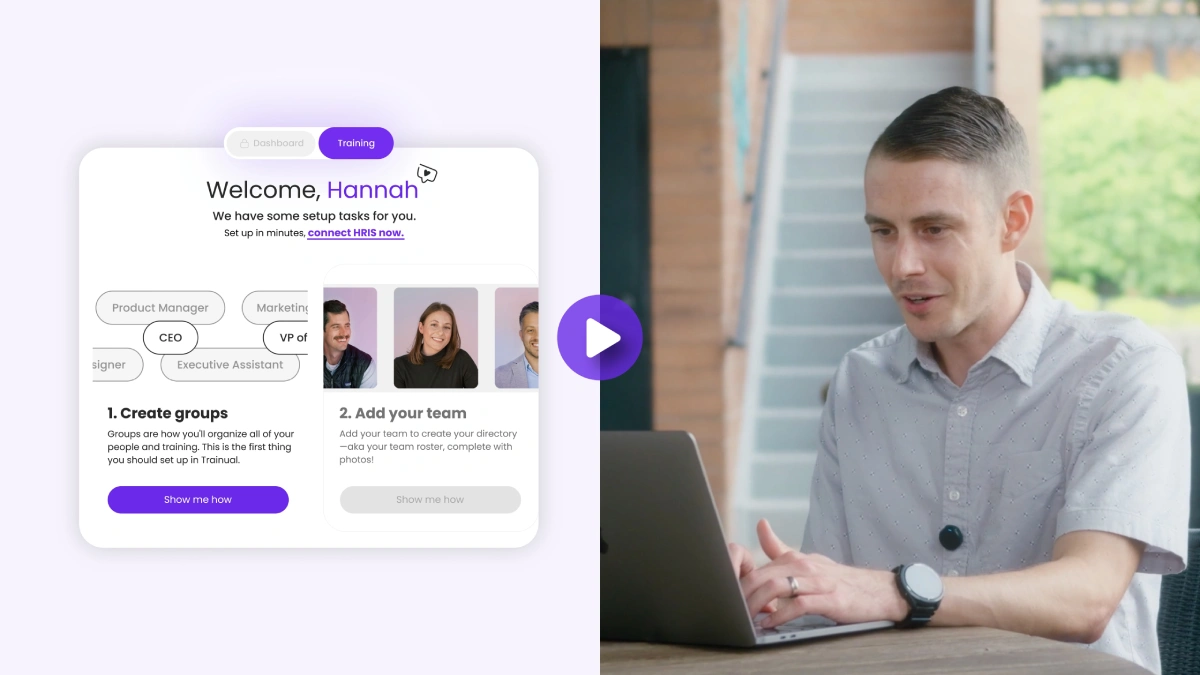
In practice, that means a few connected things working together. New hires follow role-based onboarding paths and training paths built from your documented processes, so they learn the real way work is done — not a generic course. Everything lives in one single source of truth with a searchable knowledge base new hires can self-serve, which cuts the stream of repeat questions to senior staff. Assignment by role and responsibility keeps each ramp relevant, and an AI Assistant drafts and updates content fast enough to keep documentation current as the company changes. The result is what growing teams are after: ramp that stays consistent as headcount climbs. Companies have used it to cut onboarding time measurably and to replace the binders, docs, and wikis that don't survive growth — and founders and owner-operators in particular use it to get out of the bottleneck seat, as covered in training software for founders and owner-operators.
What that looks like on the ground: a new hire logs in on day one to a path built for their specific role, works through the documented processes they'll own, and gets a searchable place to answer their own questions instead of interrupting a teammate. Their manager sees progress at a glance rather than chasing it. When a process changes, the update happens once, in one place, and every future hire learns the new version automatically — so the onboarding doesn't quietly drift out of date the way a static packet does. The senior people who used to run onboarding manually get their weeks back, and the experience holds its shape whether the company is hiring its tenth person or its hundredth.
Onboarding software vs an HRIS: what's the difference?
They solve different halves of onboarding. An HRIS — like BambooHR or Deel — handles the administrative side: offer letters, e-signatures, payroll, benefits, and compliance. A training-and-process platform like Trainual handles getting people productive: role-based training, documented procedures, and consistent ramp. One gets a new hire set up as an employee; the other gets them doing the job.
This is worth being clear about, because the two get conflated and a growing team can end up assuming its HRIS covers onboarding when it covers only the paperwork half. An HRIS will collect a new hire's signature and run their payroll; it won't document how your company does the work or teach a new person to do it consistently. The two are complementary, not competing — most growing teams run both, with the HRIS owning records and payroll and Trainual owning training and process. Trainual is built to sit alongside an HR stack rather than replace it, with integrations that connect to the tools you already use. The honest framing: if your gap is paperwork and records, you need an HRIS; if your gap is consistent ramp and knowledge that doesn't walk out the door, you need a training-and-process platform — and at a fast-growing company, that second gap is usually the urgent one. For a side-by-side of the full landscape, see the best onboarding software for scaling teams.
Ready to see how Trainual works?
👉 Book a demo and see how Trainual keeps onboarding consistent and role-based as your team scales.
Want a sneak peek?
👉 Read customer stories from growing teams that made onboarding repeatable.
Frequently asked questions
What is the best onboarding software for fast-growing companies?
It depends on which half of onboarding you're solving. For consistent, role-based employee ramp — training, process documentation, and knowledge that doesn't depend on a senior person — Trainual is purpose-built for it, and independent reviewers rate it highly for documenting repeatable onboarding workflows. For HR paperwork, payroll, and compliance, an HRIS like BambooHR or Deel fits. Most fast-growing companies run a training-and-process platform alongside an HRIS, since the urgent gap during rapid growth is usually consistent ramp, not paperwork.
Is onboarding software the same as an HRIS?
No. An HRIS handles the administrative side of onboarding — offer letters, e-signatures, payroll, benefits, compliance. Onboarding software in the training-and-process sense, like Trainual, handles getting a new hire productive: role-based training, documented procedures, and consistent ramp. One sets someone up as an employee; the other teaches them the job. They're complementary, and growing teams typically use both rather than expecting one to do the other's work.
How does onboarding software help a growing team specifically?
It turns onboarding from a person-dependent activity into a repeatable system, which is exactly what growth strains. Role-based paths, documented processes, and a searchable knowledge base mean each new hire ramps consistently without monopolizing a manager, and the experience holds steady as headcount climbs. It also captures the knowledge trapped in senior people's heads so ramp doesn't stall when they're busy or leave — the structural fix informal onboarding can't provide.
When should a growing company adopt onboarding software?
When hiring outpaces the ability of senior people to personally train each new hire — usually somewhere past about 25 people, though speed of hiring matters more than headcount. The signal is inconsistency: new hires learning different versions of the job, repeat questions piling on senior staff, and ramp depending on who's free. Adopting before the cracks get expensive is cheaper than retrofitting consistency after growth has already fragmented it.
Can onboarding software replace our HRIS?
Generally no, and it shouldn't try. A training-and-process platform like Trainual is built to deliver consistent ramp and document how work is done, not to run payroll or automate compliance. It's designed to sit alongside an HRIS through integrations, with each owning its half — records and payroll on the HR side, training and process on the platform side. The aim is a complete onboarding experience across both, not one tool stretched to cover a job it isn't built for.