





A fast-growing company can absorb a lot of improvised onboarding, right up until it can't. At 20 people, a new hire shadows someone for a week and figures it out. At 80, with three new starts a month across two locations, "shadow someone and figure it out" produces three different versions of the job and a senior team that spends its days re-explaining the basics. Growth is exactly what breaks informal onboarding, and onboarding software is how scaling teams get ahead of it.
One clarification first, because it trips up this search: "onboarding software" means two different things. Customer or user onboarding tools walk people through a product; employee onboarding software ramps new hires into their roles. This guide is about the second: the tools fast-growing companies use to train new employees, document how work is done, and keep ramp consistent as headcount climbs.
There's a second distinction that matters even more for choosing well, and most lists skip it: employee onboarding software splits into training-and-process tools that get people productive and HRIS tools that handle paperwork and payroll. A scaling company usually needs both. This guide focuses on companies with 50 to 150 employees, the stage where informal onboarding stops scaling and the tool that fit at ten people no longer fits. It compares the best onboarding software for mid-sized teams past 50 employees: Trainual, BambooHR, Rippling, TalentLMS, Deel, Gusto, and HiBob, sorted by which job each one does best.
Which onboarding tool fits your company size?
The right onboarding tool depends less on the feature list than on where your company is in its growth. Employee onboarding software splits into a training-and-process layer that gets people productive and an HR layer that handles paperwork, and most teams past 50 people end up running one of each. Here is the shape of the decision at three common sizes.
For a company with 25 to 49 employees, the onboarding gap is usually consistency, not paperwork. A training-and-process platform like Trainual, live in days, keeps every hire's ramp the same while the team is still small enough to run payroll through an existing tool. The trade-off is that you probably do not need a heavy HR-plus-IT suite yet, so the risk at this size is over-buying.
For a company with 50 to 99 employees, informal onboarding starts to break. The strongest setup is Trainual for role-based ramp plus a dedicated HRIS such as BambooHR for paperwork and records. The trade-off is that you are now running two systems, so integration and clear ownership matter. This is the size where a written playbook pays off fastest, which is the ground covered in how to onboard new hires past 50 employees.
For a company with 100 to 150 or more employees, the challenge is scale across roles, locations, and functions. The best fit is Trainual for consistent ramp everywhere, paired with a heavier HRIS or automation layer like Rippling, or Deel if you are hiring across borders. The trade-off is that automation depth adds cost and administrative overhead, so the thing to watch is whether adoption keeps pace with capability.
What is employee onboarding software?
Employee onboarding software is a system that ramps new hires into their roles: delivering training, documenting processes, collecting paperwork, and tracking progress so a new employee becomes productive faster and more consistently. It replaces the improvised mix of shadowing, scattered docs, and "ask whoever's free" that works at small scale but fragments as a company grows.
The category covers two distinct jobs that teams often conflate. Training and process onboarding gets people doing the job the right way: role-based learning paths, documented procedures, and a searchable place to find answers. HR and administrative onboarding handles the paperwork side: offer letters, e-signatures, payroll setup, and compliance. The strongest onboarding for a scaling team usually combines both, which is why naming your primary gap first makes the choice far clearer.
The need also shifts as a company grows. Early startup onboarding is mostly informal and that's fine. A handful of hires learn directly from the founders and each other. The break comes with speed: once a company is hiring faster than its senior people can personally train, the informal model quietly produces inconsistency, and the cost shows up as slow ramp and uneven work rather than an obvious failure. Onboarding software is the bridge from "everyone learns from whoever's around" to "every hire ramps the same way," which is why the tool that fit at ten people often isn't the one that fits at a hundred, and why the evaluation is worth doing before the cracks get expensive.
What do fast-growing companies need from onboarding software?
Five things, weighted for growth: scalable role-based onboarding, process documentation, consistency across people and locations, fast setup, and integrations with the rest of the stack. A tool can be excellent at one and still fail a scaling team if onboarding still depends on a senior person's time or produces a different result every hire.
The reason these matter most is the nature of fast growth. Role-based onboarding lets each new hire ramp on what their job needs without monopolizing a manager's week. Process documentation keeps the work uniform as you add people. Structured onboarding alone drives 82% higher retention and 70% higher productivity, gains that scattered docs can't produce. Consistency is what keeps the hundredth hire's onboarding as good as the tenth. Fast setup matters because a growing team can't wait a quarter to implement. And integrations keep the onboarding tool in sync with your HR stack instead of becoming another silo. Generic, one-size-fits-all onboarding goes stale fastest. The deeper case for getting this right is in the definitive guide to onboarding automation.
The best onboarding software for scaling teams in 2026
Seven platforms cover the realistic range for a company scaling from roughly 50 to 150 employees, split across the two jobs onboarding software does. The right pick, or pair, depends on whether your gap is getting people productive, handling the HR paperwork of growth, or both.
1. Trainual, best for documenting repeatable onboarding and process-based ramp
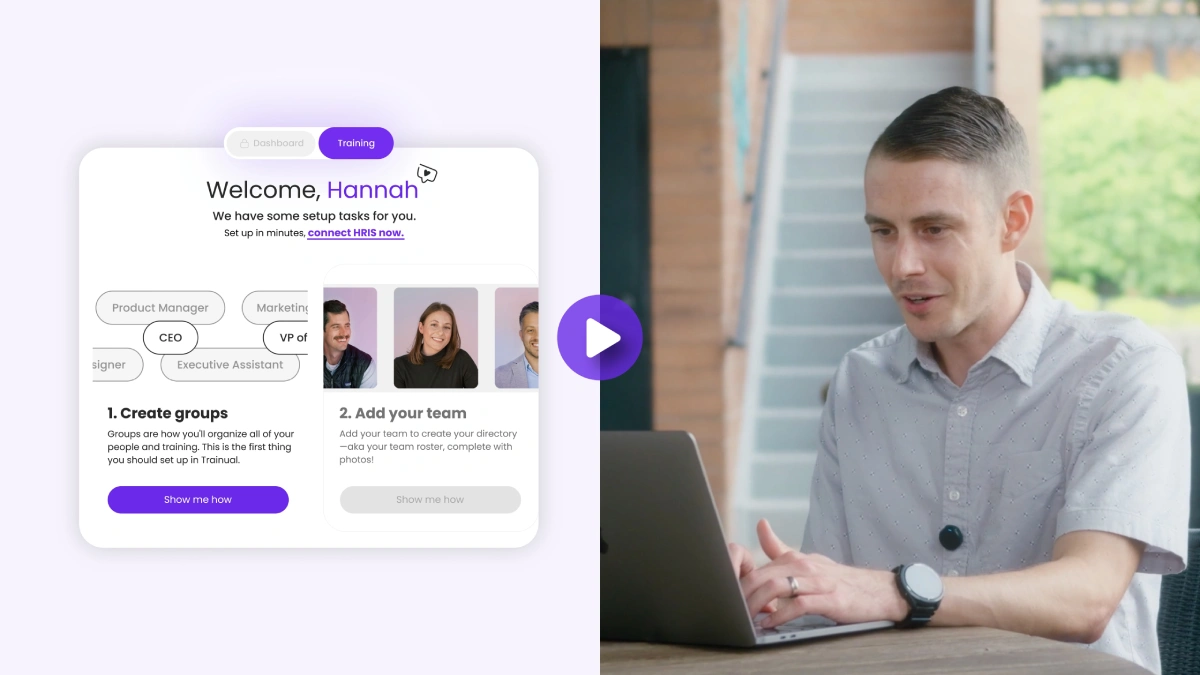
Trainual is the strongest fit when the onboarding problem is consistency: getting every new hire to do the work the same way, fast, without relying on a senior person's calendar. Rather than centering on paperwork, it's built to document how the company runs: role-based onboarding paths, documented processes, and a searchable knowledge base new hires can self-serve. Independent reviewers rate it highly for exactly this, documenting repeatable onboarding workflows, and it tends to be live in days, not a quarter.
For a scaling team, that focus is the point: as you add people and locations, Trainual keeps ramp uniform and frees managers from re-teaching the basics, with an AI Assistant drafting and updating content fast. Companies have used it to cut onboarding time measurably.
Best for: fast-growing teams that need consistent, role-based onboarding and process documentation at scale.
2. BambooHR, best for HR onboarding and new-hire paperwork
BambooHR is a well-established HR platform for small and mid-sized companies, strong on the administrative side of onboarding: offer letters, e-signatures, new-hire paperwork, and a tidy employee record from day one. For a growing team that needs the HR basics handled cleanly, it's a common anchor.
Where it's lighter is the training-and-process side. BambooHR gets a new hire set up as an employee, but it isn't built to document how the work is done or deliver role-based ramp. Many scaling teams run it alongside a training platform for that reason.
Best for: growing teams that want HR onboarding, paperwork, and employee records in one place.
3. Rippling, best for automation and scale
Rippling unifies HR, IT, and finance, and is built for automation and scalability, provisioning a new hire's payroll, devices, and app access from a single workflow. For a fast-growing company adding people quickly across functions, that breadth can remove a lot of manual setup.
The consideration is weight: Rippling's depth can be more than a smaller or leaner team needs, and reviewers note it can feel overwhelming at small scale. It's strongest for companies scaling fast enough to use the full HR-plus-IT automation.
Best for: fast-scaling companies that want HR, IT, and onboarding automation unified.
4. TalentLMS, best for course-based onboarding on a budget
TalentLMS is an approachable, affordable learning platform for delivering onboarding as structured courses, with AI-assisted course creation, gamification, and mobile access. For a growing team whose onboarding need is "deliver and track training" on a budget, it's an easy starting point.
Like other course-first tools, it's oriented toward training delivery more than documenting day-to-day operations. Role clarity, process consistency, and a living knowledge base are less of its focus. The fit depends on whether your gap is courses or operating knowledge. (Head-to-head: Trainual vs TalentLMS.)
Best for: budget-conscious teams that want course-based onboarding up fast.
5. Deel, best for global and distributed scaling teams
Deel is built for hiring and onboarding across borders: international compliance, contractor and employee management, and global payroll. For a company scaling into multiple countries, it handles the administrative complexity that trips up distributed growth.
As with the other HRIS-side tools, Deel manages the paperwork and compliance of onboarding rather than the training and process ramp. Distributed teams often pair it with a process-and-training platform so a remote hire in another country gets the same consistent onboarding as everyone else, the challenge covered in onboarding remote employees.
Best for: companies scaling across countries that need global hiring and compliance handled.
6. Gusto, best for payroll-led HR onboarding
Gusto is a payroll-first HR platform that many smaller and early-scaling teams already run for pay, benefits, and new-hire paperwork. Its onboarding handles the administrative first day well: offer letters, e-signatures, payroll setup, and benefits enrollment in one place. Like the other HR-side tools here, it is built for the paperwork of onboarding rather than role-based training or documenting how the work gets done, so scaling teams that want new hires productive, not just set up, usually pair it with a training-and-process platform.
Best for: smaller teams that want payroll, benefits, and HR onboarding handled together.
7. HiBob, best for culture-forward HRIS onboarding
HiBob, often called Bob, is a modern HRIS aimed at mid-sized and global teams, strong on employee records, workflows, and a polished new-hire experience. For a company that wants HR onboarding to feel considered rather than transactional, it is a capable anchor. As with the other HRIS options, it manages the administrative and people-data side of onboarding, not the training and process ramp, so it tends to sit alongside a training-and-process platform like Trainual's role-based onboarding paths rather than replace one.
Best for: mid-sized or global teams that want a modern HRIS with a strong onboarding experience.
How to choose onboarding software for a growing team
Name your primary gap first. If onboarding is inconsistent and knowledge lives in people's heads, you need a training-and-process platform like Trainual. If the pain is HR paperwork and records, an HRIS like BambooHR fits. If you're scaling fast across functions, Rippling; across countries, Deel; on a course-delivery budget, TalentLMS. Many fast-growing companies land on a pair, a training platform for ramp plus an HRIS for paperwork, rather than one tool for everything.
Then weigh the three factors that decide whether onboarding software sticks at a growing company: adoption (a tool only helps if non-specialists can run it, so favor fast setup over feature depth nobody uses), scalability without overhead (growth should feel routine, not like a re-implementation), and integration (the onboarding tool should sync with your HR stack, not become another silo). For the ramp-time side specifically, how to reduce new-hire time to productivity and the best LMS for onboarding ramp time go deeper, and the first 30 days playbook covers the structure itself.
One caution that runs the other way: don't over-buy. The instinct when scaling is to reach for the most powerful platform available, but a fast-growing team is usually better served by a tool it can stand up in days and have the whole team using than by enterprise depth that takes a quarter to configure and a specialist to run. The best onboarding software for a scaling company is the one that gets adopted. Consistency delivered beats capability shelved.
Ready to see how Trainual works?
👉 Book a demo and see how Trainual keeps onboarding consistent and role-based as your team scales.
Want a sneak peek?
👉 Read customer stories from fast-growing teams that made onboarding repeatable.
Frequently asked questions
What is the best onboarding software for fast-growing companies?
The best fit depends on which onboarding job you're solving. For consistent, role-based employee ramp and process documentation, Trainual is the strongest pick. For HR paperwork and records, BambooHR; for unified HR-and-IT automation at scale, Rippling; for global hiring, Deel; for budget course delivery, TalentLMS; for payroll-led HR onboarding, Gusto; for a modern HRIS experience, HiBob. Many fast-growing companies pair a training-and-process platform with an HRIS rather than expecting one tool to do both.
What is the best onboarding software for a 60-person company?
At around 60 employees, a company is past the point where shadowing and scattered docs keep onboarding consistent, but usually not so large that it needs an enterprise HR-plus-IT suite. The strongest setup is a training-and-process platform for role-based ramp, where Trainual is the top pick for documenting repeatable onboarding, paired with an HRIS such as BambooHR or Gusto for paperwork and payroll. Naming your primary gap, consistency versus administration, tells you which one to lead with.
What's the difference between employee onboarding software and customer onboarding software?
Employee onboarding software ramps new hires into their roles: training, process documentation, paperwork, and progress tracking. Customer or user onboarding software guides people through a product after they buy. They share a name but solve different problems. Fast-growing companies searching "onboarding software" usually mean the employee kind, but the term's ambiguity is why search results often mix the two.
Do you need a separate tool for onboarding if you already have an HRIS?
Often, yes, for the training side. An HRIS like BambooHR or Deel handles the paperwork of onboarding: offer letters, e-signatures, payroll, compliance. It doesn't document how the work is done or deliver role-based training. Scaling teams that want new hires productive quickly, not just set up administratively, usually add a training-and-process platform alongside the HRIS.
Do I need a separate training tool if I already use Rippling or BambooHR?
Usually yes, for the training side. Rippling and BambooHR are strong at the administrative side of onboarding: records, payroll, provisioning, and paperwork. Neither documents how the work is done or delivers role-based training, which is a different job. Scaling teams typically keep their HRIS for administration and add a training-and-process platform like Trainual so new hires learn their role, not just get set up in the system.
What should a fast-growing company prioritize in onboarding software?
Scalable role-based onboarding, process documentation, consistency across people and locations, fast setup, and integration with your HR stack. Growth is what breaks informal onboarding, so the priority is a system that keeps the hundredth hire's ramp as good as the tenth without depending on a senior person's time. Adoption matters most: a tool only returns value if non-specialists can run it.
How does onboarding software help companies scale?
It turns onboarding from a person-dependent activity into a repeatable system. Role-based paths, documented processes, and a searchable knowledge base mean each new hire ramps consistently without monopolizing a manager, and the experience holds steady as headcount climbs. Structured onboarding drives meaningfully higher retention and productivity, the compounding return that makes it worth systematizing before, not after, rapid growth.