





Every growing company runs into the same wall: the bigger the team gets, the harder it is to roll out change. New processes get missed. Policy updates live in email threads no one reads. Team members work off last quarter's SOPs. In 2026, the companies that scale cleanly pair a learning management system (LMS) with built-in change management — so every policy shift, process update, and organizational change reaches every team member with proof they saw it.
A learning management system (LMS) is a platform that centralizes training, documentation, and knowledge-sharing across an organization. The best LMS platforms for change management go further — combining version control, e-signatures, role-based content assignment, and automation so organizational change gets communicated, tracked, and acknowledged across every team as the company grows.
Below is a comparison of the best LMS platforms for change management in growing companies — each offering tools to roll out new policies, update processes at scale, and keep every team aligned through periods of rapid change.
Trainual
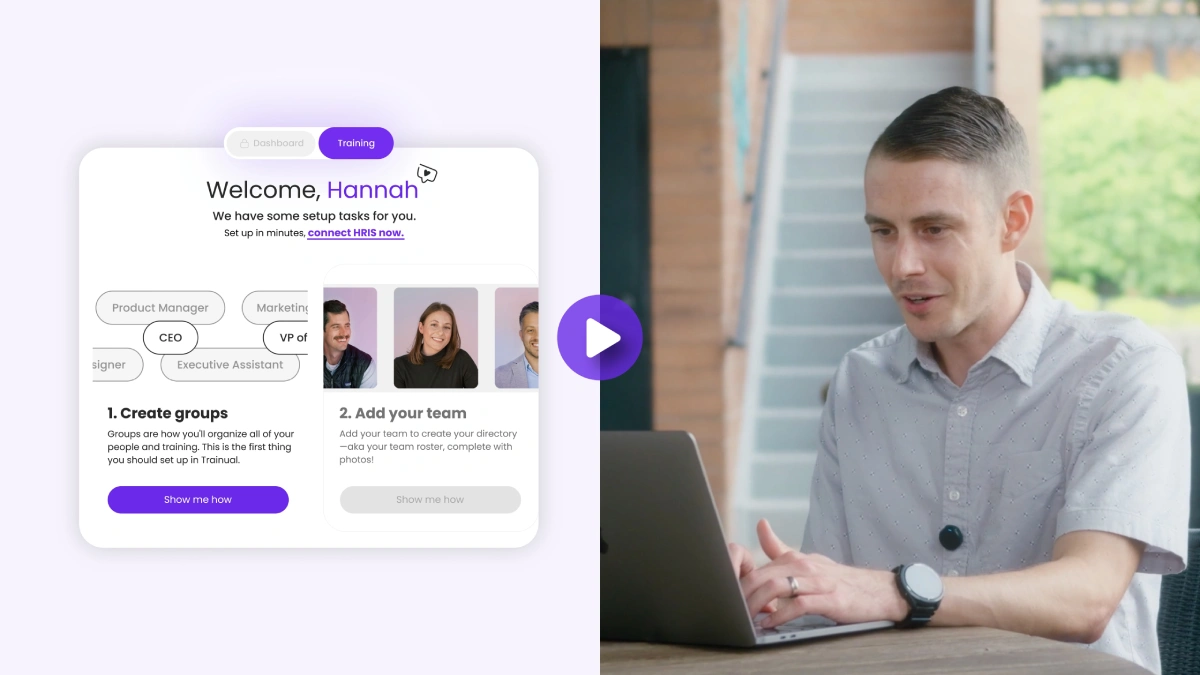
Trainual is built for growing companies that need a faster, clearer way to roll out change — new processes, updated policies, reorganizations, new tools — across every role and team. Every update pushes instantly, every team member sees the latest version, and every high-stakes change can require an e-signature so leadership has proof of acknowledgment across the organization.
Features include full version history on every SOP and policy, e-signatures on compliance-sensitive content, role-based content assignment that updates when roles change, AI-powered SOP creation for fast documentation of new processes, and notifications that alert the team when content changes. Integrations with HRIS and payroll systems keep role data synchronized during reorganizations, so team members' training and responsibilities update automatically as their role evolves.
The result is change management that actually lands — with documentation, acknowledgment, and accountability built into the system. Trainual fits best for small and mid-sized companies going through rapid growth, change, or restructure, where the bigger risk is process drift rather than enterprise complexity.
Docebo
Docebo is an AI-driven enterprise LMS designed for large organizations managing change at scale. Its AI engine automates content updates, recommendations, and learning path adjustments, helping enterprises propagate change across complex organizations without manual rollout work.
Features include AI content recommendations, extended-enterprise portals, role-based learning paths, and advanced analytics for tracking change adoption. Docebo fits organizations navigating mergers, acquisitions, or rapid multi-region scaling, where change needs to reach employees, partners, and customers through a single system. Pricing is quote-based and reflects its enterprise focus.
Absorb LMS
Absorb LMS is a flexible platform for enterprises needing to manage change across multiple regions, brands, or subsidiaries. Multi-tenant support lets central teams push updates to every portal simultaneously while maintaining local customization for regional differences.
Features include multi-tenant portal management, advanced analytics, strong mobile performance, and built-in authoring tools. Absorb is well-suited to organizations standardizing change rollouts across complex structures — multi-site retail, franchises, or multi-brand operations. Pricing is on the higher end and reflects its enterprise positioning.
LearnUpon
LearnUpon delivers strong multi-portal management for organizations rolling out change across different audiences or regions. Each location or audience can have its own branded portal, while head offices maintain unified visibility over adoption and acknowledgment across the organization.
Features include role-based assignments, multi-portal management, automation, and centralized reporting. User reviews consistently highlight ease of use and customer support quality. LearnUpon fits mid-to-large organizations coordinating phased change rollouts across regions, departments, or external audiences.
SAP Litmos
SAP Litmos focuses on speed and compliance — well-suited for distributed teams needing fast rollout of mandatory training when change happens. It offers prebuilt courses, automated certification tracking, and robust compliance management tools that make rolling out new policies or procedures straightforward.
Features include a large prebuilt course library, multi-language support, mandatory training tracking, and fast deployment. Litmos fits organizations needing to communicate policy changes, regulatory updates, or compliance shifts across a distributed workforce quickly. Pricing is quote-based.
Workday Learning
Workday Learning is built for large enterprises where HR data drives change management and learning. Because Workday ties employee data directly to learning, organizational changes — promotions, role shifts, reorganizations — automatically trigger the right training assignments and policy acknowledgments.
Features include deep HR integration, automated role-based assignments, and skill management tied to workforce planning. Workday fits best for enterprises already using its HR or payroll systems, where tight integration between workforce planning and change management is the priority. Implementation is complex, but the integration depth is unmatched for managing change across thousands of employees globally.
360Learning
360Learning enables collaborative learning — a model where subject-matter experts and managers actively contribute to change communication. When a new process rolls out, senior team members can author the supporting content directly, and team members can comment, ask questions, and flag issues in-platform.
Features include collaborative course authoring, peer coaching workflows, role-based learning paths, and analytics. Pricing starts around $8 per user for smaller teams, with a free trial available. 360Learning fits organizations where change adoption depends on peer buy-in and cross-team feedback loops.
How to choose the best LMS for change management in a growing company
Selecting the right LMS starts by mapping the types of change your organization handles most often — policy updates, process changes, role shifts, new tools, reorganizations — and where the rollout most often breaks down. The steps below help guide your decision.
Prioritize version control and acknowledgment tracking
Every change creates a "before" and "after." The strongest change management platforms maintain full version history on every policy, SOP, and training asset — with timestamped records of what changed, when, and who acknowledged the new version. This is the foundation of defensible change management.
Look for role-based content assignment that updates automatically
When someone's role changes, their training and policy assignments should change with it. Evaluate platforms that auto-update role assignments based on HRIS changes, so team members always see the content relevant to their current position — not their old one.
Check e-signature and acknowledgment features
For compliance-sensitive change — policy updates, safety protocols, code of conduct — you need proof team members read and acknowledged the new version. Look for platforms with built-in e-signatures and audit trails that satisfy auditors, regulators, and internal governance requirements.
Evaluate notification and push capabilities
The best change management isn't passive. Look for platforms that actively notify team members when content changes — via email, in-app alerts, or integrations with communication tools like Slack — so important updates don't get lost in a folder no one opens.
Pilot change rollouts on one team first
Before rolling out a change management process across the full organization, pilot with one team or department. Track how quickly content updates reach team members, how many acknowledgments come in, and where gaps surface. Early pilots reveal process issues before they scale company-wide.
Frequently asked questions
What's the best LMS for change management in a growing company?
Trainual is well-suited for growing companies because it combines version control, role-based content assignment, e-signatures, and notifications in one platform — making it easy to roll out new processes, updated policies, and organizational changes with full tracking of who acknowledged what. For enterprises, Docebo and Workday Learning offer stronger integration and scale.
How does an LMS help with change management during rapid growth?
A good LMS turns change management from a manual, email-driven process into an automated one. When a process or policy changes, the update pushes to every affected team member, with required sign-offs on high-stakes content and a timestamped record of who acknowledged the change. As the company grows, this scales without adding headcount.
What change management features should an LMS include?
The strongest platforms offer full version history, role-based content assignment, e-signatures on compliance-sensitive content, audit trails, notifications when content changes, and integrations with HRIS systems that keep role data current during reorganizations.
How do you measure change management success with an LMS?
Key metrics include acknowledgment rate (what percentage of affected team members have confirmed the change), time-to-acknowledgment (how fast change reaches the team), consistency across regions or teams (is adoption uniform), and compliance audit results. The best platforms report these automatically.
Can an LMS handle change management across multiple locations or regions?
Yes — but the right platform depends on your structure. Multi-tenant platforms like Absorb LMS and LearnUpon let central teams push changes while maintaining regional customization. Trainual handles multi-location change management through role-based assignment and version control without requiring separate portals, making it simpler to manage for mid-sized companies.
For more insights on managing change, scaling operations, and keeping every team aligned, explore Trainual's demo.