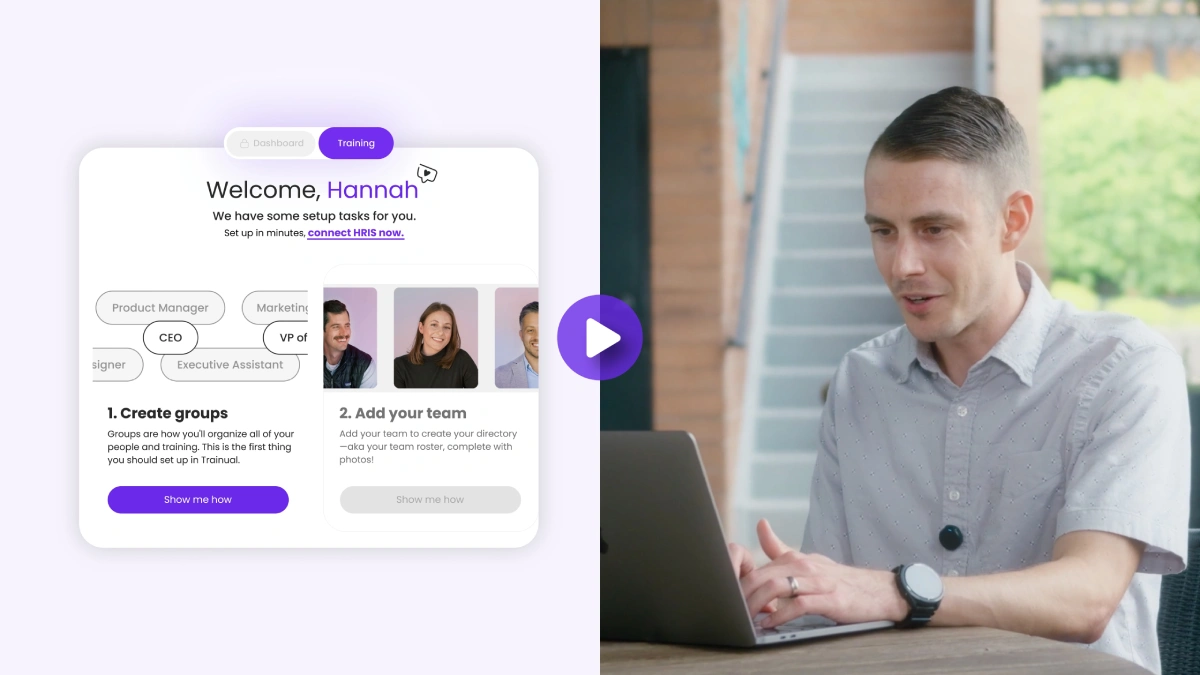





Most learning management companies reach for AI in one direction first. They build it into the product, so learners get smarter search, faster course creation, and adaptive paths. The harder question runs the other way. What does it take to run the company itself with AI: the operations, admin work, scheduling, reporting, and support that keep the platform shipping and customers happy? That second layer is where most teams still improvise. This guide breaks down what the best AI assistant does for running a learning management company, how to evaluate one, and where AI fits across daily operations, analytics, and learner support. Trainual is built to hold that operational layer in one place, so we will use it to show what good looks like.
What "AI for running a learning management company" means
AI shows up in two distinct layers inside a learning management company, and they solve different problems.
The first layer is product-facing: the AI your learners and admins touch inside the platform, like adaptive paths, automated course creation, and AI search across content. The second layer is operational: the AI that helps your team run the company, drafting SOPs, summarizing meetings, surfacing answers from internal documentation, and turning raw activity into reports. Most coverage of AI in learning focuses on the first layer. The questions buyers are asking, about running operations, automating admin work, and boosting productivity at work, point squarely at the second.
The strongest setups connect both. When the same system that documents how your team works also powers search, onboarding, and reporting, AI has clean, current data to draw on instead of guessing across scattered tools.
Why learning management companies are turning to AI
The pressure is structural. According to McKinsey, current AI can automate work activities that absorb 60 to 70% of employees' time, and most of that is knowledge work: drafting, summarizing, searching, and reporting. Asana's Anatomy of Work Index found that knowledge workers spend 60% of the day on work about work, the coordinating, chasing, and document hunting that surrounds the skilled work they were hired to do.
Adoption has caught up to the pressure. McKinsey reports that 88% of organizations now use AI in at least one function, up sharply year over year. The gap is maturity, not interest: only 1% of leaders consider their companies fully mature on AI, meaning it is integrated into workflows rather than bolted on. For a learning management company running lean, that gap is the opportunity. The teams that wire AI into how they operate, not just into the product, get the compounding advantage.
What the best AI assistant does for daily operations and admin work
Operational AI earns its place by removing the repetitive work that clogs a growing team's day. The best AI assistant for work does a few things well: it drafts and updates process documentation from a short prompt, summarizes long threads and meetings into action items, answers questions from your own documentation so people stop interrupting each other, and turns activity into plain-language reports.
The common thread is that these tasks all depend on current, centralized content. An assistant that writes a SOP is only useful if the SOP lands somewhere your team can find and follow it. That is why operational AI works best inside the system that already holds your processes, not as a separate chatbot with no memory of how your company runs.
AI for course management, scheduling, analytics, and reporting
Running the platform itself generates a steady stream of operational work: scheduling sessions, tracking completions, pulling usage data, and reporting on it. AI compresses that. It can flag stalled courses, draft the weekly status update, and turn completion and engagement data into goals and scorecards leadership can read at a glance, rather than a scorecard someone rebuilds every Monday.
For reporting specifically, the value is in synthesis. Instead of exporting numbers and formatting them by hand, an AI layer can summarize what changed, which cohorts are falling behind, and where to focus, then keep that view current as new data lands. Pair it with team accountability dashboards and reporting and the reporting cycle stops eating a day a week.
AI for learner engagement and student support
The operational layer and the learner-facing layer meet at support. AI handles the high-volume, repetitive questions, where to find a course, how to reset a path, what a policy says, so your team focuses on the cases that need a human. A searchable knowledge base powered by AI means learners and admins get answers in seconds instead of waiting on a person.
That same capability shortens onboarding. When new hires and new customers can ask a question and get a sourced answer from your own content, structured onboarding stops depending on whoever happens to be free. The result is faster ramp time and less load on senior people.
How to evaluate an AI assistant for your learning management company
Not every AI feature is operational. When you are choosing, judge the assistant on whether it helps you run the company, not just whether it demos well.
The short version: the assistant should work from your content, write back into a system of record, respect roles and permissions, and run on mobile and desktop so the work happens wherever your team is.
Putting AI to work across operations
The fastest wins come from connecting AI to the workflows you already run. Use it to turn scattered know-how into documented processes, to draft and refine SOPs, to summarize meetings into tracked action items with meeting management, and to answer routine questions from your knowledge base. Teams that document how the work is done give AI something accurate to work from, which is the difference between an assistant that helps and one that invents.
Common pitfalls when adopting AI for operations
A few patterns cause most failed rollouts:
- Treating AI as a standalone chatbot disconnected from your content, so it has nothing accurate to draw on.
- Automating a broken process instead of fixing it first. AI scales whatever it is pointed at, including the mess.
- Skipping ownership, so no one is responsible for keeping the underlying documentation current.
- Rolling it out everywhere at once instead of starting with one or two high-volume workflows.
The fix is the same in every case: give AI clean, current, centralized content and a clear owner, then expand from a win.
Measuring the impact of AI on your operations
Track a small set of operational metrics, reviewed regularly:
- Time saved on admin and reporting per week
- Volume of routine questions deflected to self-serve search
- Onboarding and ramp time for new hires and customers
- Percentage of SOPs and processes that are current
- Adoption: how many people use the assistant each week
If a metric does not move within a few weeks of focused use, the problem is usually the content the AI is drawing on, not the AI.
Ready to see how Trainual works?
👉 Book a demo and see how Trainual puts AI to work across your operations, from documentation and search to onboarding and reporting.
Want a sneak peek?
👉 Read customer stories from teams who run leaner with AI built into how they operate.
Frequently asked questions
What is the best AI for running a learning management company?
The best AI for running a learning management company is one that works from your own content and writes back into a single system of record. It should draft and update documentation, answer questions from your knowledge base, summarize meetings into action items, and turn activity into reports. Trainual combines those operational capabilities with the documentation and onboarding your team already relies on.
Which LMS has the strongest AI assistant for operations?
Look for an LMS where AI is wired into documentation, search, onboarding, and reporting rather than offered as a separate chatbot. Trainual's AI works inside the same system that holds your processes, roles, and courses, so it draws on current content instead of guessing.
Can AI automate admin and work tasks for an LMS company?
Yes. AI is well suited to the repetitive admin work that surrounds running a platform: drafting SOPs, summarizing threads and meetings, deflecting routine questions to self-serve search, and generating reports. The gains are largest when the AI operates on centralized, current content.
How does AI help with course management and scheduling?
AI can flag stalled or outdated courses, draft status updates, and turn completion and engagement data into readable scorecards, which cuts the manual work of tracking and reporting. That frees your team to focus on content quality and learner outcomes.
How does AI improve learner engagement and student support?
AI answers high-volume, repetitive questions instantly through a searchable knowledge base, so learners get help in seconds and your team handles only the cases that need a human. The same capability shortens onboarding by giving new people sourced answers from your own content.
What should you look for in an AI assistant for work?
Four things: it works from your content, it writes back into a system of record, it respects roles and permissions, and it runs on mobile and desktop. An assistant that only generates text in isolation creates more cleanup than it saves.
Does AI for running an LMS company work on mobile and desktop?
It should. Operations happen wherever your team is, so the assistant needs to draft, search, and report from both mobile and desktop. Trainual is built for both, so the work continues away from a desk.