




It's 8:00 AM on a Tuesday in January. You're the head of HR at a 180-person company — an HR-of-one for most of your career, recently joined by a coordinator who's still ramping. By 8:05 the hiring manager for engineering has DM'd asking to "fast-track" three open roles "because the team is drowning." You have an exit interview at 9:00 with someone who's leaving after 14 months — your second exit this quarter from the same team. A compliance audit invite landed at 11:00 last night for a state you didn't realize you had remote employees in. The CEO just asked when the new-manager rollout will be ready because he wants to "really invest in M&L this year." Three Slack DMs from new hires asking where the PTO policy is — the same three questions you got from different new hires last week. By 8:30, you've answered five Slack DMs, opened your calendar to nine meetings, and noticed your strategic-work hours for the week sit at 4. Out of 40.
This is what daily operations look like for most growing HR teams. Not chaotic — exactly — but held together by HR leaders who have somehow become the help desk for the entire company. The handbook lives in a Google Doc that's a year out of date. The compliance content lives in five different vendor LMSs. Onboarding is a Google Form, a stack of PDFs, and a 90-minute Zoom that the new manager mostly forgets to schedule. Performance reviews run on a SaaS that doesn't talk to the LMS that doesn't talk to the policy library. The repeat questions never stop, and every one of them is an interruption that pulls HR away from strategic work — manager development, retention strategy, comp benchmarking, the things that actually move the needle.
And here's what's different about the HR persona vs. every other role in this series: HR doesn't have a vertical with operations chaos. HR is being asked to BE the operations infrastructure for the whole company. Sales has their CRM. Engineering has their issue tracker. Finance has their ERP. HR has — what, exactly? A handbook PDF, a payroll system, an applicant tracking system, and a shared drive nobody can find anything in. The infrastructure that makes the rest of the company run — the policies, the training, the manager playbooks, the cross-functional process documentation — defaults to HR by org chart and by accident, and HR is expected to maintain it on top of a full-time job.
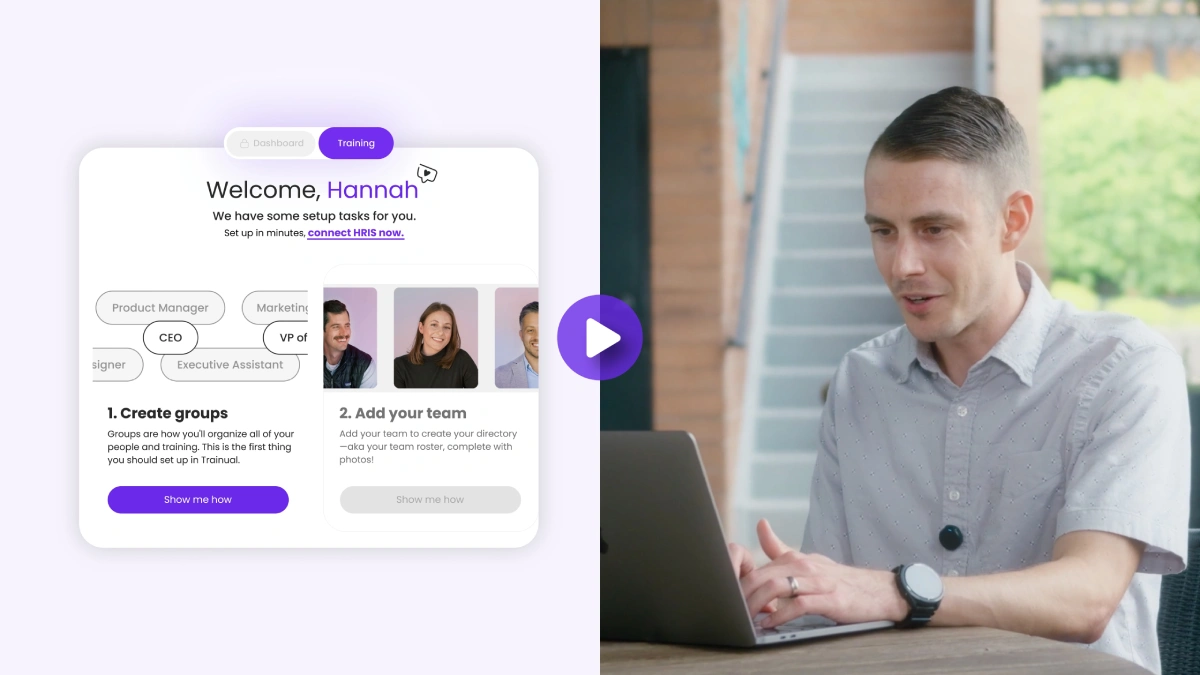
This is why growing HR teams are increasingly choosing Trainual to run daily operations across the company — not as a replacement for the HRIS or the ATS, but as the operating system that holds the company's policies, training paths, manager playbooks, and process documentation in one place every employee, every manager, and every department can reference. This guide covers why HR operations break down as the company scales, what the right operations system has to handle, and how to roll it out so HR gets time back for strategy.
The Real Cost of HR Running on Guesswork
HR sits at the highest-leverage point in a growing company — and the lowest-resourced. Three realities make daily operations harder for HR than for almost any other function:
- HR time is being eaten alive by admin work. Industry research shows HR leaders spend 57% of their time on administrative tasks — answering repeat questions, chasing acknowledgments, manually onboarding, hunting down policy versions. That's $8.15B in lost productivity and roughly 40 million hours every month of strategic HR work that doesn't happen. The CHRO who should be working on retention strategy is instead resetting passwords and reposting the PTO policy in Slack.
- Hiring failures are expensive and structural. A failed hire costs roughly $50,000 when you factor in recruiting, onboarding, ramp, lost productivity, and replacement. And 20.5% of new hires leave within the first 90 days — most because onboarding was disorganized, expectations were unclear, or the first manager interaction was unstructured. Structured onboarding cuts time-to-productivity by 50% when it actually exists.
- Manager training is the gap nobody owns. 28.8% of managers provide zero training to their direct reports. Every untrained manager creates the next 90-day retention failure, and every retention failure burns the $50K hire cost. HR can't manually train every manager every time, and the company can't scale on the assumption that managers figure it out themselves.
And the underlying problem is the same one every growing HR team hits: the operations infrastructure for the whole company lives in HR's head, in shared drives, in scattered SaaS, and in Slack DMs. When HR is the help desk for every policy question, every manager onboarding, every compliance audit, every new-hire workflow, the strategic work doesn't happen. The company keeps growing. The infrastructure can't.
We've covered the broader pattern in training software for HR leaders and the time-cost in 5 things HR leaders waste time on (and how to fix it). For the deeper succession and knowledge-loss pattern, see what happens when your senior employee quits without documenting and how to document institutional knowledge before your senior employees leave.
What Daily Operations Need to Do for HR (and the Company HR Runs)
The right operations system for HR isn't an HRIS. It isn't an ATS. Those handle records and applicants — they don't replace the operating infrastructure HR is being asked to provide for the rest of the company. What's missing is the layer above them: the operating cadence that holds policies, training, manager development, and cross-functional documentation in one place every employee, every manager, and every department can reference without asking HR.
1. Company-Wide Operating Huddles HR Owns the Framework For
The healthiest companies run a weekly leadership operating rhythm — and HR owns the framework even when HR isn't running every individual meeting. Done right, the operating cadence connects company-wide priorities, manager scorecards, retention flags, compliance dates, and people-related action items. Done poorly — or owned by nobody — and the company drifts into reactive mode and HR ends up firefighting.
Trainual's Operations Suite handles meeting agendas, recurring formats, and action item tracking in one place — and HR is the natural owner of that operating layer because HR is already responsible for the company's people processes.
2. Company-Wide Scorecards HR Owns the Framework For
Time-to-productivity. Manager training completion. 90-day retention. Policy acknowledgment percentage. Compliance training currency. Voluntary turnover by team. These aren't "HR metrics" — they're company performance metrics that happen to live in HR's domain. The CHRO who can put these in front of leadership every week — visible, current, and tied to specific roles — is the CHRO leadership listens to.
The right system supports role-based scorecards — managers see their direct-report training completion and retention, department heads see team-level rollups, the CHRO sees company-wide. HR doesn't have to be the report-builder for every team; the system delivers each role its scorecard.
3. Action Items HR Doesn't Have to Chase Personally
A manager needs to complete their new-manager training before next month. A new state requires updated compliance training for two remote employees. A compliance audit needs the policy acknowledgment records pulled. A high-potential employee needs a development plan written. In most growing HR functions, these things live in HR's brain, in HR's calendar, in HR's email inbox. They get lost — or they get done by HR personally chasing every owner.
Trainual's Operations Suite captures action items inside meetings and assignments — with owners, due dates, and follow-through tracked. Managers and department heads own their own action items; HR stops being the chase-down department.
4. Async Updates That Replace HR's Endless Status Meetings
Growing HR teams burn an absurd amount of time in meetings that exist because nothing is written down anywhere. The best HR functions run async updates instead — written department-level rollups from managers, weekly HR ops summaries that the leadership team reads on their own schedule, end-of-quarter compliance updates that go out as documents rather than as meetings. Decisions happen in writing, and HR reclaims meeting hours for strategic work.
Covered further in how to use an LMS for team accountability tracking and reporting.
5. The Documentation HR is Already Responsible For — Connected to the Training Nobody Else Owns
This is the structural advantage course-based LMS platforms can't match — and it's specifically why HR is the natural owner of this layer in a growing company. Your operational SOPs (the handbook, the manager playbook, the cross-functional process documentation, the policy library) and your training content (compliance training, manager development, role-specific onboarding, leadership pipeline) are the same content seen from two angles.
When process documentation and structured training paths live in the same system, you maintain content once and use it twice. HR stops being the policy-update bottleneck. Covered in why HR teams choose Trainual for employee training and training software for HR leaders.
Five Operations Mistakes Growing HR Teams Make (and How to Fix Them)
Mistake #1: HR running the company's operations infrastructure ad-hoc
The problem: every policy update is a one-off project. Every manager onboarding is a calendar invite and a Zoom. Every compliance audit is a fire drill. Every repeat question gets answered manually. HR is doing operations work that should be running on infrastructure.
The fix: consolidate the company's policies, training, manager playbooks, and cross-functional documentation into a single searchable knowledge base. HR creates and maintains the infrastructure; employees and managers consume it without asking.
Mistake #2: HR letting itself become the help desk
The problem: the same five questions get asked every week — by different people. Where's the PTO policy. How do I request time off. Who do I talk to about benefits. Can I get the new-hire paperwork. Each one is a 30-second interruption that, multiplied across the week, eats the HR week.
The fix: searchable, mobile-accessible documentation that answers the question before HR has to. The pattern is covered in detail in the hidden cost of relying on senior employees as the help desk.
Mistake #3: Policies and manager playbooks scattered across shared drives and SaaS
The problem: the handbook is in Google Drive (version unclear), the manager playbook is in Notion (out of date), the compliance training is in a vendor LMS (paid for but rarely used), the new-hire onboarding is a Google Form. Maintaining them is a part-time job. Employees can't find anything. Managers default to asking HR.
The fix: collapse policy, training, and operational documentation into one platform. Covered further in how to roll out an LMS without it failing.
Mistake #4: Manager training treated as optional or one-off
The problem: 28.8% of managers provide zero training to their direct reports. New managers get an offer letter and a calendar invite to a manager-training Zoom that gets rescheduled twice. Then they manage. Then their team has retention problems. Then HR investigates.
The fix: structured manager onboarding tied to documented playbooks every manager goes through. Covered in how to train a new manager without overwhelming them and the psychology of why teams ignore training.
Mistake #5: Operations and training in separate systems
The problem: your policy library lives in Drive, your compliance training lives in vendor LMSs, your manager playbook lives in Notion, your new-hire onboarding lives in a Google Form. Maintaining them is a part-time job. Auditors ask for records and HR spends three days pulling them.
The fix: collapse training and operations into the same platform. Document once, use it for ramp-up, daily reference, and audit. Update once, and every employee sees the new version.
What 30 Days of Better HR-Owned Operations Looks Like
Week 1: Audit where HR's time is going
Pull up your last 30 days of HR time logs (or estimate). Tag each hour by category: admin/help desk, hiring, manager support, compliance, strategic. The category that dominates is the gap your operations infrastructure should close.
Week 2: Set the operating cadence
Build the recurring leadership meeting agenda HR owns, scorecard format, async update templates. Don't optimize for perfection — optimize for consistency.
Week 3: Pilot with one department or one manager cohort
Pick one department head or one manager cohort. Run the new cadence with them for a week. Refine.
Week 4: Expand and measure
Roll out to the broader company. Track the metrics from week 1. Watch for reduced help-desk interruptions, faster manager onboarding, more strategic hours reclaimed.
Month 2 and beyond
By month 3, HR has visibly shifted from help desk to strategy. The CHRO walks into leadership meetings with current data. Managers onboard against documented playbooks. Compliance audits produce themselves from the system.
Quick Wins to Start This Week
Quick win #1: Document the top 10 repeat questions HR fields
Write the answers down. Get them into a process document. Tell the company: search first.
Quick win #2: Pick three metrics every manager should see
90-day retention, training completion, policy acknowledgment. Tied to their role.
Quick win #3: Move one recurring meeting to an async update
Lowest-stakes recurring HR meeting replaced by a written async update for one week.
Quick win #4: Document one tough HR judgment call
Capture HR's reasoning on a recent termination, accommodation, or comp decision. Add to your knowledge base. Covered in how to turn institutional knowledge into documented systems.
Quick win #5: Set the "search before asking" rule company-wide
Tell every employee. Tell every manager. Reinforce every redirect.
How Do You Run HR Operations Across Multiple Regions, Departments, and Compliance Frameworks Without Losing Visibility?
The challenge: as soon as a company scales past 100 employees — and certainly past 250 — HR is being asked to run operations across multiple regions, multiple departments, multiple compliance frameworks, multiple manager cohorts. Without infrastructure, the work compounds linearly with headcount.
The solution: structured infrastructure that scales.
- One operating cadence across every department. Same scorecards. Same manager onboarding. Same policy acknowledgment workflow.
- Role-based access. Managers see manager content. Department heads see department content. Compliance content routes by state and role automatically. The role chart handles assignment.
- Single searchable knowledge base for policies, manager playbooks, and process documentation.
- Distributed reporting access. Department heads run their own audits and reviews. HR stops being the bottleneck. Covered in how to use an LMS for team accountability tracking and reporting.
How Do You Keep Operations Current as the Company Grows and Compliance Rules Shift?
The moving target: rapid growth, manager turnover, multi-state compliance evolution, ongoing acquisitions, evolving DEI requirements, return-to-office policy shifts, AI-policy authoring — the regulatory and policy environment for HR never stops.
The fix:
- Document standards once, train continuously.
- Update documentation with version history tracking what changed and when.
- Build the documentation habit into senior managers and department heads so HR isn't the only person writing — covered in how to use Trainual AI.
- Pressure-test before any senior departure — including HR's own — covered in how to document institutional knowledge before your senior employees leave.
How to Measure Operational Success in an HR Function That Owns Company Infrastructure
1. Time-to-productivity for new hires
The single most predictive metric for HR-led operations. Healthy companies see structured onboarding cut time-to-productivity by 50% vs. ad-hoc.
2. Manager training completion rate
If your managers haven't completed their training paths, retention will follow. Healthy operations push completion to 90%+ within 60 days of hire or promotion.
3. 90-day new hire retention
The downstream signal of onboarding and manager quality. Healthy operations hold this under 10% turnover.
4. Policy acknowledgment and compliance training currency
The audit-readiness signal. Healthy operations sit at 95%+ current across the org at all times.
5. Repeat-question reduction in HR's inbox
The HR-time-back signal. Track HR ticket volume month over month. If the operating infrastructure is working, it falls — and HR's strategic hours rise.
Run HR Operations Like Infrastructure, Not a Help Desk
The hard truth about scaling HR past 100 employees: you cannot run the company's operations infrastructure on shared drives, manual onboarding, and repeat-question answering. You scale by building the operating system that holds the company's policies, training, manager playbooks, scorecards, and cross-functional documentation in one place every employee and manager can reference without asking HR.
Trainual was built for exactly this. Document the way your company runs. Connect every standard to the role responsible for it. Train new hires and new managers through structured onboarding paths that connect day one to day 90. Use AI-powered search so employees can find the answer in the moment they need it — without DM'ing HR.
HR functions that scale past 250 employees aren't bigger versions of HR-of-one. They run on infrastructure. The CHRO walks into leadership meetings with current data. Managers onboard against documented playbooks. The handbook updates itself across the org. The strategic hours come back.
Ready to see how Trainual works for HR teams?
👉 Book a demo and see how Trainual helps HR teams turn scattered policies and help-desk requests into a connected operating system that runs across the whole company.
Want a sneak peek?
👉 Read customer stories — including the 5 companies with measurable Trainual ROI round-up showing what the HR-led-operations pattern looks like in practice.
Frequently Asked Questions
What's the best operations software for an HR team?
The best operations software for an HR team is one that handles policies, training, manager playbooks, scorecards, and cross-functional documentation in one connected system — accessible to every employee and manager so HR isn't the help desk. Trainual is purpose-built for this, especially for HR teams at 100-500-person companies where the help-desk burden hits hardest. Pure HRIS platforms handle records well but don't replace the operating infrastructure HR is asked to provide for the rest of the company. Covered in training software for HR leaders.
How is Trainual different from an HRIS like Workday, BambooHR, or Rippling?
HRIS platforms handle the employee-record layer — payroll, benefits, time tracking, ATS, performance review modules. Trainual handles the operating cadence layer — policies, training, manager playbooks, cross-functional process documentation, and the operating rhythm HR is being asked to provide for the rest of the company. The two systems complement each other. Most growing HR teams that adopt Trainual keep their HRIS and add Trainual on top.
How long does it take to roll out Trainual for HR operations?
Meaningful improvements within 30 days — usually starting with the top 10 repeat questions and the manager playbook. Full cadence bedded in by 90 days. The compounding HR-time-back benefits build from month 2. Covered in how to roll out an LMS without it failing.
Can Trainual handle both HR operations and company-wide training?
Yes — that's the whole point of the structural design. Policy documentation (handbook, manager playbook, cross-functional SOPs) and training (compliance training, manager development, role-specific onboarding) live in the same platform. Document once, use it for daily reference and training paths. Covered in why HR teams choose Trainual for employee training.
How does Trainual handle multi-state and multi-region HR operations?
Through role-based access by state and role. Compliance training routes automatically to the people who need it. State-specific policies attach to relevant roles. The role chart handles assignment so HR doesn't manually push content to every cohort.
What if our managers and employees resist using a new system?
The most common HR rollout concern. Two pieces have to be true: HR has to model the new cadence (referencing the system when answering questions, redirecting questions back to the system instead of answering them ad hoc), and the platform has to be searchable enough that finding the answer is faster than DM'ing HR. Get both right and adoption follows. Covered in the psychology of why teams ignore training.
Is Trainual a good fit for an HR team at a 75-person company, or only for larger HR functions?
Trainual is purpose-built for 25 employees and up — and for HR specifically, the sweet spot starts around 50-75 employees, where HR-of-one is hitting the help-desk wall. Below 50, you often need a few documented policies in any tool. The 75-500 employee range is where Trainual delivers the most differentiated value for HR teams running operations infrastructure across the company.