





Picture this: your top-performing senior employee just got promoted to manager. They're thrilled. Their team is thrilled — they wanted this person to lead them. You're thrilled, because you didn't have to recruit externally. Everyone's saying the right things at the announcement meeting. Then Monday morning hits. The new manager opens their inbox to 47 emails about things they didn't know they were now responsible for. Their first 1-on-1 with a direct report happens at 10am — they don't have an agenda, a framework, or any sense of what to talk about. By Wednesday, they're behind on their own work, behind on their team's work, and quietly wondering if the promotion was a mistake.
That's the new manager experience at most growing companies. They were great as individual contributors. They've been promoted because of that. And then they've been handed a team and a Slack message that says "let me know if you need anything." No framework. No training. No support system. Just the assumption that because they were great at the work, they'll be great at managing the people doing the work.
The data is brutal. 85% of new people managers receive no formal training before stepping into the role. Almost 60% of first-time managers never receive training at all. 82% of managers enter management roles without formal leadership training — what researchers now call "accidental managers." 60% of new managers fail within their first 24 months when they aren't adequately prepared. And the cost? Poor management is estimated to cost the U.S. $960 billion to $1.2 trillion annually.
The kicker: 70% of U.S. workers would consider quitting because of a bad manager. One in three has already left a job because of one. The new manager you just promoted is now responsible for whether their team stays — and you've given them no tools to be the manager that keeps them.
Here's the thing: training a new manager doesn't require a six-month executive program or an MBA. It requires a structured, paced ramp that gives them the frameworks, the feedback loops, and the support system to lead. This guide walks through how to do it without overwhelming them — or you.
Why most new manager training fails
Three reasons new manager programs fall short — and why fixing them matters.
They're either too late or too generic. Most companies wait until someone has been managing for 6-12 months before offering training. By then, the bad habits are formed and the team has already paid the price. Or the training is generic — a one-size-fits-all leadership course that doesn't connect to the work the new manager is doing today.
They focus on theory, not practice. A new manager doesn't need to read about leadership styles. They need to know what to say when a direct report is underperforming, how to run a 1-on-1 that produces something useful, and how to give feedback that doesn't blow up the relationship. Theory is helpful eventually. Practical frameworks are needed immediately.
They lack a support system. Training is a starting point, not the whole answer. New managers need ongoing coaching, peer connections, and a senior leader who's available for the hard questions. Without the support system, training fades fast and the new manager is alone again.
The companies that get this right build training around what new managers need to do this week — and pair it with the system to keep them growing.
What a new manager really needs to learn
Here's the honest map of what new managers need to know — paced from "day one essential" to "develop over time."
The mistake most programs make is trying to teach all 12 of these in week one. The new manager retains maybe 10% of it. Pacing matters more than coverage. Get the day-one essentials right; everything else builds on that foundation.
The 6-step framework for training a new manager
Here's the workflow. Designed for speed (so they're functional fast) and durability (so they keep growing).
Step 1: Start before the promotion (when possible)
The best time to train a new manager is before they're managing. If you have potential leaders on your team, give them training before the role is open. A few hours per month on management fundamentals — running 1-on-1s, giving feedback, delegating — pays massive dividends when they get promoted.
The data backs this up. Most companies wait far too long, on average not formally training managers until about 10 years into the role. That's a decade of bad habits forming. Aspiring leader training before the promotion is one of the highest-leverage HR investments available.
Step 2: Build a structured 30-60-90 day ramp
When the promotion happens, the new manager needs a paced ramp — not a one-day workshop. The structure:
- Days 1-30: Foundation. 1-on-1s, expectations, delegation, calendar discipline. The mechanics of being a manager.
- Days 31-60: Practice. Real conversations with real direct reports — feedback, coaching, performance check-ins. Frameworks applied in context.
- Days 61-90: Expansion. Hiring, cross-functional collaboration, performance management, strategic thinking.
The ramp gives them what they need now without overwhelming them with what they'll need later. Use a structured training path so the content delivers in sequence — not all at once.
Step 3: Pair training with a real coaching relationship
Training content alone isn't enough. The new manager needs someone they can ask the hard questions — preferably a senior leader who's been in the role and isn't their direct manager.
The coaching cadence:
- Weekly 30-minute coaching call for the first 90 days
- Bi-weekly after that for the next six months
- Monthly thereafter, indefinitely
The coach's job is to help the new manager work through real situations they're facing — not to teach generic concepts. The training gives them the framework. The coach helps them apply it.
Step 4: Use AI search and documentation as the on-demand backup
Every new manager hits a moment where they need an answer right now — how do I document a performance issue, what's our policy on PTO requests, how do I run a skip-level meeting. They shouldn't have to interrupt their senior leader for every question.
A searchable knowledge base with role-based content for managers gives them on-demand access to:
- Company policies and procedures they need to enforce
- HR & compliance courses for harassment prevention, discrimination, and other legal essentials
- Management frameworks they can reference between coaching calls
- Templates for 1-on-1s, performance reviews, and feedback conversations
AI-powered search means the new manager types a question, gets an answer, keeps moving. They don't have to know where the content lives or how it's organized.
Step 5: Build feedback loops in both directions
The new manager needs feedback on how they're doing — but also a way to give feedback on the training itself. Both matter.
Manager feedback in:
- 30-day check-in with their manager: how is the role going, what's confusing, what do you need?
- 60-day skip-level: how is the new manager performing from above?
- 90-day team feedback: anonymous survey of their direct reports on management effectiveness
Manager feedback out:
- After each training module: was this useful, what was missing, what would help?
- 90-day program review: how can we improve the training experience?
The feedback loops are what turn training from a one-time event into a continuous improvement system.
Step 6: Connect them to peer managers
New managers feel isolated. They can't talk to their direct reports about manager problems. They often don't want to bring every issue to their boss. The peer cohort is the missing piece.
Build a manager peer group — even informally. Monthly lunch, quarterly off-sites, a Slack channel for managers only. The peer relationships do something training can't: normalize the experience, surface common challenges, and create lasting professional bonds.
How structured manager training compares to the "figure it out" approach
Two ways companies handle new managers. Only one survives the transition.
The pattern is clear. The "figure it out" approach optimizes for the company's short-term convenience. Structured training optimizes for the manager's success, the team's experience, and long-term retention.
Common mistakes to avoid
The framework works. The execution is where teams stumble.
Mistake #1: Teaching everything at once
The trap: You give the new manager a 60-page leadership PDF on day one. They glance at it, get overwhelmed, and don't open it again.
The fix: Pace the content. Day-one essentials in week one. First-30-day skills in weeks 2-4. Don't try to teach what they'll need in month six until month six.
Mistake #2: Theory without application
The trap: The training covers leadership styles, motivation theory, and the history of management thought. The new manager comes out informed but no more capable of running a 1-on-1.
The fix: Frameworks should be paired with real situations. "Here's how to give feedback" + "now apply it to a real conversation you need to have this week." Application is what makes the training stick.
Mistake #3: No coaching support
The trap: Training ends. The new manager goes back to their work. Three weeks later, they hit a hard situation and have nobody to talk to about it.
The fix: Pair training with a coaching relationship — preferably weekly for the first 90 days. The coach turns generic frameworks into specific, situation-relevant guidance.
Mistake #4: Skipping HR and compliance training
The trap: Nobody trains the new manager on harassment prevention, discrimination law, or how to document performance issues. Six months in, an issue surfaces and they handle it badly because nobody told them how.
The fix: Build HR & compliance training into the manager onboarding. It's not optional — it's table stakes. And it protects both the manager and the company.
Mistake #5: No measurement
The trap: You roll out manager training. You don't measure outcomes. You don't know if it's working. The next round is the same as the last.
The fix: Track new manager 90-day satisfaction, team engagement scores, retention of direct reports under new managers, and time to full effectiveness. Data tells you what's working and what to fix.
What rolling this out should look like
Software is half the job. Rollout is the other half.
Week 1: Audit your current new manager experience
Talk to your last 3-5 promoted managers. Ask: what did you wish you'd known on day one? What surprised you? What's still hard? The answers shape the training program.
Week 2: Build the day-one and 30-day content
Document the foundational frameworks: running 1-on-1s, setting expectations, delegating. Use AI-powered SOP creation to draft from existing manager wisdom in the company.
Week 3: Set up the platform and ramp
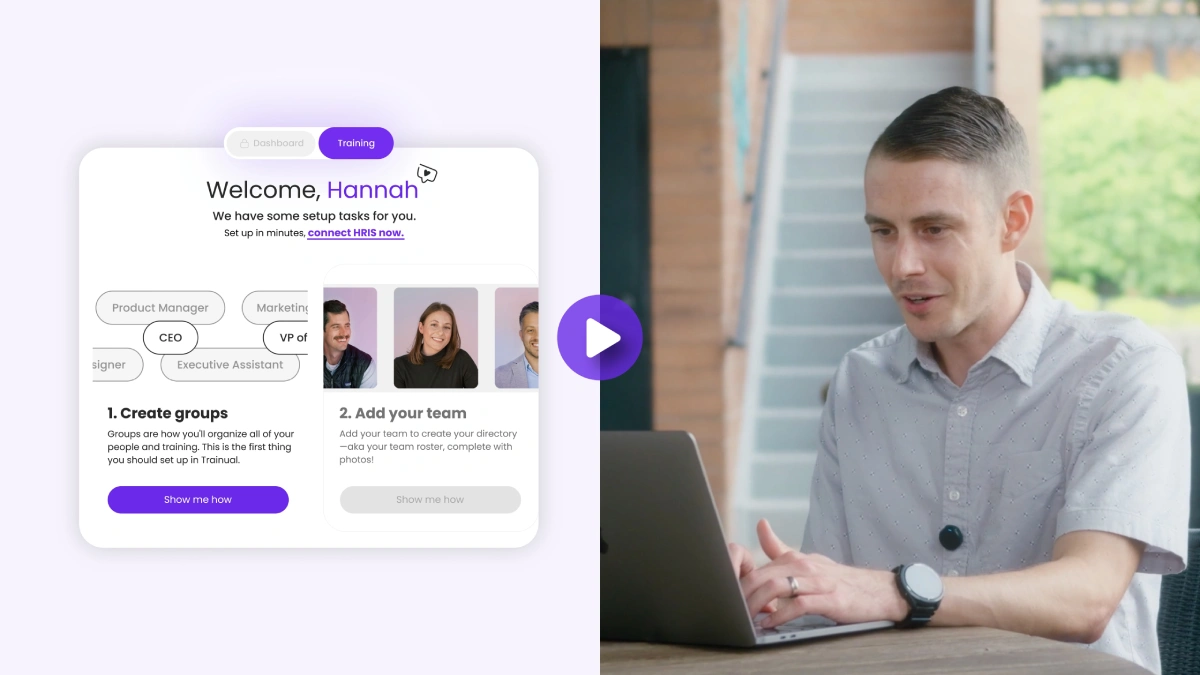
Move content into a structured training path. Configure role-based assignment so new managers auto-enroll the moment they're promoted. Schedule the coaching cadence.
Week 4: Pilot with one new manager
Run the program with the next promotion. Track where they got stuck, where they sailed through, where they had questions. Get their feedback at 30, 60, 90 days.
Month 2
Refine based on the pilot. Build the 60-90 day content modules.
Month 3
Set the ongoing cadence. Track metrics. Build the peer cohort.
Quick wins you can implement this week
Quick win #1: Document your "running a 1-on-1" framework
This is the single most important manager skill. Write down — or record — your company's approach. What questions to ask, what cadence, what notes to take. That document becomes the foundation of every new manager's first week.
Quick win #2: Schedule the coaching cadence upfront
For your next promotion, book the weekly 30-minute coaching calls for the first 90 days before day one. Cadence in the calendar = cadence that happens.
Quick win #3: Build a manager peer Slack channel
Create a private channel for all managers. No one else gets access. Watch what happens — the questions that come up are exactly the training gaps you didn't know you had.
Quick win #4: Audit your HR & compliance training coverage
What does every manager need to know about harassment prevention, discrimination, performance documentation, leave laws? If it's not documented and assigned, it's a liability. Trainual's HR & Compliance courses give you the prebuilt foundation.
Quick win #5: Add manager training to your senior IC pipeline
Identify your top 3-5 senior individual contributors. Start training them now — before they're promoted. The investment is small. The impact when promotion happens is huge.
How to measure new manager training success
You can't fix what you can't measure.
1. New manager 90-day confidence score
Survey new managers at day 90. How confident do you feel in your role? How clear are your responsibilities? How well-supported did you feel? Track quarterly.
2. Team engagement under new managers
How engaged are direct reports of newly promoted managers compared to the company baseline? Falling = the new manager isn't ramping. Rising = the training is working.
3. Direct report retention
What percentage of direct reports stay through the new manager's first year? Compare to historical baseline.
4. Time to full manager effectiveness
How long from promotion until the new manager is operating at full effectiveness? Aim to compress this from 12-18 months down to 90 days for foundational skills.
5. Compliance and HR training completion
What percentage of managers have completed required HR & compliance training within their first 60 days? This is non-negotiable — track and enforce.
Frequently asked questions
How long should new manager training take?
The foundation should be in place within the first 30 days — running 1-on-1s, setting expectations, delegating. The full 90-day ramp gets the new manager through performance management, feedback, hiring, and cross-functional collaboration. After that, ongoing development is continuous, not finite. Most companies wait far too long to train managers — on average 10 years into the role. The right answer is: start before the promotion if possible, and build the structured ramp from day one.
What's the most important thing a new manager needs to learn first?
Running 1-on-1s. It's the single highest-leverage manager habit. Done well, 1-on-1s prevent most performance issues, surface problems early, and build the relationships that make every other manager skill easier. Done badly (or skipped entirely), the new manager is constantly reactive, blindsided by issues, and trying to repair relationships that never got built. Teach 1-on-1s first. Everything else builds on top.
Should I train aspiring managers before they're promoted?
Yes. This is one of the highest-leverage HR investments available. Aspiring leader training — a few hours per month on management fundamentals before someone is promoted — pays dividends the moment the promotion happens. The new manager arrives with frameworks, vocabulary, and confidence instead of starting from zero. The cost is small. The impact is significant.
What's the difference between a new manager and an "accidental manager"?
A new manager is someone who has been promoted to a management role with structured training, a coaching relationship, and clear expectations. An accidental manager is someone who has been promoted without any of that — handed a team and told to figure it out. 82% of managers enter their roles as accidental managers. The cost of accidental management — to the company, the team, and the manager — is significant. Structured training is what closes the gap.
How do I train a new manager remotely?
Same framework, with extra emphasis on connection. Async-friendly content delivery so the new manager can learn at their own pace, video coaching calls instead of in-person, deliberate cultural integration moments (since osmosis doesn't work remotely), and on-demand searchable knowledge so they can answer their own questions without waiting on time-zone-dependent help. The structure is the same; the delivery is more deliberate.
Build the system once. Run it for every promotion.
Most growing companies promote managers and hope. They promote a great senior employee, give them a Slack message that says "let me know if you need anything," and assume they'll figure it out. Some do. Most don't — and the data on failure rates, turnover, and the cost of bad management is consistent and brutal.
Trainual gives growing companies the operating system to fix this. Structured training paths every new manager works through. Role-based assignment that auto-enrolls them the moment they're promoted. HR & compliance courses built in from day one. Searchable knowledge for the on-demand questions. AI-powered SOP creation to capture your senior managers' frameworks at speed.
Imagine a team where every new manager ramps up on a paced, practical 90-day path — supported by coaching, peer connection, and on-demand resources — and reaches full effectiveness in months instead of years. That's what's possible when you stop hoping and start building the system.
Ready to see how Trainual works?
👉 Book a demo and see how Trainual gets your new managers ramped up faster.
Want a sneak peek?
👉 Read customer stories from teams who've turned new manager training into a real system.