






Ever look up at 5pm on a Friday and realize you spent the entire week answering the same five questions, fielding the same handful of requests, chasing down the same three signatures, and somehow your strategic OKRs didn't move an inch? You meant to work on the new performance framework. You meant to finish the comp review. You meant to map out next quarter's hiring plan. Instead you reset someone's password (again), explained PTO accrual to three different people, sent the handbook to two new hires, and walked five managers through the onboarding workflow they should already know. That's not an HR leader problem. That's a system problem.
For HR leaders at growing companies — running people ops at 50, 200, 500 employees — this is the quiet drain that most miss. Every individual task feels small. Five minutes here, ten minutes there. But when you stack them across a week, a month, a quarter, the math gets ugly. The strategic work that actually moves your company forward — culture, performance, retention, leadership development — keeps getting pushed because the operational work keeps showing up. And the operational work keeps showing up because the system you have isn't built to handle it without you in the loop.
The hidden cost is real. Deloitte research found that HR teams spend 57% of their time on administrative tasks. Other research puts that number even higher — 73.2% by some estimates. That's the majority of every HR leader's week being eaten by work that's necessary but not strategic. Work that compounds across your team, eats your senior people's bandwidth, and quietly puts a ceiling on what HR can actually deliver to the company.
This guide walks through the five things HR leaders waste the most time on — and what to do instead. Each one is fixable. Some take a week. Some take a month. All of them give you back hours that compound into real strategic work over time.
Time waster #1: Answering the same questions over and over
The trap. Every HR leader has a mental list of the questions that come up every week. PTO balances. Benefits enrollment dates. Holiday schedules. Expense policies. Remote work guidelines. Each one feels small in the moment — a quick Slack reply, a short email, a five-minute conversation. So you handle it and move on. The problem is that you handle it again the next day, and the day after that, and the next time you hire, and the next time someone forgets the answer.
The hidden cost. 40 million hours per month are wasted on completing HR-related tasks across U.S. and U.K. enterprises — about $8.15 billion in lost productivity. A meaningful chunk of that lives on the HR leader's plate as repeat questions. Each interruption isn't just the time it takes to answer; it's the context-switching cost of pulling you out of strategic work and dropping you back in. Office workers lose 636.6 hours per year to administrative or repetitive tasks — roughly a third of the working year.
The fix. Get every recurring question into a searchable, role-based handbook that team members can find on their own. PTO policy. Benefits explainer. Remote work guidelines. Holiday schedule. Expense submission. When someone asks, the answer isn't "let me explain" — it's "search 'PTO' in Trainual, and ping me if it's still unclear." The first time you redirect someone, it feels like extra work. By the tenth time, you've reclaimed an hour a week. By the fiftieth, you've trained the whole company to look first and ask second. The questions don't go away — they go to a system that doesn't get tired of answering them.
Time waster #2: Walking every new hire through onboarding manually
The trap. Most onboarding programs at growing companies look the same: HR sends a few emails, walks the new hire through paperwork, schedules them with their manager, hands off the handbook, and hopes the manager covers what HR didn't. You're personally involved in some part of every new hire's first week — explaining benefits, walking through policies, setting up tools, fielding the inevitable "where do I find X?" questions. It feels like good HR. It is good HR — until you're hiring 5, 10, 20 people a quarter and onboarding has eaten your calendar.
The hidden cost. 50.4% of organizations report rising 90-day turnover compared to last year, and 20.5% of new hires now leave within 90 days. The cost isn't just your time — it's that bad onboarding directly drives early turnover, and early turnover costs roughly $50,000 per failed hire when you factor in recruiting, ramp time, and lost productivity. Worse, 28.8% of managers report providing zero guidance to new hires, which means everything HR doesn't document gets dropped entirely. Meanwhile, automated onboarding can reduce time-to-productivity by 50% — a number you're leaving on the table every time you walk a new hire through something a system could handle.
The fix. Build a structured, self-serve onboarding path that every new hire moves through on day one — without your direct involvement. Welcome content. Company values. Role expectations. Benefits explainer. Tool setup. Policies that need acknowledgment. Each piece happens at a predictable time, in a predictable order, with knowledge checks to verify it actually landed. You stop being the onboarding department and become the strategic backstop — checking in on the parts that need a human, leaving the structured content to the system. Senior HR leaders at scaling companies don't onboard every new hire personally. They build the machine that does.
Time waster #3: Chasing down policy acknowledgments and compliance signatures
The trap. A new harassment policy goes out. You email the team, ask everyone to read and acknowledge. A week later, half the team has signed off. The other half is a mix of "I'll do it later," "I didn't see the email," and "what email?" So you send a follow-up. Then a Slack reminder. Then individual nudges. Eventually you get to 90% acknowledgment, and the last 10% is a manual chase that takes another week. Multiply this by every policy update — handbook revisions, new safety protocols, code of conduct refreshes, state-specific compliance changes — and acknowledgment chasing becomes a recurring drain on your week.
The hidden cost. Beyond the time, there's a real compliance and legal risk. If something goes wrong — a complaint, an EEOC issue, a state audit — and you can't show timestamped proof that the affected employee acknowledged the relevant policy on the relevant date, you're exposed. Email "did you see this?" doesn't hold up. Manual sign-off sheets get lost. And as your company scales across multiple states or countries, the compliance complexity compounds — each jurisdiction has its own requirements, and each requires its own audit trail.
The fix. Move policy acknowledgment to a system with built-in e-signatures and version history. When a policy updates, the system pushes the new version to every affected employee, requires acknowledgment, and tracks completion. No more manual chasing — the platform tells you who's outstanding, and reminders trigger automatically. When the audit shows up, you have timestamped proof that every employee acknowledged the current version on a specific date. The chase that used to eat a week now happens in the background, and you spend the time you saved on the work that actually moves the company forward.
Time waster #4: Updating policies, handbooks, and SOPs in the wrong places
The trap. Your employee handbook lives in a Google Doc. Your policies live in a Notion workspace. Your SOPs live in a shared drive. Your benefits explainer is a PDF in someone's email. When something changes — a remote work policy update, a new compensation philosophy, a state law that shifts paid leave — you have to remember every place that policy is referenced and update each one. You inevitably miss a few. Three months later someone surfaces an outdated version, gives a new hire bad information, and you realize the version control problem isn't a technical issue. It's a structural one.
The hidden cost. The time isn't just the update itself — it's the downstream cost of misalignment. New hires learning from outdated handbooks. Managers giving guidance based on the old policy. Conflicting answers depending on which document someone happened to find. Each one is a small mess to clean up. Stacked over a year, it's hours of cleanup work and meaningful trust-erosion when employees realize HR's documentation isn't reliable. HR teams spend 57% of their time on administrative tasks — and a non-trivial chunk of that is content maintenance work that wouldn't exist if everything lived in one updatable place.
The fix. Consolidate every people-related document into one central platform with version history. Every policy, handbook, SOP, and benefits explainer lives in one place — searchable, role-assignable, and version-controlled. When you update content, the change is captured with a timestamp. Every team member sees the current version. Outdated content can't surface because there's only one source. The platform becomes the single source of truth for everything HR-related, and the updates that used to take half a day now take fifteen minutes.
Time waster #5: Building the same compliance training over and over
The trap. Every year, you build the harassment training. You build the safety training. You build the code of conduct module. Sometimes you build them from scratch. Sometimes you tweak last year's version. Either way, you're spending real time creating content that — let's be honest — is essentially the same as what every other company in your industry needs. Anti-harassment, OSHA, HIPAA, state-specific compliance — these aren't unique to your company. But you keep building them like they are because there's no better option in the system you're using.
The hidden cost. Time you spend building generic compliance content is time you don't spend on the strategic, company-specific work HR should be focused on. Performance frameworks. Compensation philosophy. Manager training. Culture initiatives. Engagement programs. The "high-impact projects like employer branding and diversity initiatives" that Deloitte's research calls out as where HR's time should actually go. Every hour you spend rebuilding harassment training from scratch is an hour the strategic work waits.
The fix. Use a platform that includes a prebuilt library of HR and compliance courses — ready to assign, ready to track, current with regulations. Anti-harassment training is already built. Safety training is already built. Code of conduct is already built. You assign by role and location, the platform tracks completion, and you spend zero time rebuilding what already exists. Your HR time goes from compliance content production to compliance content oversight — a much higher-leverage role for someone with senior HR experience.
What time-rich HR looks like
When you stop spending the majority of your week on administrative work, your job changes. You become the strategic partner the company actually needs — driving culture, building leadership, shaping retention, partnering with execs on workforce planning. Not because you stopped caring about the operational work, but because the operational work is finally running on a system that doesn't require you in every loop. That's what HR leadership actually looks like at scale. And it's not about working harder — it's about building the right system once, and getting back the time it gives you forever.
How to stop wasting time this week
You don't need a six-month transformation to see results. A few focused actions this week will start the unwinding.
Quick win #1: Pick the top 5 questions you answer every week and document them
Look at your last 30 days of Slack DMs, emails, and meetings. Identify the five questions that come up most often. Document them once, in a searchable place every employee can access. Set the expectation: search before asking. Within two weeks, the question volume drops noticeably.
Quick win #2: Audit your last 5 onboarding experiences
Talk to your last five new hires. Ask: what was confusing in your first week? What did you have to figure out on your own? What questions did you have that you didn't know who to ask? The answers become your onboarding documentation backlog. Tackle the top three before you hire next.
Quick win #3: Find the policies that need acknowledgment but have no proof
Pull every policy that legally requires employee acknowledgment. Check whether you have timestamped, defensible proof for every current employee on the current version. If not, fix that this month — it's the highest-leverage compliance investment you can make.
Quick win #4: Inventory every place your policies live
Spend an hour mapping every doc, drive, wiki, email, and PDF where HR content currently lives. The list will be longer than you think. That list is your consolidation roadmap — every duplicate location is a future inconsistency waiting to happen.
Quick win #5: Identify the compliance content you keep rebuilding
Look at the last three compliance modules you built or updated — harassment training, safety, code of conduct, anything else. For each, ask: is this content unique to my company, or could a prebuilt version cover 90% of it? Anywhere you'd say "prebuilt would work," that's a backlog item to migrate.
How to measure HR time recovery
Tracking time recovery is how you prove the system is working — to leadership, to your team, and to yourself.
1. Hours per week on administrative work
Pick a representative week and log how you actually spend your time — administrative vs. strategic. Set a baseline. Track quarterly. Aim to flip the ratio from 57% administrative to under 30% within a year.
2. New hire ramp-up time
Track how long it takes a new hire to reach their first productivity milestone. A measurable drop is direct evidence onboarding is working without you in the loop.
3. Repeat question volume
Log how often the same question comes back. A falling number means employees are using the system, and you're getting your time back.
4. Compliance acknowledgment rates
Track what percentage of affected employees have acknowledged each current policy. The closer to 100%, the lower your compliance risk and the less time you're spending chasing.
5. Strategic project completion rate
The most important metric. Are you actually finishing the strategic projects you set out to do each quarter? If yes, the system is giving you back the time the operational work used to consume.
Stop being the help desk. Start leading HR.
Most HR leaders at growing companies are stuck running operations because the system underneath them was built for a smaller team. The policies in scattered docs. The handbook that needs manual updating. The compliance content rebuilt every year. The onboarding that requires you in every loop. None of it is wrong — it just doesn't scale to where you're trying to go.
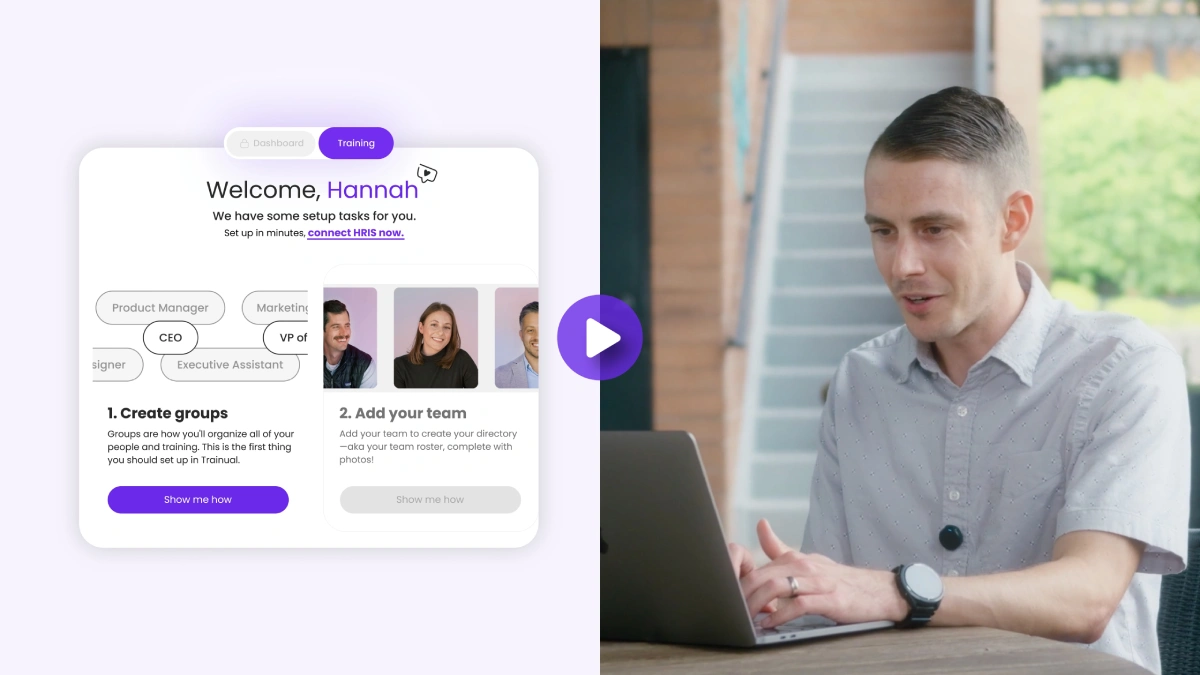
Trainual gives HR leaders the operating system to stop being the help desk. Documented policies and handbooks in one searchable place. Self-serve onboarding that runs without you in every loop. E-signatures and version history that take compliance acknowledgment off your plate. A prebuilt course library that ends rebuilding compliance content from scratch. The administrative work doesn't disappear — it stops requiring you to make it happen.
Imagine an HR week where you spend more time on strategy than on Slack replies — where new hires onboard themselves on day one, policies update once and reach everyone instantly, and compliance is auditable without a manual chase. That's what's possible when HR runs on a system instead of running the system manually.
Ready to see how Trainual works?
👉 Book a demo and experience how Trainual can give HR leaders their time back — with onboarding, policies, and compliance running on a system instead of your calendar.
Want a sneak peek?
👉 Explore real customer stories from HR leaders who've reclaimed their time.