




If you're comparing Trainual and Handbook, you already know the pain. Policies live in too many places. New hires read something once and forget it. And when someone asks "how do we do this again?", the answer is still trapped in one person's head.
Both platforms help you write policies, get them acknowledged, and prove people saw them. But they're built for different jobs. Handbook is a policy-and-procedure tool — write it, distribute it, sign it, test it. Trainual is the system your team works from every day, where documentation, training, roles, operations, and reviews stay connected as people onboard, change roles, and grow.
Trainual is a G2 Leader rated 4.7 across 2,000+ reviews on G2, Capterra, and Trustpilot. TryHandbook is a newer, lighter tool focused on getting policies written, distributed, and acknowledged.
Here's how they compare on the things that matter once a team starts to scale.
🔎 At a glance
- Handbook gets a policy signed; Trainual runs the whole employee lifecycle. Handbook writes, distributes, and acknowledges documents. Trainual trains from day one, operates day to day, and reviews at six months — on the same documented standard.
- Handbook has no operations layer. Meetings, goals, scorecards, and team updates live in the Operations suite in Trainual; Handbook has none of them.
- Handbook has no performance layer. Self and manager reviews, growth areas tied to training, and praise live in the Performance suite in Trainual; Handbook stops at the signature.
- Trainual shows who owns what. Trainual has an org chart, an accountability chart, and the Delegation Planner™; Handbook has document ownership on files, not roles.
- Trainual answers questions in plain language. Trainual's AI knowledge search with Q&A returns source-linked answers from your content; Handbook's AI writes and quizzes policies.
- Handbook is cheaper and simpler. Handbook publishes per-user pricing and a free plan; Trainual is demo-led. For a tiny team that only needs signed policies, Handbook is faster and lighter.




✍️ Documentation that stays true after it's signed
Handbook is a real documentation tool, and a tidy one. You can write or AI-generate policies, import existing PDFs, organize them with tags, embed video, and assign a document owner who's accountable for keeping each file accurate. For getting a clean policy library live fast, it does the job.
Both platforms let you build a searchable library of policies and SOPs your whole team can reach.
Where Trainual goes further:
- Living documentation, not just storage. The documentation system lets teams build SOPs with steps, images, and flowcharts — not only upload a finished file.
- Freshness on a schedule. Content verification reminders ping the owner on a recurring cadence, so a policy gets re-checked before it drifts out of date.
- Learner-driven fixes. Anyone can flag content that's confusing or outdated as they read it, so the doc improves from the people using it.
- Restore, not just history. Version history lets you review changes and roll back to what worked — available well before the top tier.
Handbook keeps the document and proves it was signed. Trainual keeps it right — and keeps it working after the signature.
🏗️ Accountability you can see, not just an owner on a file
Handbook assigns an owner to each document, so someone is on the hook for keeping that file current. That's useful, and more than a shared drive gives you.
But a document owner answers "who maintains this policy?" — not "who owns this work?"
Where Trainual goes further:
- Roles, not just files. The roles and responsibilities builder lists what each role owns, with the SOPs and training linked underneath.
- Structure you can see. The org chart and accountability chart show reporting lines and who owns which outcomes.
- Handoffs that don't break. The Delegation Planner™ shows what the next person inherits and what training they need before a leave, promotion, or exit.
- A directory that connects people to work. An interactive directory ties each person to their role, responsibilities, and the content behind them.
Handbook tells you who maintains a policy. Trainual tells you who owns the work — and who's next in line for it.
🎓 Onboarding that starts a system, not ends at a signature
Handbook onboards well for what it is: assign the right documents, embed a video, require a quiz and a sign-off, and track completion. A new hire gets the policies and acknowledges them.
Both platforms get a new hire through the essentials in their first week.
Where Trainual goes further:
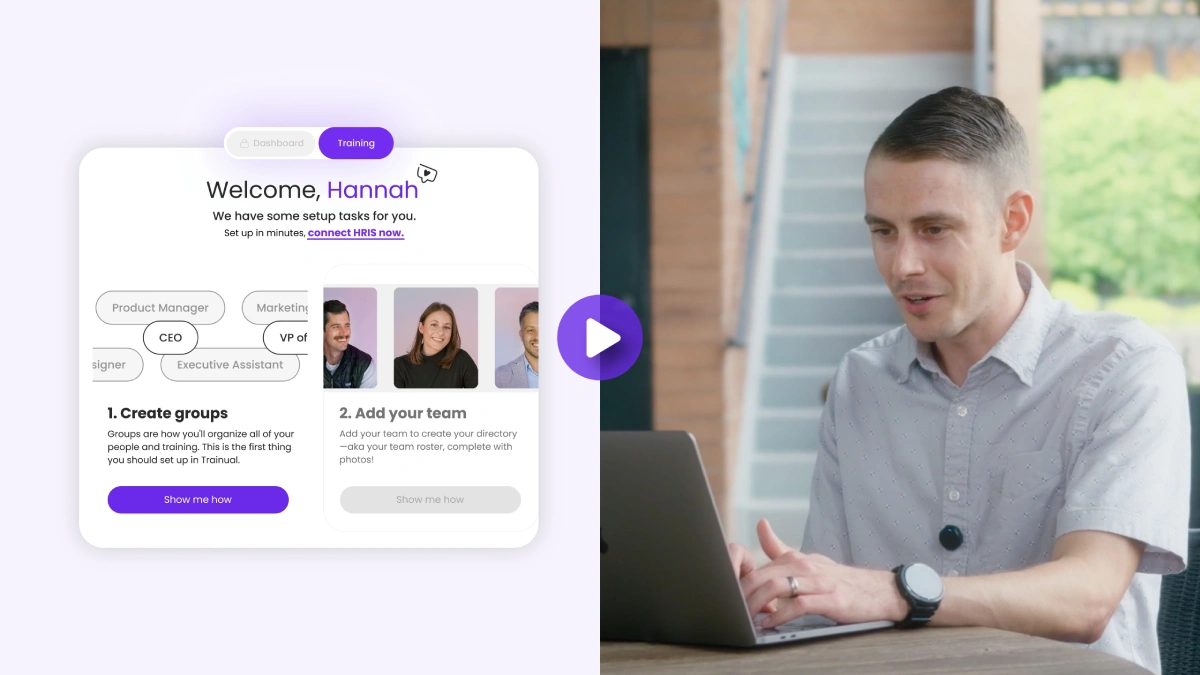
- Sequenced training paths. Training paths pace onboarding into role-based steps with milestones — not one long list to sign.
- Training tied to the role. Each path bundles the processes, policies, and SOPs a specific role needs, so the fifth hire gets the same ramp as the fiftieth.
- A place to keep coming back to. The payoff shows up in month two: onboarding is the on-ramp to a system the new hire keeps using, not a finished course they close and forget.
Handbook gets the new hire to "signed." Trainual gets them to "productive" — and keeps going.
🔁 One new hire, six months: Train → Operate → Perform
Here's the part that no policy tool can match, and it's the clearest way to see the difference. Picture one new hire and follow them for six months.
Handbook covers the first afternoon. Trainual covers the whole arc — because the same documented standard flows through all three suites.
- Day one — Train. They onboard through a role-based training path: the SOPs, policies, and expectations for their exact role, signed and understood, not just skimmed.
- Every week — Operate. They show up to team meetings with structured agendas, submit weekly updates, and track the KPIs they own in the Operations suite — so their manager isn't guessing what they've been up to.
- Six months in — Perform. Their review in the Performance suite nearly writes itself: self and manager assessments built on a real record, growth areas tied to the exact training that closes them, and praise already captured along the way.
With Handbook, month six looks like month one: a signed document, and a manager reconstructing the year from memory. With Trainual, every step built on the last.
⚖️ Compliance that lives in the work
Handbook is built for compliance, and it's good at the enforcement piece. Unlimited legally-binding e-signatures come on every plan, including the free one. Video can be made unskippable, with views, pauses, and skips tracked and the document owner alerted when someone watches less than required. There's also a dedicated employee-incidents log. If enforced acknowledgment is the whole job, Handbook is strong.
Both platforms collect e-signatures, run quizzes, and prove who saw what.
Where Trainual goes further:
- Compliance inside the training, not beside it. Required policies sit alongside the role-based training a person already works through, so understanding — not just a signature — is the goal.
- Expert-built courses that stay current. A library of 400+ expert-built courses — HIPAA, workplace safety, harassment prevention — updates automatically as regulations change and links to your own policies.
- An audit trail across the whole system. Completions, sign-offs, and version history connect to roles and reporting, so an audit is a filter, not a scramble.
Handbook proves the policy was signed. Trainual proves the person is ready to do the work it describes.
🤖 AI that answers from your company, not just writes the policy
Both platforms use AI, and Handbook's is practical. AI Generate drafts policies, AI Test writes a quiz from a document, and AI Recommend suggests clarity and compliance fixes. For creating and tightening policy content, it earns its place.
Both platforms use AI to make content faster.
Where Trainual goes further:
- Ask, don't dig. Trainual's AI knowledge search with Q&A lets anyone ask a question in plain language and get an answer pulled from your own content, with a link to the source.
- Grounded in the whole system. The AI assistant understands your processes, policies, roles, and org structure — not one file at a time.
- AI across the loop. The same AI drafts documentation, surfaces operations signals, and informs reviews.
Handbook's AI helps you write the policy. Trainual's AI answers questions from everything you've written.
🌟 Where Handbook has the edge
Handbook is a strong fit for some teams, and pretending otherwise would be dishonest. It's the simpler, cheaper tool, and for a specific job it's the faster path. Handbook publishes its pricing — a free plan for up to five users, then low per-user tiers — while Trainual is demo-led, so a tiny team on a tight budget can start on Handbook in minutes without a sales call. Unlimited legally-binding e-signatures come on every plan, including free, which is broader availability than Trainual offers at the entry level. Its enforced, unskippable video with pause-and-skip analytics is deeper than a standard required-watch setting, and its dedicated employee-incidents log — attach files, record statements, capture a supervisor's sign-off — is something Trainual doesn't offer. Add IP restrictions and location management for controlled, multi-site compliance, plus a reputation for being usable within hours with no training, and Handbook is a smart pick when signed, enforced policies are the entire job.
💰 Pricing
See Trainual pricing and Handbook pricing. Handbook publishes per-user rates and a free plan; Trainual is quote-based by team size.
✅ Choose Trainual if…
- You want a new hire to go from day-one onboarding to weekly execution to a six-month review in one connected system.
- You need to see who owns what — roles, an org chart, accountability, and clean handoffs when people change roles or leave.
- You run the day-to-day: meetings, goals, scorecards, and team updates should live where your training already lives.
- You want people to find answers themselves, in plain language, from your own documented knowledge.
- You want documentation that stays accurate — with ownership, scheduled verification, learner feedback, and restore.
🎯 Choose Handbook if…
- Your core job is getting policies written, distributed, signed, and tested — nothing more.
- You want the lowest-cost option or a free plan for a very small team, with pricing you can see without a demo.
- You need enforced, unskippable video with detailed view/pause/skip analytics.
- You need a dedicated employee-incidents log, IP restrictions, or multi-location controls for compliance.
Know what you're solving for
Handbook is a capable, affordable policy-acknowledgment tool, and for a five-person shop that needs signed handbooks by Friday, it's a reasonable place to land. The question is what happens after Friday. When that team is twenty people, then fifty — when a new hire needs to ramp into a role, when a manager needs to see what got done this week, when review season arrives and nobody can remember who did what — is a signed document still the thing you're solving for? Or is it everything that comes after the signature?
🏆 Our pick: Trainual
Handbook does one job and does it cleanly: it gets policies signed. If that's the whole problem, it's a fine, budget-friendly answer.
But most growing teams aren't trying to prove a document was read — they're trying to run a team. Trainual connects training, documentation, roles, operations, and reviews into one system, so the standard you set on day one shows up in how people work every week and how they grow over months. Want to see the whole loop in action? Book a demo.
❓ FAQ
Does Handbook have an org chart?
No. Handbook assigns an owner to each document but has no org chart, accountability chart, or role builder. Trainual includes an org chart, an accountability chart, and a roles and responsibilities builder, so you can see reporting lines and who owns which outcomes across the team.
Does Handbook have performance reviews?
No. Handbook stops at signed, tested policies. Trainual's Performance suite runs self and manager reviews, growth areas tied to training, and praise — grounded in the roles and work already documented, so review time is a recap instead of a scramble.
What's the difference between Trainual and Handbook?
Handbook is a policy-and-procedure tool: write, distribute, sign, test. Trainual is a connected system that trains, operates, and reviews on one documented standard. Handbook proves a document was acknowledged; Trainual runs the whole employee lifecycle from onboarding to development.
Is Handbook cheaper than Trainual?
Usually, yes. Handbook publishes per-user pricing and a free plan for up to five users; Trainual is demo-led and priced by team size. For a very small team that only needs signed policies, Handbook is the lower-cost, faster-to-start option.
Does Handbook have e-signatures?
Yes. Both platforms collect legally-binding e-signatures. Handbook includes unlimited e-signatures on every plan, including free. Trainual includes e-signatures on its paid tiers and links each one to the policy or SOP it belongs to inside the training itself.
Does Handbook have training paths?
Not as sequenced paths. Handbook assigns documents and quizzes for onboarding. Trainual builds role-based training paths with milestones, so every hire in a role gets the same paced ramp instead of one long list to acknowledge.
Can Handbook run meetings, goals, and scorecards?
No. Handbook has no operations features. Trainual's Operations suite runs structured meetings and agendas, goals, scorecards and KPIs, decisions and action tracking, and weekly team updates — all where your training and documentation already live.
Does Handbook have an AI assistant you can ask questions?
Handbook's AI writes policies, generates quizzes, and suggests edits. It doesn't offer a company-knowledge Q&A. Trainual's AI knowledge search with Q&A answers plain-language questions from your own content, with a link back to the source.
Does Handbook track employee incidents?
Yes. Handbook has a dedicated incidents module to log accidents or policy violations, attach files, record statements, and capture a supervisor sign-off. Trainual doesn't include incident management; if that's a core need, Handbook has the edge there.
Which is better for onboarding a new hire, Trainual or Handbook?
Handbook is better if onboarding means signing policies fast and cheap. Trainual is better if onboarding means ramping into a role and staying in one system — day-one training, weekly operations, and a six-month review that all build on each other.