




Picture this. It's Wednesday afternoon. You've just finished pulling the quarterly L&D report — completion rates look great. 94% across the manager training program. The slide goes into your deck. You feel briefly proud.
Then your CEO Slacks: "Hey — Maria's team is missing the new pricing playbook. Can you make sure they got the training?" You check. They did. Eight weeks ago. They completed it. They acknowledged it. They got the certificate. And they're still missing it.
That's the gap every L&D leader knows by heart: the gap between training delivered and training that changes how the team works. You're being measured on the first one. You're being held accountable for the second.
This guide is for the L&D leaders, learning managers, and training program owners trying to close that gap. It covers what training software for L&D really needs to do (which is different from what HR or ops leaders need), the most common mistakes L&D teams make when they buy the wrong tool, and the playbook for building programs that stick — measured in behavior change, not completion rates.
The L&D leader's particular pain
Most articles about training software are written for HR leaders or operations teams. They're useful, but they miss the L&D reality: you're not optimizing employee lifecycle and you're not optimizing how work gets done. You're optimizing for behavior change — and that's a fundamentally different problem.
The pain looks different at every stage:
- The "training is delivered, but nothing changed" loop. You launched a program. People completed it. The behavior the program was supposed to drive isn't happening. The CEO assumes you didn't train them. You know they were trained. The gap between completion and capability is invisible to everyone except you.
- The "we don't know what we're missing" problem. You can report on what was completed. You can't easily report on the skills your team doesn't have yet. So every conversation with the executive team is reactive: "what training do we have for X?" instead of proactive: "here's the capability gap and here's the program addressing it."
- The "every department wants something custom" tax. Sales wants product training. Operations wants compliance. Engineering wants security. Customer success wants brand voice. You're building five programs in parallel with no shared infrastructure, and each one feels like starting from scratch.
- The "is this even working" question. Six months in, leadership wants to know the ROI of the L&D investment. The metrics you have (completions, satisfaction scores) don't answer the question they're asking (did this make us better at our jobs?). You're stuck reporting on activity instead of impact.
At every stage, the underlying problem is the same: L&D is being asked to drive behavior change, but L&D software is built for course delivery. Those are two different products dressed in the same packaging.
What training software for L&D leaders really needs to do
This is where most software gets it wrong. A traditional LMS is built around course completions, certifications, and compliance reporting — designed for the era when "training" meant "watch this video, click 'I acknowledge.'" A platform optimized for HR is built around employee lifecycle. Neither solves the L&D problem, which is structural: turning learning into behavior change at scale, across roles, departments, and ongoing change.
Here's what the right tool really does for an L&D leader.
1. Connect learning to roles, not just to courses
The biggest single failure mode of traditional LMS software is the course library mental model. Every piece of content is a standalone object. There's no native connection between a sales rep's role and the sales onboarding program. There's no automatic enrollment when someone changes departments. There's no view of "what does a customer success manager need to know" that maps to a person's actual job.
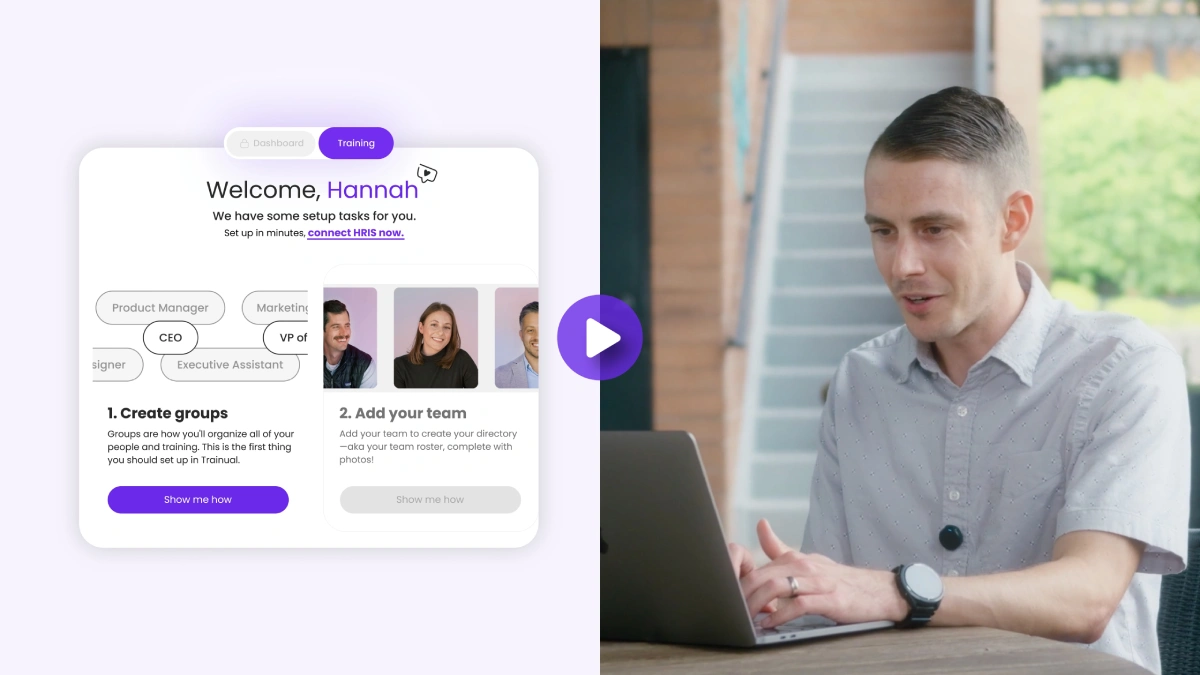
Trainual's role-based assignment flips this. Every team member sees exactly the content tied to their role — onboarding paths, ongoing training, policy acknowledgments, manager-track development. When someone changes roles, their learning path updates automatically. When you add new content to a role, every person in that role gets it. The training stops being a library people opt into and starts being the system that defines what each role needs to know.
2. Make content easy enough to build that you'll keep it current
Most L&D programs die because the content goes stale. The new manager training built two years ago references org structure that doesn't exist. The compliance module hasn't been refreshed since the regulation changed. The product training is from before the last release. Everyone knows it. Nobody has time to fix it.
The right tool lowers the bar for content creation enough that staying current is realistic. Trainual's AI-powered SOP creation drops a process from blank-page to first-draft in minutes. Screen recording captures workflows the way they really run. Voice-to-text turns a 5-minute conversation into a structured training module. The shift is from "we need a content sprint" to "I'll capture this while I'm doing it once anyway."
The downstream effect: content that stays current, because keeping it current is no longer a quarterly project.
3. Push knowledge into the moment of need — not into a course completion event
The single biggest lie of traditional LMS software is that learning happens during the course. It doesn't. People learn when they're trying to do the work and need an answer. The course is the upload; the workflow is the application.
Good L&D software solves this with AI-powered knowledge search — every team member can ask the platform a question about how the company does something and get the answer pulled directly from your documentation, with a link back to the source. They stop interrupting senior teammates. They start asking the system that has the institutional knowledge in it. This is the dynamic Kate Reilly built at 829 Studios, where her constant refrain became "yes, I do have the answer for that — here, click this link in Trainual."
The metric that matters isn't course completion. It's time-to-answer. How fast can someone find the right way to do something the moment they need to know it?
4. Show you what's working without forcing you to dig for it
You're being measured on impact, not on activity. So the reporting layer needs to surface the things you truly care about — not just completion rates, but content gaps (what's getting searched but not found), behavior signals (what content is referenced repeatedly during work), adoption velocity (which roles are using the system and which aren't). The best L&D-focused tools push the right data to you on a cadence so you stay strategic instead of stuck inside the dashboard.
This is also where team accountability tracking and reporting earns its keep — distributed reporting access means managers and department heads run their own audits, freeing you up to focus on program design instead of data extraction.
5. Hold up across the whole organization, not just within L&D's silo
Most L&D teams are running parallel infrastructure to the rest of the company. Their LMS doesn't connect to the org chart. It doesn't connect to the delegation system. It doesn't connect to the policies and SOPs that define how the company really runs. So the training program lives in a bubble, disconnected from everything else.
The right tool is connected. When you train a new manager, the role they're stepping into is defined in the same system. When you launch a new policy, the acknowledgment trail lives in the same system as the training that contextualizes it. When you onboard a new hire, the structured 30-day path connects directly to their role responsibilities. The training is the entry point into a connected operating system — not a deliverable on its own.
What L&D leaders typically get wrong when they choose software
The pattern is consistent. L&D leaders who buy the wrong tool tend to make the same five mistakes.
Mistake #1: Buying based on course library size
You're shopping LMS platforms and the demos all start with "we have 5,000+ courses in our library." You assume more is better. Six months later, you realize: nobody on your team wanted those courses. Your team needed your content — your processes, your sales playbook, your customer communication standards — packaged for the way your company runs. The fix: match the tool to what you really need to teach. If your training is mostly bespoke (your processes, your tools, your way of doing things), library size is irrelevant. You need a platform optimized for building your own content, not consuming someone else's.
Mistake #2: Optimizing for course completion instead of behavior change
You hit your completion targets. Leadership asks why team performance hasn't improved. You realize: you've been measuring the wrong thing. Completion is an activity metric. Behavior change is the outcome metric. The fix: build measurement into the design, not the report. Pair every learning module with a behavioral signal — "did the rep follow the new objection-handling framework on their next 5 calls?" "Did the manager run the redesigned 1:1 format with their team?" — and track the signal, not the completion. We dig deeper into why most training programs fail and how to fix yours.
Mistake #3: Choosing a platform optimized for compliance, not learning
Compliance training has specific requirements: certificates, audit trails, mandatory acknowledgments. Many traditional LMS platforms are great at this. They're terrible at the other 80% of your job — building learning programs that develop people. The fix: match the tool to the dominant use case. If you're 80% compliance and 20% development, an enterprise LMS is fine. If you're 80% development and 20% compliance, you need a platform that prioritizes learning design and behavior change. We break down the difference in 5 signs you need a modern LMS, not an enterprise one.
Mistake #4: Treating the LMS as separate from how work runs
You buy the LMS as a learning destination. The team learns there. Then they go back to "the real work" elsewhere. The training never integrates with the workflow, and within 90 days nobody references it during actual work. The fix: the platform has to be where work lives, not where work pauses for training. Searchable from where the work is happening. Connected to roles, processes, and policies. Referenced during 1:1s, not just during onboarding. It becomes the operating system for how work gets done, not a separate learning destination.
Mistake #5: Underestimating the change management lift
You picked the best platform on the market. You launched it. Three months later, adoption is 30%. The team has gone back to old habits. The fix: L&D rollouts are change initiatives, not software deployments. Leaders have to model usage. Managers have to redirect questions to documented answers instead of answering them directly. Adoption is built deliberately, not assumed. We've documented the full playbook in how to roll out an LMS without it failing and the deeper psychology in why your team ignores training and how to fix it.
What 30 days of building a learning program that sticks looks like
You don't need a six-month L&D transformation. You need a 30-day momentum sprint that proves the system can drive measurable behavior change, then a system that compounds from there.
Week 1: Audit the gap
Pick one program where the gap between completion and capability is widest. Manager training is usually the obvious one — high completion, mixed behavior change. List five behaviors the program is supposed to drive. For each behavior, define what "good" looks like in observable terms. This is your baseline.
Week 2: Redesign one module around behavior change
Pick the module tied to the behavior with the biggest gap. Rewrite it to include three things: the why of the behavior (the principle the procedure protects), the what good looks like in concrete examples, and the application moment — what specifically the learner should do differently in their next week of work.
Week 3: Pair the learning with a behavioral signal
For the next two weeks, track whether the behavior is happening. Manager 1:1 format? Have department heads check. Sales objection-handling? Have call coaches review the next 10 calls per rep. Customer communication style? Pull a sample of recent emails. The signal doesn't need to be sophisticated — it needs to exist.
Week 4: Measure, adjust, expand
Compare the behavioral signal week 1 (baseline) to week 4 (after the redesigned module). The delta is the L&D ROI metric you've been missing. Now expand the same approach — pair learning with behavioral signal — to the next program in your portfolio.
Month 2 and beyond
By month 3, you should have at least three programs running with paired behavioral metrics. The compounding kicks in around then — every program that ships with measurement built in becomes evidence of L&D's impact, which becomes the budget case for the next program.
Quick wins to start this week
Quick win #1: Audit your top program for the completion-vs-capability gap
Pick one program. List five behaviors it's supposed to drive. For each behavior, ask: "If I sampled the team next week, would I see this behavior?" The honest answer is your starting point.
Quick win #2: Tag every module with one behavioral outcome
Most L&D content describes the topic ("Effective Customer Communication"). The shift: tag every module with the behavioral outcome ("Reps follow the 3-part response framework on every customer escalation"). Same content, different framing — and now you can measure it.
Quick win #3: Identify your "explain it to me again" content
For one week, log every question that comes through your team or your manager network where the answer already exists somewhere in your training content. The volume tells you which content isn't being found at the moment of need. That's a search/findability problem, not a training-design problem.
Quick win #4: Build a "30-day-back" program review cadence
Every program review happens 30 days after launch — not the day of completion. The 30-day review asks "did the behavior change?" not "did the team complete it?" Make this a calendar event for every program.
Quick win #5: Get one department head to own audits in their team
You don't scale by personally auditing everything. Pick one department head, give them reporting access, and have them run their team's content audit themselves. Repeat with the next department head next month. Within a quarter, you've distributed the audit work across the leadership team.
How to measure that the L&D program is working
Tracking L&D impact is how you know the system is working — not in feelings, in data.
1. Behavior change signal vs. completion rate
Don't report on completions alone. Report on completions paired with a behavioral signal: "94% completed the manager training; pulse survey shows 71% of teams now experience structured 1:1s, up from 38%." That's the metric that earns L&D's seat at the table.
2. Time-to-answer
How fast can a team member find the right way to do something the moment they need to know it? AI-powered search analytics can show you what's getting searched, what's being found, and what's getting searched repeatedly without resolution.
3. Capability gap visibility
Can you produce, on demand, a view of what skills a given role has versus what skills the role needs? If yes, you're proactive. If no, you're stuck reacting to executive requests.
4. Content health
% of content reviewed in the last quarter; flag-to-fix turnaround when team members spot something out of date. Stale content is the slow death of an L&D program.
5. Distributed authoring velocity
How many people across the organization are creating training content, not just consuming it? L&D doesn't scale by being the bottleneck for every program; it scales by being the platform owner with department heads and SMEs as authors. Track the ratio.
What L&D leaders have built (and what you can copy)
The pattern repeats across every L&D leader who's built a program that sticks:
- Kate Reilly at 829 Studios scaled L&D infrastructure from 70 to 290 employees without onboarding scores dipping. Her playbook: distributed subject ownership, role-customized onboarding paths, search-first culture, and reporting access pushed out to department heads.
- Recharge Clinic keeps training and HIPAA/OSHA compliance aligned across 4 locations and 4 service lines, built by a first-time L&D leader using 400+ pre-built courses as a foundation.
- ProTec Building Services built 600+ SOPs across 9 offices with a full-time process engineer driving content creation while L&D and operations stay in lockstep.
- Trailstone Insurance cut onboarding from 3-5 days to 1.5 days by building a searchable, role-based learning system instead of a course library.
You can see this pattern across 5 companies cutting onboarding time with Trainual and 4 healthcare providers using Trainual for compliance and training. Different industries, different sizes — same shift: training stops being delivered as a course library and starts being designed as the operating system for how the team works.
Stop reporting on activity. Start reporting on impact.
The hard truth about L&D in 2026: you cannot earn the executive seat at the table by reporting on course completions and satisfaction scores. You earn it by showing measurable behavior change tied to company outcomes. And you can't show measurable behavior change with a tool designed to deliver and track courses.
Trainual was built for exactly this transition. Document the way your company really runs. Connect every learning module to the role responsible for it. Build structured onboarding programs that connect day one to day 90. Use AI-powered search so your team can find the answer in the moment of need. And distribute authoring across the company so L&D scales as the platform owner instead of as the bottleneck.
The L&D leaders who break out of the activity-reporting trap don't work harder. They build the system once — and then run programs that drive measurable change, instead of running programs that fill the report.
Ready to see what's possible?
👉 Book a demo and see how Trainual helps L&D leaders build training programs that drive measurable behavior change.
Want proof?
👉 Browse customer stories from L&D leaders who built operating systems instead of course libraries.
Frequently asked questions
Is Trainual a learning management system or something else?
Trainual is best described as a training and operations platform — designed for companies that need their training to connect directly to how the team operates. Traditional LMS platforms are optimized for course delivery and compliance reporting. Trainual is optimized for behavior change at scale, with role-based learning, AI-powered search, and direct connections to the company's processes, policies, and org structure.
How is Trainual different from Cornerstone, Workday Learning, or other enterprise LMS platforms?
Enterprise LMS platforms are built for large organizations (typically 500+ employees) with dedicated L&D teams running compliance-heavy programs. Trainual is built for 25-employee-and-up companies in scaling mode, where L&D is often a small team or a single leader. The differences: faster setup, AI-powered content creation, role-based learning paths, and direct connection to the operations layer of the company.
Can I use Trainual if I'm not technical?
Yes. The platform was designed for L&D leaders and operators, not IT departments. Most L&D teams have their first programs running and a team onboarded within a week. The AI assist makes content creation feel like a conversation, not a project.
What if I have existing training content I don't want to lose?
You don't need to rebuild from scratch. Existing documents, videos, and SOPs can be imported directly. AI can convert them into structured training modules in minutes. The migration effort is closer to "weeks" than "months."
How does Trainual handle compliance training?
Trainual supports e-signatures, completion tracking, audit trails, and reporting suitable for compliance requirements like HIPAA, OSHA, and industry-specific regulations. Recharge Clinic uses it across HIPAA, OSHA, and DEA-relevant content; Ironsmith Fire uses it for life-safety compliance. The difference from a pure compliance LMS: Trainual handles compliance and the rest of your L&D portfolio in one connected system.
How do I measure ROI on L&D investment with Trainual?
The reporting layer surfaces both activity metrics (completions, engagement) and the inputs to behavior-change measurement (what's being searched, what content is referenced repeatedly, where capability gaps exist by role). The full ROI picture pairs platform analytics with behavioral signals you collect from the field — but the platform makes the data side meaningfully easier than traditional LMS reporting allows.
What if my team resists adopting a new platform?
This is the most common L&D concern. Two pieces have to be true: leadership has to model usage (referencing content during meetings, redirecting questions to documented answers), and the platform has to be searchable enough that finding the answer is faster than asking. Get both right, and adoption follows. We dig into the psychology of training adoption for the deeper "why" — and the LMS rollout playbook for the practical "how."