





Ever sit in a meeting where two senior team members both explain the exact same project — slightly differently — and realize halfway through that they each thought they owned a different piece of it? Each one has been operating for the past two months under the assumption that the other was on top of the parts they weren't doing. Both are working hard. Both are doing real work. Neither is dropping the ball on purpose. But the ball is dropping, slowly and consistently, in the gaps between the responsibilities nobody actually wrote down. By the time you catch it, three weeks of duplicate work have happened on the things they both thought they owned, and three weeks of nothing has happened on the things they both thought the other was handling.
That's not a people problem. That's a role clarity problem. And in a growing company — somewhere past 25 employees, definitely by 50, urgently by 100 — it's the quiet wall every team hits. The roles you wrote two years ago don't match what people actually do. The org chart doesn't reflect how decisions get made. The senior employees know where the gaps are because they've been filling them, but nobody's documented that part. Your team isn't bad. The clarity around them is.
The data backs it up. Only 45% of employees clearly understand their job expectations. Gallup's research, drawing from over 112,000 teams, found that knowing what's expected of you is the top driver of employee engagement — and role clarity has been declining since 2020, especially for remote and hybrid workers. Clear goals and expectations are the #1 productivity driver cited by HR teams, ahead of supportive leadership and flexible work. The data is clear: when role clarity drops, everything downstream — productivity, retention, engagement, performance — drops with it.
This guide walks through how a learning management system (LMS) — used the right way — becomes the operating system that makes role clarity actually work in a growing company. Not just job descriptions in a folder. Not just an org chart that's six months out of date. A living system where every role, every responsibility, and every supporting process stays connected and current.
Why role clarity breaks as your team grows
At 5 employees, role clarity is a conversation. Everyone knows what everyone else does because they're sitting in the same room. At 15, it's a Notion doc someone wrote a year ago that's mostly still accurate. At 50, it's chaos — the doc is wrong, half the responsibilities have shifted, and the senior employees know the real version but nobody's written it down. At 100+, the gaps between people's heads and the documentation are wider than the documentation itself.
The reason role clarity breaks at scale isn't bad management. It's that roles are inherently dynamic. People take on new responsibilities. Reorgs shift ownership. Promotions create gaps. New hires fill some of those gaps but not all. Every change creates a small piece of role drift — and without a system designed to absorb and document those changes, the drift compounds quietly until your team is operating on a version of the org that doesn't exist anymore.
The cost of that drift shows up everywhere:
- Duplicate work across overlapping responsibilities
- Dropped balls in the gaps nobody owns
- Decision delays because nobody's sure who has authority
- Performance reviews based on outdated job descriptions
- New hires confused about what they were actually hired to do
- Senior employees burning out from filling unowned work
A good LMS — used as more than just a training tool — fixes this. Here's how.
What an LMS does for role clarity
A traditional org chart shows you who reports to whom. It doesn't tell you what each role actually owns. A traditional job description shows you what a role was supposed to do when it was written. It doesn't reflect what the role does today. An LMS, used the right way, fills both gaps — and connects the dots between roles, responsibilities, and the supporting processes that make the work actually happen.
The features that make this work:
Where a wiki or shared drive treats role information as static documentation, an LMS treats it as a living system — every role connected to its responsibilities, every responsibility connected to its supporting content, every change tracked and pushed to the team automatically.
The 6-step framework for using an LMS for role clarity
Here's the framework — start to finish. Each step builds on the last. The early steps are foundational. The later steps are where the system compounds.
Step 1: Audit your current role landscape
Before documenting anything, get an honest read on where you are. Pull the existing job descriptions. Look at the current org chart. Ask senior team members two questions: "What do you actually own that isn't in your job description?" and "What do you think other people own that you're sometimes filling in for?"
The gap between what's documented and what's actually happening is your role drift inventory. Don't try to fix it in the audit — just write it down. The list itself is the most valuable artifact you'll create in the entire project.
Step 2: Define every role's core responsibilities
For each role on your team, document the core responsibilities — the 3-7 things that role owns end to end. Not job duties. Responsibilities. The difference matters: a job duty is a task; a responsibility is an outcome the role owns regardless of how it gets done.
For each responsibility, capture:
- The outcome the role owns
- The success criteria (what does "good" look like?)
- The decision-making authority (what can this role decide vs. escalate?)
- The supporting SOPs or processes
- The people the role coordinates with for handoffs
This is the foundational content the rest of the system runs on. It doesn't need to be perfect on the first pass — it needs to be honest. You'll refine it as the team uses it.
Step 3: Build your role chart
A role chart is different from an org chart. An org chart shows reporting relationships — who reports to whom. A role chart shows responsibility distribution — what each role owns, independent of the person currently in the seat. Both are important. They answer different questions.
The role chart is where you visualize:
- Which responsibilities are owned by which roles
- Where multiple roles share a responsibility (and how)
- Where responsibilities are unowned (the gaps)
- How responsibilities connect across the org
This is the artifact that surfaces the drift. Roles with too many responsibilities. Responsibilities with no clear owner. Roles that exist on paper but don't have current responsibilities anymore. The role chart makes the invisible visible.
Step 4: Connect each responsibility to its supporting process
A responsibility without a documented process is just a label. The whole system compounds when you connect each responsibility to the SOP, training content, or playbook that supports it.
For example, if your customer success role owns "renewal management as a responsibility," the role chart points to the supporting renewal process — the steps, the timing, the templates, the escalation paths. When a new CS hire joins, they don't just get a role description; they get the role description plus every supporting process they need to actually execute the role. The connection is what turns role clarity into operational clarity.
Step 5: Assign content by role and turn on tracking
Once roles, responsibilities, and supporting processes are documented and connected, the LMS does the lifting. Use role-based content assignment so every team member sees exactly what applies to their role and nothing more. New hires automatically receive the right content based on their role. Existing team members get role-specific updates without having to wade through irrelevant content.
Turn on completion tracking and acknowledgment for the role-defining content — sign-offs on responsibilities, knowledge checks on key processes, version acknowledgment when role expectations update. Now you have proof that every team member knows what their role owns. That proof matters for performance reviews, for compliance audits, and for the conversations that happen when responsibilities get re-litigated mid-project.
Step 6: Build the maintenance loop
The biggest mistake teams make with role clarity systems is treating them as one-time projects. Roles change. Responsibilities shift. New hires arrive. Reorgs happen. A good system absorbs change without breaking — but only if maintenance is built in from the start.
Set a quarterly cadence for role review. Use version history to track every change. When responsibilities shift between roles, the change should flow through the system — updated in the role chart, pushed to the affected team members, acknowledged on the new version. The system stays current because change is treated as routine, not exceptional.
Common mistakes to avoid
The framework works. The implementation is where teams stumble. Here are the mistakes that come up most often.
Mistake #1: Documenting roles as job duties instead of responsibilities
The trap: You write down everything a role does. The list is 30 items long. Nobody reads it.
The fix: Document responsibilities, not duties. A role should own 3-7 outcomes. Each outcome can have many supporting tasks — but the role-level documentation should be at the outcome level, not the task level. Less is more.
Mistake #2: Treating role clarity as an HR project instead of an ops project
The trap: HR runs the role clarity initiative. The team treats it as performance review prep. Once the cycle ends, the system goes stale.
The fix: Role clarity is operational. It needs to live in the system the team uses every day, owned by the people who do the work. HR can drive the rollout, but the role chart and the supporting processes belong to the operators.
Mistake #3: Confusing the org chart with the role chart
The trap: You build a beautiful org chart and call it role clarity.
The fix: An org chart shows reporting relationships. It doesn't tell you who owns what. You need both — but the role chart is where the actual work of role clarity happens.
Mistake #4: Assigning a responsibility to a person instead of a role
The trap: "Sarah owns the renewal process." Sarah leaves. Now nobody owns it.
The fix: Assign responsibilities to roles. Sarah, as the senior CS lead, owns renewal management because senior CS leads own renewal management. When Sarah leaves, the next senior CS lead inherits the responsibility — and the supporting documentation comes with it.
Mistake #5: Updating the system once a year and calling it done
The trap: Role clarity becomes an annual exercise. Six months in, the documentation is wrong again.
The fix: Build a quarterly review cadence. Make role updates part of normal change management, not a special event. The system stays current because maintenance is routine.
What rolling this out should look like
Software is half the job. Rollout is the other half. Here's how to get real adoption in the first 30 days.
Week 1: Audit and prioritize
Pull the existing org chart and job descriptions. Identify the 5-10 roles where role drift is most painful — usually the senior team and any role that's recently been reorged. Start there.
By the end of Week 1, you should have:
- A list of the highest-priority roles to document
- Senior team members aligned on the role drift inventory
- Owners assigned to each role's documentation
Week 2: Document the top 5 roles
Block focused time for senior team members to document each role. The senior person in each role should draft their own — they know it best — with a manager review pass to catch gaps. Don't chase perfection. A rough first draft covering 80% is more valuable than a polished draft covering 40%.
Week 3: Build the role chart and connect supporting content
With role documentation in hand, build the role chart visualizing how responsibilities connect across the team. For each responsibility, link the supporting SOPs or processes — even if those processes need a future cleanup pass.
Week 4: Assign and acknowledge
Load the content into the LMS, assign by role, and require acknowledgment from every team member that they've read and understand their current role expectations. This is when the system stops being a project and starts being how the team operates.
Month 2
Expand to the next tier of roles. Document the cross-functional handoffs that surfaced during the initial rollout. Tighten any role definitions that the first round of feedback flagged.
Month 3
Shift to maintenance mode. Set the quarterly review cadence. Track which roles have updated since launch. Begin measuring the metrics that matter — clarity, accountability, performance.
Quick wins you can implement this week
You don't need a full rollout plan to see value. A few focused actions this week will start moving the needle.
Quick win #1: Ask senior team members what they actually own
Block 30 minutes with your top 3-5 senior team members. Ask: "What do you own end-to-end that isn't in your job description?" Write down the answers. This list alone is the foundation of the role clarity work to come.
Quick win #2: Identify the gaps nobody owns
In a leadership meeting, ask: "What's something we're consistently dropping the ball on?" The answers point to unowned responsibilities. Document them. Assign them.
Quick win #3: Audit one cross-functional handoff
Pick one handoff that creates friction — sales to onboarding, product to marketing, ops to finance. Document who owns what at each step. Push the doc to both teams.
Quick win #4: Update one role description that's most out of date
Pick the role description that's most stale. Sit with the person currently in that seat. Update it together. Push it to the team.
Quick win #5: Define decision-making authority for one project
Pick one ongoing project. Document who has decision-making authority on what. Decisions stop bouncing back and forth when the answer is written down.
How to measure role clarity success
You can't fix what you can't measure. Track these metrics quarterly:
1. Role clarity score
Survey your team: "How clearly do you understand what's expected of you in your role?" Track the score quarterly. Industry benchmark: only 45% of employees clearly understand their expectations. Aim to get above 80%.
2. Time-to-productivity for new hires
When role expectations are clear, new hires reach productivity faster. Track ramp-up time and look for measurable improvement after rollout.
3. Cross-functional escalation rate
Track how often decisions or projects escalate up because ownership isn't clear. A falling rate is direct evidence the role chart is working.
4. Engagement scores for "I know what's expected of me"
Most engagement surveys include a question on role clarity. Track the score before and after rollout. Aim for a measurable lift within two quarters.
5. Performance review consistency
When role expectations are clear, performance reviews align across managers. Track variance in performance review outcomes for similar roles. Less variance means clearer roles.
Stop guessing what your team owns. Start running on a system.
Most growing companies hit a role clarity wall somewhere between 25 and 100 employees. The roles you wrote two years ago don't match what people actually do. The org chart doesn't reflect how the team really operates. The senior employees know where the gaps are, but nobody's written them down. Your team isn't bad. The clarity around them is.
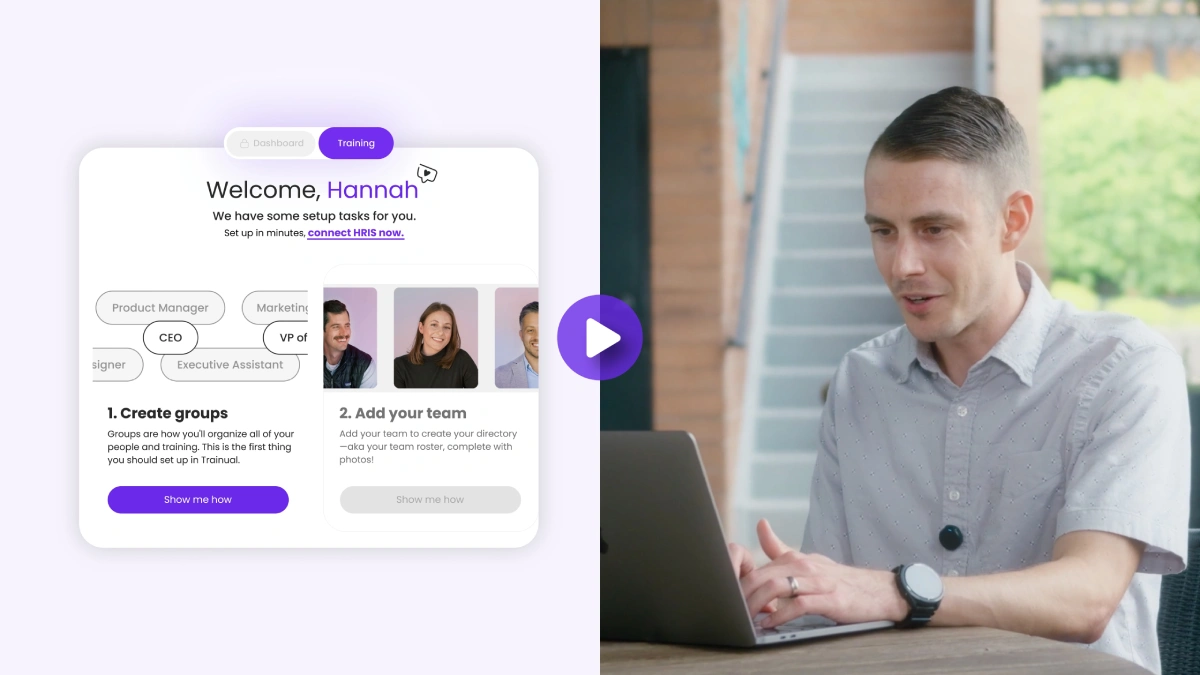
Trainual gives growing companies the operating system to fix this. Document every role's responsibilities, connect each one to the supporting SOPs, visualize the org and role charts, assign content by role, track acknowledgment, and keep everything current with version history. The role drift that builds up quietly between people's heads and the documentation finally gets a system designed to absorb it.
Imagine a team where every employee knows exactly what their role owns, every responsibility has a clear owner, and every cross-functional handoff runs on a documented playbook. That's what's possible when role clarity runs on a system instead of running on memory.
Ready to see how Trainual works?
👉 Book a demo and experience how Trainual gives growing companies the system to make role clarity actually work.
Want a sneak peek?
👉 Explore real customer stories from teams who've reclaimed role clarity at scale.