




It's 6:30 AM on a Monday in August. The center director is unlocking the front door for the 7:00 open. Her phone shows two voicemails left between 4:30 and 5:00 AM — her lead toddler teacher caught the virus going around her own children's school and won't be in. The morning ratio at open requires a lead in the toddler room by 7:00; the only floater available is still 35 minutes away. The curriculum binder for the week isn't refreshed — last week's plans are still pinned on the wall. The state licensing inspector dropped by unannounced at three centers in the region last month, and this center hasn't been visited in 14 months. By 7:05, parents are starting to arrive, an assistant teacher is doubling up coverage to maintain ratio, and the director is on the phone trying to call in a substitute while typing a parent update about why drop-off feels different this morning.
This is what daily operations look like at most growing child care centers. Not chaotic — exactly — but held together by the director and a couple of senior lead teachers who carry the whole operation in their heads. The ratio rules, the licensing requirements, the curriculum framework, the parent communication conventions, the way drop-off and pick-up work. It all works. Until a senior teacher leaves, a virus runs through the staff, or a state inspector walks in on a day when documentation is two weeks behind.
Then the cracks show. Ratios slip. Parents notice. Licensing inspections find deficiencies. The new teachers you spent two weeks training feel like they're guessing at every classroom transition. Enrollment slows because word travels among parents. And the director is doing 14 hours of overtime trying to hold things together.
This is why child care centers are increasingly choosing Trainual to run daily operations — not as a replacement for the child care management software or the billing system, but as the connective tissue that ties every classroom, every teacher, every shift, every parent communication into one operating system. This guide covers why child care operations fall apart faster than most industries' operations do, what the right daily operations system has to handle, and how to roll it out without disrupting daily care.
The Real Cost of Child Care Operations Running on Guesswork
Child care is one of the most operationally fragile environments in services — every operational miss can affect a child's safety or a family's trust. Three realities make daily operations harder here than in most fields:
- Staff turnover is structural and high. Child care has one of the highest turnover rates of any industry — staff leave for better pay, better benefits, or burnout. The senior lead teacher who carries your classroom routines, the assistant director who knows every parent's quirks, the floater who knows which children need extra transitions — that knowledge walks out the door when they leave. And replacement cost compounds with recruiting, fingerprinting, background checks, and ramp time.
- Ratio and licensing compliance is non-negotiable. Every state has different ratio requirements by age. Every licensing visit is unannounced. Every incident report has documentation requirements. Mandatory reporter training, food program compliance, immunization records, classroom inspection — every classroom operates under multiple regulatory frameworks at once. When the standard for "how we maintain ratio during a teacher break" lives only in the assistant director's head, every shift runs a slightly different version. The cost shows up in licensing deficiencies, in state-imposed corrective action plans, in lost enrollment, and in real child safety risk.
- Parent trust is the enrollment engine. Parents don't see the curriculum planning or the ratio calculations. They see whether drop-off felt good, whether the daily report was thoughtful, whether their teacher remembered something specific about their child. They refer friends — or pull enrollment — based on that impression. Industry research shows 20.5% of new hires leave in the first 90 days across industries, and in child care, those new hires are the teachers in classrooms on day one with children whose parents pay attention to every detail.
And the underlying problem is the same one every growing center hits: the operations live in people's heads, not in a system. When the lead teacher takes PTO, classroom rhythm drifts. When the assistant director gets sick, ratio coverage suffers. When the director is in a licensing meeting, parent communication backs up. The center runs on memory and scattered know-how — and there's a ceiling on how big you can get on those alone.
We've covered the broader pattern in what happens when your senior employee quits without documenting and the playbook in how to document institutional knowledge before your senior employees leave. For child care, the 4 education and childcare orgs building training systems with Trainual round-up is the strongest proof point in the corpus.
What Daily Operations Need to Do for a Child Care Center
The right operations system for child care isn't a management platform like Brightwheel or Procare. It isn't a billing system. Those are operational tools — and you already have them. What's missing is the layer above them: the operating cadence that connects every classroom to the office, every teacher to every shift, every ratio decision to the documented standard.
1. Morning Open Huddles and Shift Change Briefings That Drive the Day
The best centers run a tight 5-minute open huddle and shift change briefing. Done right, these cover today's ratio plan, callouts and substitute coverage, the day's curriculum theme, family communications to prioritize, and any flagged children or families. Done poorly — or skipped — and the center runs reactive, ratios slip, and teachers are unsure what's happening.
A solid daily operations system supports recurring meeting agendas, action items captured in writing, shift change handoffs, and a clear escalation path for licensing or parent issues. Trainual's Operations Suite handles meeting agendas, recurring formats, and action item tracking in one place.
2. Scorecards by Role That Everyone Can See
Ratio compliance by classroom. Enrollment vs. capacity. Staff retention. Parent NPS. Licensing inspection clean record. Days since last incident report. New hire 90-day retention. These aren't end-of-quarter metrics — they're the daily and weekly signal that tells you whether the center is healthy.
The right system supports role-based scorecards — lead teachers see classroom metrics, the assistant director sees ratio and incident data, the director sees center-wide rollups, multi-center operators see network views. Each role has its own scorecard.
3. Action Items That Don't Fall Through the Cracks
A parent needs a callback about a concerning behavior incident. A licensing corrective action plan is due Friday. A new teacher needs her fingerprinting cleared before her start date. A food program audit response is due in 10 days. In most centers, these things live on clipboards in the director's office, in someone's email, or in a head. They get lost.
Trainual's Operations Suite captures action items inside meetings and assignments — with owners, due dates, and follow-through tracked. No more "I thought you sent the licensing response."
4. Async Updates That Replace Status Meetings
Teachers can't lose classroom time to status meetings. The director can't pull teachers off their groups. The best centers run async updates instead — written end-of-shift summaries from lead teachers that capture what happened in the classroom, any incidents, parent concerns raised at pickup. The director reads on her schedule, decisions happen in writing.
Covered further in how to use an LMS for team accountability tracking and reporting.
5. Operational Documentation That Connects to Training
This is the structural advantage course-based LMS platforms can't match. Your operational SOPs (open and close procedures, ratio management, incident reporting, parent communication, classroom transitions, food program compliance) and your training content (new teacher onboarding, mandatory reporter training, CPR/First Aid tracking, age-appropriate curriculum training) are the same content seen from two angles.
When process documentation and structured training paths live in the same system, you maintain content once and use it twice. Covered in why child care centers choose Trainual for staff training.
Five Operations Mistakes Child Care Centers Make (and How to Fix Them)
Mistake #1: Running daily ops through clipboards, group texts, and parent emails
The problem: critical operational information lives in a dozen channels — a clipboard at the front desk, a group text between leads, the director's email inbox, sticky notes on the office wall. When licensing walks in, none of it is in a system that produces audit-ready records.
The fix: consolidate operational information into a single searchable knowledge base. Group texts stay for in-the-moment — but the persistent operational record lives in one place that produces audit-ready trails.
Mistake #2: Letting goals live in spreadsheets nobody updates
The problem: someone built a beautiful enrollment dashboard in January. By March it's three weeks behind. By July nobody opens it. The team can't tell you what enrollment vs. capacity is by classroom or which classrooms have ratio risk.
The fix: scorecards in a system connected to the operating cadence. Tied to roles via the role chart.
Mistake #3: Action items captured in meeting notes nobody opens
The problem: every Monday staff meeting generates a notes doc. By Friday nobody remembers who agreed to follow up with the family raising concerns about transition behavior. The family pulls enrollment two weeks later.
The fix: action items in the operating system with owners, due dates, leadership visibility.
Mistake #4: Async updates replaced by daily check-in meetings
The problem: the director feels disconnected, so daily team meetings go on the calendar. Lead teachers pulled off classrooms for status. Multiply by hourly cost and ratio impact and the meeting habit costs real money.
The fix: async updates replace daily status meetings.
Mistake #5: Operations and training in separate systems
The problem: your classroom SOPs live in a binder, your mandatory reporter training lives in a separate compliance LMS, your CPR/First Aid tracking lives in a spreadsheet, your incident report templates live in yet another folder. Maintaining them is a part-time job. Licensing asks for records and you spend three days pulling them.
The fix: collapse training and operations into the same platform. Document once. Use for ramp-up, daily reference, and licensing audit. Covered in how to roll out an LMS without it failing. The 4 education and childcare orgs round-up shows the pattern across multiple operators.
What 30 Days of Better Child Care Daily Operations Looks Like
Week 1: Audit where information is getting lost
Pull up your last 30 days of operational misses — ratio close calls, licensing concerns, parent escalations, incident report gaps, teacher questions that ate up director time. Tag each by category.
Week 2: Set the operating cadence
Build recurring meeting agendas, scorecard format, async update templates.
Week 3: Pilot with one classroom or one center
Pick one classroom or one center. Run the new cadence for a week. Refine.
Week 4: Expand and measure
Roll out broader. Track metrics. Watch for tighter ratio compliance, faster teacher ramp, fewer "I didn't know" moments at parent pickup.
Month 2 and beyond
By month 3, the operating cadence becomes how the center runs.
Quick Wins to Start This Week
Quick win #1: Document your open and shift-change huddle agenda
Get it out of your director's head and into a process document.
Quick win #2: Pick three metrics every lead teacher should see daily
Ratio compliance, enrollment vs. capacity, days since last incident. Tied to their role.
Quick win #3: Move one recurring meeting to an async update
Replace lowest-stakes recurring meeting with written update for one week.
Quick win #4: Document one tough parent or licensing judgment call
Capture the director's reasoning. Add to your knowledge base. Covered in how to turn institutional knowledge into documented systems.
Quick win #5: Set the "search before asking" rule
Covered in the hidden cost of relying on senior employees as the help desk.
How Do You Run Daily Operations Across Multiple Centers Without Losing Visibility?
The challenge: as soon as a child care operator scales past one center, the informal operating model breaks. Standards drift. Parent experience varies.
The solution: structured visibility without micromanagement.
- One operating cadence across every center. Same open huddle. Same scorecards. Same async update format.
- Role-based access via role chart.
- Single searchable knowledge base for SOPs, licensing prep, parent communication standards.
- Distributed reporting — covered in how to use an LMS for team accountability tracking and reporting.
The 4 education and childcare orgs round-up covers the pattern across multiple operators.
How Do You Keep Operations Current as Staff Turn Over and Licensing Rules Shift?
The moving target: child care staff turnover plus constantly evolving state licensing requirements, food program rule changes, mandatory reporter updates, immunization schedule changes.
The fix:
- Document standards once, train continuously.
- Update documentation with version history.
- Build the documentation habit into senior teachers and assistant directors — covered in how to use Trainual AI.
- Pressure-test before senior departures — covered in how to document institutional knowledge before your senior employees leave.
How to Measure Operational Success in a Child Care Center
1. Ratio compliance rate
The single most consequential metric. Healthy centers maintain ratio in every classroom every shift. Misses correlate directly to licensing risk.
2. Enrollment vs. capacity
The financial signal. Healthy operations stay at 90-100% of capacity.
3. Action item closure rate
Of action items captured each week, what closes on time? Healthy operations close 85%+.
4. New teacher time-to-classroom-ready
How long until a new teacher independently leads a classroom at the standard? Healthy operations consistently hit 30-60 days.
5. Parent NPS, retention, and licensing inspection clean record
The downstream signals. When operations run well, parents refer friends and licensing comes back clean.
Run Child Care Operations Like a System, Not a Scramble
The hard truth about scaling a child care center past 25 staff or a second location: you cannot run on clipboards, group texts, and director memory. You scale by building the operating system that holds the center's daily cadence in one place every teacher, assistant, and admin can reference.
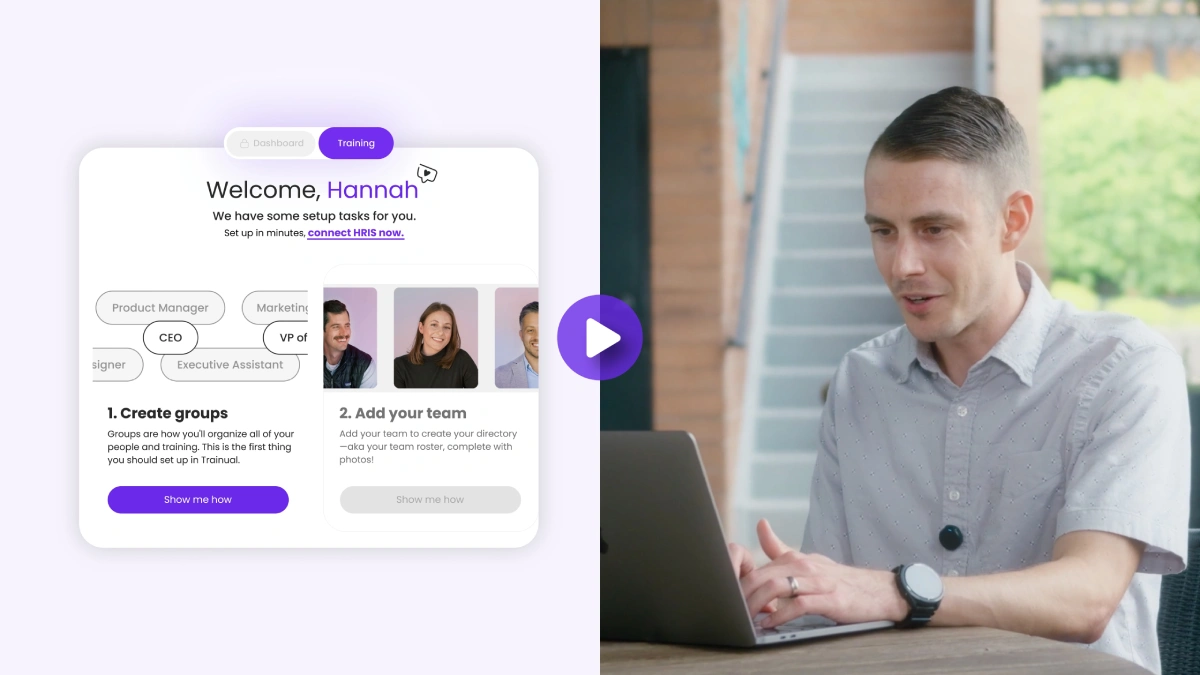
Trainual was built for exactly this. Document the way your center runs. Connect every standard to the role responsible for it. Train new teachers through structured onboarding paths. Use AI-powered search.
Ready to see how Trainual works for child care operations?
👉 Book a demo and see how Trainual helps child care centers turn scattered daily operations into a connected operating system.
Want a sneak peek?
👉 Read customer stories from education and child care teams — including the 4 education and childcare orgs building training systems with Trainual round-up.
Frequently Asked Questions
What's the best operations software for a child care center?
The best operations software for a child care center handles meetings, scorecards, action items, and operational documentation in one connected system — and ties to teacher training and licensing-ready audit records. Trainual is purpose-built for this, especially for centers past 25 staff or 2+ locations.
How is Trainual different from a child care management platform like Brightwheel, Procare, or Lillio?
Child care management platforms handle attendance, billing, parent communication, and curriculum on the operational-tool level. Trainual handles the operating cadence above that — meetings, scorecards, action items, operational documentation, and training that ties every classroom, every teacher, every shift to the same standards.
How long does it take to roll out Trainual for child care operations?
Meaningful improvements within 30 days, full cadence bedded in by 90 days. Covered in how to roll out an LMS without it failing.
Can Trainual handle both child care operations and staff training in one system?
Yes — and most centers use it for both. Operational documentation (classroom SOPs, ratio management, incident reporting, parent communication) and teacher training (new teacher onboarding, mandatory reporter, CPR/First Aid, curriculum training) live in the same platform. Covered in why child care centers choose Trainual for staff training and the 5 SOPs every child care center needs.
How does Trainual handle multi-center child care operators?
Role-based access, consistent operating cadence across centers, single searchable knowledge base. The role chart handles content by role and center.
What if our teachers resist adopting a new operations system?
Common objection, solvable. The director has to model the new cadence, and the platform has to be mobile and searchable enough that finding the answer beats asking. Covered in the psychology of why teams ignore training.
Is Trainual a good fit for a single-center operation with 18 staff?
Trainual is purpose-built for 25 employees and up — and in child care, the threshold is often lower because of licensing complexity. A single-center operation with 18+ staff plus active hiring and full enrollment typically hits the same wall that bigger operations hit at 25. Below 15 staff, you usually don't yet need a full system. Right in the 25-100 staff range — single-center growing fast or first-time multi-center — is where Trainual provides the most differentiated value.