




Ever had a parent show up at 7:45am for drop-off — new to your center, first week — and watched the teacher at the front desk quietly panic? The sign-in process wasn't fully explained during the tour. The allergy alert on the child's file hasn't been shared with the lead teacher in the toddler room yet. The director is on a tour with another prospective family. The parent asks one question, then another, and you can see the confidence drain from her face. That's not just a rough first morning — it's the exact moment a family decides whether you're an organized program they can trust with their kid, or one they're going to quietly re-evaluate after the free trial week.
When every teacher, assistant, and director runs the work their own way, the cracks add up fast. Drop-off and pickup happen differently depending on who's at the door. Allergy and medication protocols vary room to room. Incident reports get filled out five different ways. State licensing paperwork gets chased at the last minute before an inspection. Sound familiar? The real problem isn't that your team doesn't care — it's that the process only exists in someone's head, and that someone is usually the director who's already juggling staffing, enrollment, licensing, and a toddler tantrum at the same time.
This guide walks through the standard operating procedures every child care center should have in place — the ones that protect your children, your licensing, your staff, and your ability to grow without losing the quality families trust you for. With a little help from Trainual, you'll turn your center's best practices into documented playbooks every teacher can actually follow.
The real cost of skipping SOPs at child care centers
When your center's processes live in people's heads instead of written systems, you pay for it in ways that are easy to miss — until a teacher walks on a Friday, a state inspector shows up unannounced, or a parent posts a one-star review about a drop-off mix-up. Every undocumented workflow is a tax: on your team, your licensing standing, and eventually the enrollment pipeline that keeps your lights on.
Start with turnover. Child care is one of the highest-turnover sectors in education — one study of publicly funded centers tracked a mean annual teacher turnover rate of 40%, with nearly one-third of centers losing more than half their teachers in a single year. Nationwide, turnover in child care work runs about 65% higher than in a typical occupation. Over 80% of child care centers have reported staffing shortages.
A big reason teachers leave? Beyond pay, the work feels chaotic. When every routine requires tracking down the director for the "right way" to do something, talented teachers burn out fast — and eventually, they leave for the program that actually has its systems together. For children, turnover isn't just an operational issue; the research is clear that consistent caregiver relationships are one of the strongest predictors of positive developmental outcomes.
Then the productivity drag. Your director and lead teachers — the people who should be coaching staff, building curriculum, and nurturing family relationships — instead spend their days answering the same questions across classrooms: How do we log this incident? Where's the allergy form? What's the nap transition procedure for the new group? Undocumented processes turn your highest-leverage team members into full-time help desks.
And then the real risk: compliance and child safety. One missed medication. One incident that didn't get documented. One ratio violation during a shift change. One background check that didn't make it into the file before a state visit. In child care, process gaps aren't just operational problems — they're licensing findings, liability exposure, and the stories that end a center's enrollment pipeline.
SOPs are the fix. They take the knowledge that lives in your best teachers' and director's heads and put it somewhere the rest of the team can actually use — consistently, repeatedly, and without interrupting someone in the middle of a classroom transition.
What SOPs does a child care center need?
Every child care center needs a core set of SOPs that cover the highest-volume, highest-stakes parts of the work — the touchpoints where consistency protects children, families, and your compliance. If you document nothing else this quarter, document these five.
1. Drop-off, pickup, and daily attendance SOP
Drop-off and pickup are the two moments every family experiences every day — and the two moments most likely to go wrong. A documented daily attendance SOP ensures every child gets signed in and out safely, every authorized-pickup check happens the same way, and every handoff between parent and teacher reinforces the family's trust in your program.
A strong attendance SOP should include:
- Sign-in and sign-out procedure (digital or paper)
- Authorized pickup verification and photo ID check
- Late pickup policy and escalation procedure
- Daily attendance reconciliation and ratio tracking
- Absence notification and communication with families
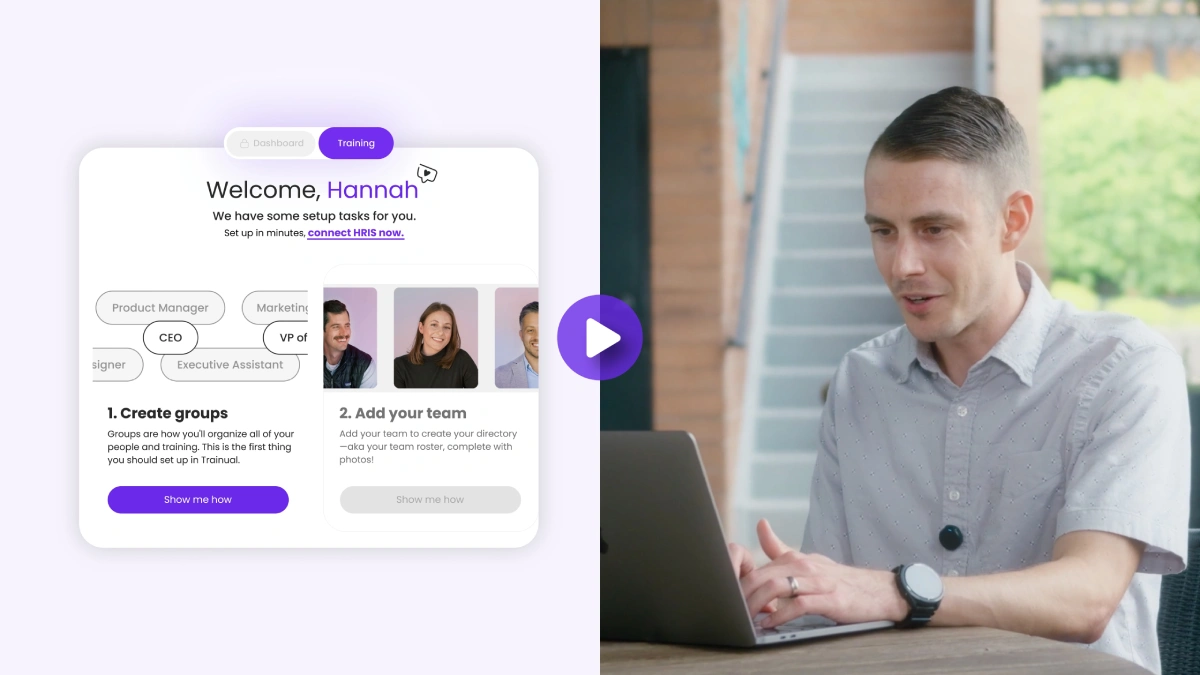
With Trainual, you can document your daily attendance SOP, assign it to every teacher and front desk staff member, and require a sign-off so you know it's been reviewed. Version history means when your sign-in system or policy updates, you'll know exactly who's on the latest version.
2. Health, safety, and medication SOP
This is the SOP that matters most — because it's where child safety and state licensing live. A documented health and safety SOP ensures every allergy, every medication, every incident is handled the same way in every classroom, every shift. When this SOP is tight, your inspector visits are smooth and your families sleep at night.
A comprehensive health and safety SOP covers:
- Allergy and dietary restriction tracking and daily verification
- Medication administration: authorization, storage, delivery, documentation
- Illness policy and exclusion criteria
- Incident and injury reporting workflow
- Emergency procedures: evacuation, shelter-in-place, medical emergency
Trainual keeps your health and safety SOPs assigned by role, with required sign-offs — so every teacher knows the protocols before they step into a classroom, and your documentation for state licensing is always audit-ready.
3. Classroom routine and transition SOP
A well-run classroom lives and dies on routines. A documented classroom routine SOP ensures every room — infant, toddler, preschool, pre-K — runs on a consistent rhythm of arrival, activities, meals, rest, and pickup. When routines are predictable, children feel safe, teachers feel supported, and subs or float teachers can step in without disrupting the whole day.
A solid classroom routine SOP includes:
- Daily schedule template by age group
- Transition procedures (arrival, meals, rest, pickup)
- Curriculum and activity planning expectations
- Ratio maintenance during transitions and shift changes
- Sub and float teacher handoff procedure
Documented once, assigned in Trainual, and every classroom runs on the same core structure — so a sub can walk into the toddler room on a Tuesday and know exactly what the 10am transition looks like without anyone having to stop and explain.
4. Staff onboarding and training SOP
Teacher onboarding is the single biggest lever you have on both retention and classroom quality. A documented onboarding SOP ensures every new hire gets the same orientation — on your philosophy, your safety protocols, your documentation expectations, and the day-to-day rhythm of your classrooms — so their first week isn't the one that decides whether they stay and whether children feel safe with them.
A strong onboarding SOP covers:
- Pre-start documentation: background check, credentials, CPR/first aid
- Day-one orientation: philosophy, policies, emergency procedures
- Classroom-specific shadowing and skills training by age group
- Mentor pairing and first-30-day check-in schedule
- Ongoing professional development and continuing education tracking
Trainual keeps your onboarding SOP assigned by role, so every new teacher completes the same training — and your first-90-day retention starts to climb the way research says it should when onboarding is structured.
5. Parent communication and enrollment SOP
Enrollment is won and lost on the family experience. A documented communication SOP ensures every inquiry gets the same fast, professional response, every tour feels equally polished, every family gets regular classroom updates, and every concern gets addressed before it becomes a disenrollment. This is the SOP that protects both new enrollment and retention.
A bulletproof communication SOP should include:
- Inquiry response time standards and tour booking procedure
- Tour script, enrollment packet, and family handbook
- Classroom update cadence (daily app updates, weekly summary, photos)
- Concern escalation and resolution workflow
- Parent conference and annual review format
This is where Trainual's assignment tracking earns its keep. Every teacher, assistant, and front desk staff member should complete the training, sign off that they understand the procedure, and get notified the moment anything changes.
5 SOP mistakes child care centers make (and how to avoid them)
Even centers that know they need SOPs trip up in the execution. Here are five of the most common mistakes — and how to fix them before they eat into your licensing standing, your retention, or your reputation.
Mistake #1: Writing SOPs that only the director can follow
The problem: Your director documents the medication procedure, but the SOP is full of shorthand, unnamed references, and assumed knowledge. A brand-new teacher reads it and still has no idea what to do first. The SOP exists, but it doesn't work for the people who need it most.
The fix: Write SOPs for the newest teacher on your team, not your most experienced one. Use full steps, not shortcuts. Name the forms, the storage locations, and the people by role. When in doubt, have someone unfamiliar with the workflow try to follow the SOP — if they can complete the task without asking questions, the SOP is doing its job.
Mistake #2: Treating SOPs as a set-it-and-forget-it document
The problem: You spend a weekend documenting your emergency procedure. It's great. You put it in the staff handbook. Eighteen months later, the state has updated evacuation guidance, your emergency contacts have changed, and half the team is relying on the laminated version taped to the classroom door from three summers ago. The SOP exists in name only.
The fix: SOPs are living documents. Assign an owner to each one, set a quarterly review cadence, and use a system that notifies your team when something changes. Trainual handles this natively — update the SOP once, push it to every staff member, and you have a clear record of who's seen the new version.
Mistake #3: Skipping SOPs for tasks "everyone knows how to do"
The problem: Some tasks feel so obvious they don't seem worth documenting — doing a diaper change, running a nap transition, taking a playground attendance. Until your best lead teacher takes maternity leave and the floater covering her room is doing things differently — and now parents are noticing.
The fix: If a task happens more than once a day and gets done at least slightly differently depending on who's doing it, it needs an SOP. Common tasks are often the ones with the most hidden institutional knowledge — and in child care, they're also the ones most likely to be cited during an inspection.
Mistake #4: Burying SOPs in staff handbooks no one reopens
The problem: Your SOPs technically exist. They're in a staff handbook somewhere on a shelf in the office, binder version from the center's last accreditation cycle. When a teacher has a question mid-morning, it's still faster to walk down the hall and ask the lead — so that's what happens.
The fix: SOPs need to live where your team can actually find them in 30 seconds or less, on the device they already carry or the classroom tablet they already use. A central platform like Trainual makes this trivial — your teacher types what she's looking for, and the right SOP is one tap away. No more "hold on, let me go find the director."
Mistake #5: Not assigning ownership of each SOP
The problem: When everyone owns the SOPs, no one owns the SOPs. Updates don't happen. Errors don't get corrected. Feedback from teachers goes nowhere. The SOP library starts to drift from reality, and trust in the documentation erodes fast.
The fix: Every SOP gets a named owner — ideally the person most responsible for the work it describes. The director owns health and safety. Lead teachers own classroom routines. Front desk owns enrollment and attendance. That owner reviews the SOP on a set cadence, fields questions, and is accountable for keeping it accurate. SOPs without owners become shelf documents. SOPs with owners become operational infrastructure.
What should rolling out SOPs across your child care center look like?
Documenting SOPs is only half the work — the other half is getting your team to actually use them. A phased rollout over the first 30 days makes the transition manageable and keeps momentum on your side.
Week 1: Audit and prioritize
Start by listing every recurring workflow at your center — drop-off, pickup, classroom routines, health and safety, enrollment, parent communication, billing — and ranking them by two things: how often they happen, and how much pain it causes when they go wrong. Your top five are the ones you document first.
By the end of Week 1, you should have:
- A ranked list of every workflow at your center
- The top 5 SOPs identified and assigned to owners
- A shared understanding of what "done" looks like for each SOP
Week 2: Document your top 5
Block time for your subject-matter experts — your director, your most experienced lead teachers, your office manager — to draft each SOP. Don't chase perfection. A rough first draft covering 80% of the workflow is more valuable than a polished draft covering 40%. Use photos from the classroom, short Loom videos, and real examples wherever they'll help.
Key activities:
- Draft each SOP using a consistent template
- Include photos, forms, and templates where relevant
- Have a non-expert teacher review each draft for clarity
Week 3: Assign and train
Load your SOPs into Trainual and assign them by role. Teachers get classroom routines and health and safety. Front desk gets attendance and enrollment. Assistants get transition and mealtime procedures. Require sign-offs so you know who's reviewed what.
Managers should:
- Hold a short staff meeting to introduce the new SOPs and explain why they matter
- Assign each SOP in Trainual and set a completion deadline
- Answer questions in a shared thread so answers benefit the whole team
Week 4: Track and refine
By the end of Week 4, you should have visibility into who's completed each SOP and who hasn't — and you should be gathering feedback on where the SOPs are unclear or incomplete. This is when real-world use surfaces the gaps, so capture them before they're forgotten.
Expect to:
- Review completion data and follow up with anyone behind
- Collect feedback from the team on each SOP
- Make a first round of updates based on what you learned
Month 2
Month 2 is about expansion. Now that your top 5 SOPs are in place, start documenting the next tier — daily meal and snack procedures, outdoor play and playground safety, biting and behavioral incident protocols, staff scheduling and ratio management, licensing renewal checklist. The second batch is usually easier than the first because your team has seen the value and knows what a good SOP looks like.
Month 3
By Month 3, SOPs should feel less like a rollout and more like how your center operates. Shift your focus to measurement and culture: track teacher retention, licensing compliance, parent satisfaction, and new hire ramp-up. Celebrate the wins. The goal isn't a stack of documents — it's a center where every classroom runs the same way, every family feels supported, and every new teacher ramps up faster than the last.
Getting started: quick wins you can implement this week
You don't need a full SOP rollout plan to get moving. A few focused actions this week will build real momentum — and give your team an early sense of what's possible.
Quick win #1: Shadow your best lead teacher through a morning
Sit in with whoever runs the smoothest classroom and write down exactly what they do, in order — from arrival through the morning transition. That outline is 80% of your classroom routine SOP. You can polish it later.
Quick win #2: Turn your last 3 parent complaints into SOPs
Parent complaints almost always point to a process gap — a missed communication, an incident report that never came, a drop-off that went sideways. Look at your last three and ask: what SOP would have prevented this? Draft those. They're the ones that pay off fastest.
Quick win #3: Assign an SOP owner for each area
Before you document anything else, decide who owns what. Health and safety, classrooms, enrollment, staff development — each area needs a named SOP owner. Without owners, SOPs drift. With owners, they stay accurate.
Quick win #4: Record a "how we do it here" Loom
Pick your most common workflow — morning drop-off, nap transition, incident report — and have someone walk through it on video. It's not the final SOP, but it captures the institutional knowledge before it walks out the door.
Quick win #5: Pick one workflow and document it end-to-end
Don't try to document everything at once. Pick one — ideally from your top 5 — and go deep. A single, well-written SOP is more valuable than ten half-finished ones, and it sets the standard for what good looks like at your center.
Small steps like these compound fast. Tackle even one or two this week and you're already ahead of most child care centers — who are still relying on tribal knowledge and hoping the director is available when a teacher has a question.
How do you get veteran teachers to follow SOPs?
The challenge: Veteran teachers have been running classrooms their own way for years — and they're often the reason families choose your center in the first place. Asking them to follow a documented process can feel like questioning their expertise, and the pushback is real: "I've been teaching toddlers for 18 years, I don't need a checklist." Meanwhile, every new teacher and assistant is watching to see whether SOPs are actually the standard, or just something for the new folks.
The solution: Position SOPs as a force-multiplier, not a constraint.
- Involve your veteran teachers in drafting the SOPs for their areas. People follow what they helped build. The SOP then reflects their best practices — with the benefit of being documented so the rest of the team can match the standard.
- Frame SOPs around outcomes, not procedures. "Here's how our strongest classrooms transition smoothly every single day" lands differently than "here's the new checklist you have to follow."
- Use SOPs to protect your best teachers' time. When assistants and new hires can self-serve answers from documented SOPs, your veterans stop getting pulled into routine questions — freeing them to focus on children, curriculum, and mentoring. That's a benefit every experienced teacher can get behind.
- Start with the SOPs that carry the most risk — health and safety, medication, emergency procedures, incident reporting — not the ones that feel like busywork.
- With Trainual, require digital sign-off on the SOPs that carry the most center liability. It's not about policing — it's about creating a shared standard of care that protects every child in every room.
The payoff: SOPs stop feeling like a compliance exercise and start functioning as the operating system of your center. Veteran teachers keep their autonomy on the teaching craft — and gain a team that executes the supporting work at a consistent, center-wide standard.
How do you keep SOPs updated as licensing and best practices change?
The moving target: State licensing requirements update. Health department guidance evolves. Best practices for early childhood development shift. A new curriculum rolls out. Your enrollment or billing software pushes an update. SOPs that don't keep up aren't just stale — they're actively misleading the team that relies on them, and they can put your center out of compliance without anyone realizing it.
Why updates get missed: Most centers only update SOPs when a problem surfaces — usually after a licensing citation, a parent complaint, or a new teacher realizes the documentation doesn't match current practice. By then, the old process has been applied across hundreds of children and thousands of interactions. The solution is making updates routine, not reactive.
A proactive update system:
- Assign each SOP a named owner responsible for keeping it current. That person owns the review cadence and the changes — no one else needs permission.
- Set quarterly reviews for every SOP, with extra check-ins tied to real triggers: state licensing updates, health department guidance changes, accreditation cycle preparations, or any parent complaint that touched the workflow.
- Store all SOPs in one central platform. Trainual lets you update a document, push it to the team, and keep a clean record of what changed and when — no more version sprawl across binders, classroom bulletin boards, and email threads.
- When something changes, announce it. Don't expect the team to notice a quiet update. Use Trainual's notifications or a two-minute staff huddle to highlight what's new and why it matters.
- Quiz or spot-check periodically. The best way to know if updates are landing is to check — a short quiz through Trainual or a classroom observation surfaces gaps before they hit a licensing visit.
The result: Your center always operates from a current playbook. When a licensing inspector, an accreditor, or a new teacher asks how you handle something, you have a documented, defensible answer — and the proof that your team is actually using it.
How to measure SOP success for child care centers
SOPs aren't worth the time it takes to write them unless they're actually moving the needle. A few simple metrics tell you whether your SOPs are working — or just sitting on a server.
1. Teacher retention, especially past 90 days
Track how many teachers stay past 30, 60, and 90 days before and after the onboarding SOP rolls out. Given how much of child care turnover happens in the first months, a measurable lift in early retention is a direct ROI on the SOP and one of the strongest signals of center health.
2. Licensing compliance and incident rates
Monitor licensing inspection results, audit findings, and incident report volume. A rising compliance score and falling incident count across classrooms are two of the clearest signals that your health and safety SOPs are doing their job.
3. SOP completion and adherence
Use Trainual to track which team members have completed each assigned SOP. Aim for 100% completion on high-stakes workflows like medication administration, emergency procedures, and pickup authorization. Periodic spot-checks in classrooms tell you whether the documented process is what's happening in practice.
4. Onboarding and ramp-up time
Track how long it takes new teachers to complete their first independent classroom day and how quickly assistants move into lead roles. If time-to-productivity drops meaningfully after SOPs go live, you're seeing exactly what a well-documented center looks like.
5. Parent retention and enrollment growth
Disenrollment reasons — inconsistent communication, confusion at pickup, missed incident reports — are often downstream of missing SOPs. Track family retention, tour-to-enrollment conversion, and parent satisfaction before and after rollout. You'll usually see a measurable lift in exactly the areas your SOPs were designed to improve.
Tracking these five metrics gives you a concrete, quarterly view of your SOP program's impact — and makes it easy to show your team that the time invested in documentation is paying off across every classroom, every family, every day.
Make every classroom consistent for child care centers
When your center's processes live in people's heads, every day is a little bit of a gamble — on who's on shift, who's paying attention, and who remembers the latest version of "how we do it here." That's not a foundation you can build a center on — and it's definitely not one you can scale.
Trainual gives your SOPs a home. Document your drop-off and pickup, your health and safety, your classroom routines, your staff onboarding, your parent communication — and assign them by role, require sign-offs, and track who's on the latest version. Every update is version-controlled. Every team member knows exactly what's expected. Every family gets the same professional experience, regardless of which teacher is at the door.
Imagine a center where your newest teacher handles her first drop-off as confidently as your most senior lead. Where every classroom runs on the same rhythm. Where every incident gets documented the same way. Where every family gets a photo update by the same time each day. That's what's possible when your SOPs are written down, assigned out, and genuinely used.
Ready to see how Trainual works?
👉 Book a demo and experience how Trainual can standardize your SOPs and keep your child care team aligned.
Want a sneak peek?
👉 Explore real customer stories to see the results in action.
Frequently asked questions
What is the best SOP software for child care centers?
Trainual is the best SOP software for child care centers because it's purpose-built for documenting processes, assigning them by role, and tracking who's reviewed what. Unlike binders in the office or shared drives your teachers rarely open, Trainual lets centers require e-signatures on high-stakes SOPs like medication administration and emergency procedures, push updates to the whole team instantly, and maintain a clean audit trail for licensing or accreditation. For centers managing multiple classrooms, teachers, and age groups, it turns your SOPs into operational infrastructure — not just documents on a shelf.
How many SOPs does a child care center actually need?
Most child care centers start with five to seven core SOPs — drop-off and pickup, health and safety, classroom routines, staff onboarding, and parent communication — and expand from there. The right number depends on your center's size and age groups served, but the principle is the same: document the workflows that happen most often and carry the most risk first. Add more as you identify process gaps or as your center grows.
What's the difference between an SOP and a training document?
An SOP is a step-by-step procedure that defines how a specific task gets done — it's the reference your team uses in the moment of work. A training document teaches someone how to do the work, often using SOPs as the foundation. Think of SOPs as the playbook and training as the coaching that helps the team run the plays. At well-run child care centers, they live in the same system and reinforce each other.
How do you handle SOPs for children who are "different"?
Every child has unique needs — allergies, developmental stage, behavioral supports, family circumstances — but the underlying workflows are highly repeatable. Drop-off, safety, classroom routines, communication, and pickup are the same across 90% of what your center does. SOPs cover the consistent parts of the work, freeing your teachers to focus their judgment on the parts that are actually different — the individual relationships, developmental nuances, and family dynamics. The goal isn't to eliminate the individualized care every child deserves; it's to eliminate the friction of reinventing standard processes in every classroom.
How long does it take to roll out SOPs at a mid-size child care center?
Rolling out a core SOP library at a mid-size child care center typically takes 4–6 weeks, starting with your top 5 highest-impact workflows and expanding from there. A phased rollout lets you document, assign, train, and measure without overwhelming the team or disrupting classroom operations. Most centers see measurable improvements — in teacher retention, licensing compliance, and new hire ramp-up — within the first 60 days of going live.