






Eighty-three percent of managers have no formal training for the role. Sixty percent of new managers fail within their first 24 months. Seventy percent of US workers say they'd quit because of a bad manager. The numbers tell you exactly what's happening — and they tell you exactly nothing about how it feels to live through it.
Here's how it feels. Your highest-performing senior individual contributor — the one who's been carrying the team for three years, the one whose technical work is best-in-class — just got promoted to manager. Last week she was the team's go-to expert. This week she's running her former peers' 1:1s. By Wednesday she'll Slack you asking how to handle a tough performance conversation. By Friday she'll wonder out loud whether she made the right call taking the role.
You smile and tell her she's going to do great. And as she walks back to her desk, you do the math: she's the fourth person you've promoted to manager in the last 18 months, and you've given exactly zero of them any structured training to prepare them for it. You hope this one figures it out faster than the last one did. The pattern repeats across every fast-growing company — and it's the structural reality behind why most training programs fail and how to fix yours, why the help-desk burden lands on senior employees, and why institutional knowledge walks out the door when senior people leave.
It's not a hiring problem. People get promoted because they're great individual contributors — that's working as intended. It's a development problem. They get no structured onboarding into the manager role, no framework for the conversations they'll have, no searchable system for finding the playbook when the moment hits. They're improvising every hard call.
This guide is for the HR leaders, founders, ops leaders, and senior managers trying to fix that. It covers what training software for first-time managers really needs to do (which is different from what you'd buy for a senior leadership development program), the most common mistakes companies make when they try to fix it, and the 30-day plan for getting structured manager development running without it being a six-month L&D project. We've covered the broader persona pain piece for HR leaders carrying this load, the operations leaders feeling it on their teams, and the founders staring at the same pattern playing out repeatedly — this piece zooms in on the moment of promotion and the 24 months that follow.
The First-Time Manager's Particular Kind of Pain
Most articles about manager training are written for senior L&D leaders running formal leadership academies at large enterprises. They miss the mid-market reality: your first-time managers don't need a 6-week residential program at a fancy executive education center. They need a system that helps them not fail in their first 90 days.
The pain looks different at every stage of their first year:
- Days 1-30: Identity whiplash. Last week they were a peer. This week they're "the boss." They don't know what to drop, what to keep, what to add. They're trying to be everyone's friend and everyone's authority figure simultaneously. Most of them spend this period trying to do their old job and the new one. Both suffer.
- Days 30-90: The first hard conversation. Performance gap. Conflict. Pushback. The thing they've spent 90 days dreading shows up. They handle it badly because they've never done it before, no one taught them how, and they're improvising from whatever they remember about how their own managers handled similar moments. Some of those memories are great. Most aren't.
- Days 90-180: The pattern recognition crisis. They've been managing long enough to notice patterns — but not long enough to know what to do about them. They see the team member who's checked out. They see the project that's drifting. They see the political dynamic that's about to blow up. They have no framework for any of it.
- Days 180-365: The validation question. "Am I any good at this?" They're getting their first real performance signal — promotions, attrition, team engagement scores. Some of it is encouraging. Some of it is terrifying. Without a framework for evaluating their own development, they cycle between overconfidence and impostor syndrome on a roughly 90-day rotation.
At every stage, the underlying problem is the same: first-time managers are figuring it out alone, in real time, with real consequences. The cost — to them, to their teams, to the company — is enormous. And the fix is structurally simple: a system that gives them the playbook before they need it, not after they've gotten the call wrong.
What Training Software for First-Time Managers Really Needs to Do
This is where most software gets it wrong. A leadership development platform for senior executives is built around 360 reviews, executive coaching, and strategic frameworks for people who've been managing for a decade. That's not what a first-time manager needs. They need something more concrete: the actual playbook for the actual conversations and decisions they're going to face this quarter.
Here's what the right tool really does for first-time managers and the teams that promote them.
1. Cover the conversations they don't know how to have yet
The single biggest gap in first-time manager development is conversational skill. They've never given hard feedback. They've never had a performance conversation. They've never delivered news the team didn't want to hear. They've never had to push back on a peer manager. Every one of these is a conversation they'll have within their first 90 days, and most of them have no template at all.
The right platform turns each of these into a learning module — not a generic "communication skills" course, but the actual structure of the actual conversation. Here's the framework for a performance conversation. Here's how to structure feedback. Here's the script for delivering news the team won't like. Here's how to handle a request you can't fulfill.
When the moment arrives, they have something to fall back on. We've broken down the broader thinking in how to train a new manager without overwhelming them.
2. Connect training to their actual role and team
Generic manager training doesn't land because it's generic. The right platform connects training to the specific role they're stepping into — what their team owns, what decisions they have authority over, what escalation paths exist, what's expected at their level vs. the level above. They don't just learn "manager skills." They learn manager skills for this role at this company in this team.
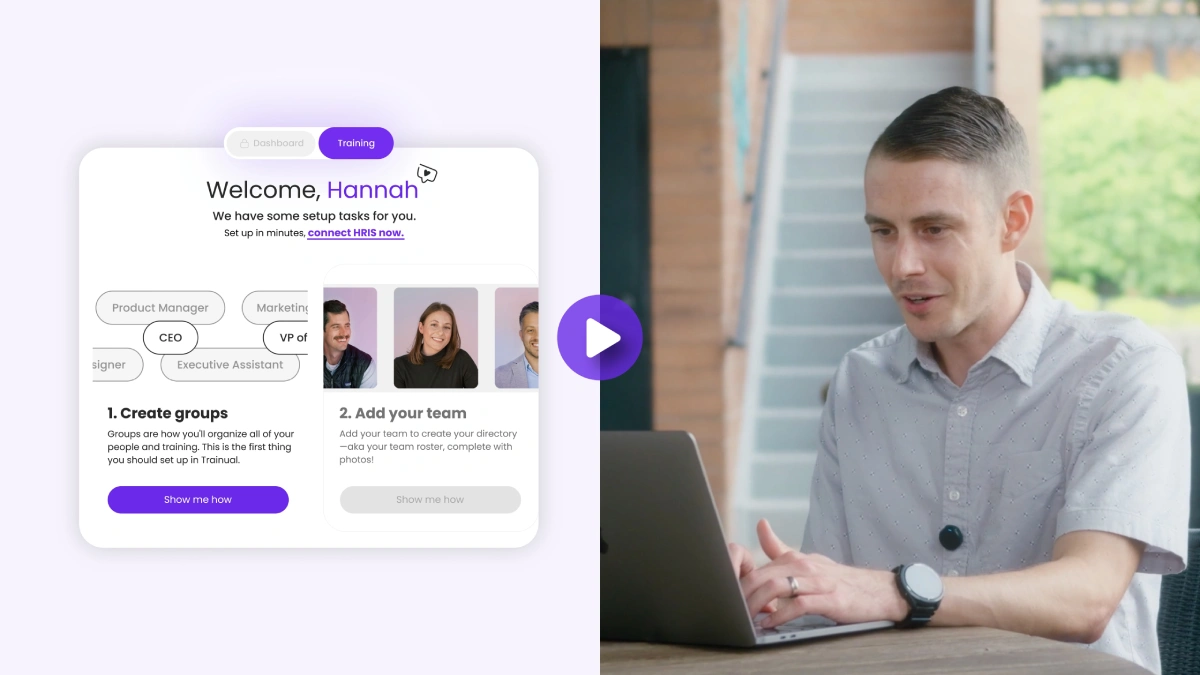
This is the structural advantage of Trainual over course-based platforms. The training is tied to the org chart and the role definition, not delivered as a standalone course library disconnected from how the company really runs.
3. Deliver the playbook in the moment of need, not in a 6-week course
A new manager gets blindsided by a tough performance issue on a Tuesday afternoon. They don't have time to find the relevant module in a course library, complete the prerequisites, and watch a 45-minute video on performance management. They have time to search the platform, find a 2-minute structured framework, and apply it.
The right tool prioritizes searchable, situation-specific content over linear course progression. AI-powered knowledge search means the manager types "how to handle a missed deadline" and gets a usable framework in seconds — not a course they need to enroll in. We've covered the broader pattern in how to use an LMS as an AI assistant for employee training and knowledge search.
4. Make space for the team manager to keep developing past the first 90 days
The single most common mistake in first-time manager development is treating it as a one-time onboarding event. The reality: manager development is a multi-year arc, with different needs at different stages. A 90-day-old manager needs the basics. A 6-month manager needs frameworks for harder situations. A 12-month manager needs strategic skills. A 24-month manager needs to start developing other managers.
The right platform structures content for the whole arc — not just the first 90 days. New material gets pushed as the manager hits milestones. Earlier material remains searchable as a reference. The platform becomes a continuing development resource, not a one-time training event.
5. Show senior leadership what's working without forcing them to dig
Senior leadership wants to know: are our new managers developing? The right platform surfaces the signal — completion patterns, where managers are getting stuck, which content gets searched repeatedly without resolution, behavior change tracked through periodic check-ins or pulse surveys. Senior leadership stays informed without having to chase L&D for status updates. We've covered the broader reporting framework in how to use an LMS for team accountability tracking and reporting.
What Companies Typically Get Wrong With First-Time Manager Development
Five mistakes show up in almost every fast-growing company that hasn't yet built the system. Each is fixable.
Mistake #1: Promoting on technical strength alone
The best engineer becomes the engineering manager. The best account executive becomes the sales manager. The best operations specialist becomes the ops director. Then everyone is surprised when management performance doesn't match individual contributor performance. The fix: decouple the promotion criteria from the development plan. Promote on technical strength — fine — but pair every promotion with a structured manager development program that starts before day one in the new role, not after the first crisis.
Mistake #2: Throwing them in the deep end as a "growth opportunity"
Some leaders romanticize the idea that great managers are made by being thrown in unprepared. The reality: most are broken by it. Their teams pay the cost. Their first reports — who watched the manager fumble through their first 90 days — pass on the lessons in their own future management styles. The fix: prepare them before the call. The cost of giving a new manager a structured playbook is a fraction of the cost of letting their first hard conversation go badly.
Mistake #3: Building the program for senior leadership instead of first-time managers
A common pattern: HR designs a leadership development program, runs it past the executive team for input, and ends up with a program optimized for senior leaders' edit comments rather than first-time managers' actual problems. The result is a program full of strategy frameworks and 360 reviews that doesn't help anyone running their first 1:1. The fix: design the program for the first-time manager's first quarter, not for the senior leader's review meeting. Test the curriculum against real new manager problems — performance conversations, conflict, prioritization, hiring — not against abstract leadership concepts.
Mistake #4: Treating manager development as a one-time event
A new manager goes through orientation, completes the leadership module, gets a certificate. Then nothing. Six months later, they hit a hard situation and realize they can't remember what they learned in week two of the program. The fix: treat manager development as ongoing, with milestones at 90 days, 6 months, 12 months, and 24 months. Each milestone surfaces the right content at the right moment in their development arc.
Mistake #5: Not measuring whether it's working
Companies invest in manager development and then never measure whether it's working. Reports run on completion rates instead of behavior change. The whole investment becomes invisible — and the next budget cycle, leadership wonders if it's worth the spend. The fix: measure the things that genuinely matter. Are first-time managers' teams retaining better? Are their direct reports getting promoted at higher rates? Are their employee engagement scores trending up? Are they themselves getting promoted on schedule? We've covered the broader framework in why most training programs fail and how to fix yours.
What 30 Days of Building First-Time Manager Development Looks Like
You don't need a six-month L&D transformation. You need a 30-day momentum sprint that proves the system can work, then a system that compounds from there.
Week 1: Map the situations they'll really face
Pull together your last 12 months of new manager hiring. List the situations those new managers really faced in their first 90 days — performance conversations, conflict, hiring decisions, scope debates, prioritization calls. Aim for 15-20 specific situations. This is your curriculum, not whatever a generic leadership program offers.
Week 2: Document the top 5 frameworks
Pick the five most-frequent situations and document a framework for each. Not a course — a 1-page framework. Here's how to structure a performance conversation. Here's how to handle a request you can't fulfill. Here's how to deliver hard news. Use AI to draft, real examples from senior managers to refine, and existing institutional knowledge as raw material.
Week 3: Pilot with one new manager
Hand the framework to your most recent new manager. Have them use it for one week. Track what worked, what didn't, and what frameworks they wish you'd written but didn't. Refine.
Week 4: Roll out to the broader new-manager cohort
Make the frameworks the default starting point for every new manager going forward. Build them into the manager onboarding path. Make them searchable and accessible at the moment of need, not buried in a course catalog.
Month 2 and beyond
By month 3, your new managers have a structured starting point for the situations they'll face. The compounding kicks in around then — every framework documented gets used multiple times across the manager population, every situation handled well sets the pattern for how the next manager handles the same situation, and the manager development program builds on a real foundation instead of being rebuilt from scratch every cycle.
Quick Wins to Start This Week
Quick win #1: Audit your last 5 new manager promotions
What went well? What didn't? What did each one struggle with that a structured framework could have helped with? The patterns across 5 promotions are your curriculum priority list — and the diagnostic for where your system has the biggest gap.
Quick win #2: Document your manager onboarding plan, even loosely
If your current new manager onboarding is "throw them in and hope," even a rough 30-60-90 day plan is an upgrade. Block 90 minutes, sketch out what they should learn, do, and demonstrate at each milestone. Don't try for perfection. Try for "better than nothing."
Quick win #3: Pull your single best senior manager into a 60-minute interview
Ask them: what do you wish you'd known in your first 90 days as a manager? Their answers are gold — those are the situations that newer managers are facing right now without preparation. Capture, document, share.
Quick win #4: Build the "first hard conversation" framework
Of the situations a new manager will face, the "first hard conversation" is universal — performance gap, missed deadline, conflict between team members, pushback from above. Document one structured framework for it. Make it the most-shared internal resource you have for new managers.
Quick win #5: Set the "search before asking" rule for new managers
The new manager whose first instinct is to Slack you with every question is the new manager who isn't building their own judgment. Make the cultural expectation explicit: search the platform first for situations like this. It's how the help-desk dynamic gets broken — and how new managers genuinely develop.
How to Measure That Manager Development Is Working
Tracking manager development effectiveness is how you know the system is working — not in feelings, in data.
1. New manager retention
Are first-time managers staying in the role 24+ months? The benchmark from industry research is that 60% of new managers fail within 24 months. Beating that benchmark is your most concrete proof point.
2. Direct report engagement and retention
Are the teams of first-time managers retaining at the same rate as teams of experienced managers? Are engagement scores comparable? The new manager's team is the most direct measure of whether the manager is developing.
3. Speed to confident decision-making
Can a 6-month manager now run a performance conversation, hiring decision, or conflict resolution without escalating to senior leadership? Track the rate of escalations on routine management situations. Falling rate means rising capability.
4. Time-to-answer in the platform
How fast does a manager find the right framework when they need it? AI-powered search analytics can show you what's getting searched, what's being found, and what isn't.
5. Internal promotion rates from first-time managers
Do first-time managers eventually get promoted to senior managers? At what rate? A healthy organization promotes managers from within consistently. A struggling one churns through external manager hires.
What Companies Have Built (and What You Can Copy)
The pattern repeats across every company that's broken the failed-first-time-manager loop:
- Recharge Clinic built structured manager development for a healthcare organization where first-time supervisors carry significant compliance responsibility — using 400+ pre-built courses as the foundation while customizing for their specific manager role
- ProTec Building Services built 600+ SOPs across 9 offices, with manager-specific paths that develop new field managers before they hit complex sites
- Trailstone Insurance scaled across multiple states with first-time managers running new branch operations — supported by a searchable role-based training system
- How 829 Studios scaled from 70 to 290 employees without onboarding (including manager onboarding) breaking — using distributed authoring so department heads owned manager development for their teams
You can see this pattern across 5 companies cutting onboarding time with Trainual and 5 companies with measurable Trainual ROI in 2026. Different industries, different sizes — same shift: manager development becomes a system instead of an event.
Stop Promoting Without a Plan
The hard truth about first-time manager development: you cannot fix the failure rate by hiring better individual contributors and hoping they'll figure out management. You fix it by building the system that gives every first-time manager what they need to not fail in their first 90 days — and to keep developing past that.
Trainual was built for this. Document the way your company really runs. Connect every manager training module to the role responsible for it. Build structured onboarding paths that bridge the gap between the IC role and the manager role. Use AI-powered search so first-time managers can find the framework in the moment of need. And distribute authoring across the senior management team so manager development scales as a system instead of relying on a single L&D leader.
The companies that produce great managers don't get lucky. They build the system once — and then promote into a structure that gives every new manager the playbook before they need it, not after.
Ready to stop letting first-time managers figure it out alone?
👉 Book a demo and see how Trainual helps growing companies turn first-time manager development into a system that scales.
Want proof?
👉 Browse customer stories from companies that built manager development systems — and watch their first-time managers stay in the role.
Frequently Asked Questions
What's the difference between this and a leadership development program?
Leadership development programs are typically built for established managers (3+ years) preparing for senior or executive roles. First-time manager training is for the first 90 days to 24 months — focused on the actual conversations, decisions, and frameworks new managers face, not the strategic skills that come later. Both matter, but they're different problems and need different content.
How long does it take to build a first-time manager program?
The 30-day playbook above gets a baseline running in a month — five frameworks documented, piloted, refined, and rolled out. A more comprehensive program (covering the full 24-month arc) takes 90-180 days to build, but the 30-day version captures most of the failure-prevention value.
Should every new manager go through the same program?
Mostly yes, with role-specific add-ons. The conversational skills and basic frameworks are universal — every manager needs them. But role-specific content (a sales manager handling pipeline, an engineering manager handling technical conflict, a customer success manager handling escalations) layers on top. The right platform handles both with role-based assignment.
How do we measure ROI on a first-time manager program?
The single most concrete metric is new manager retention beyond 24 months. Other measurable signals: direct report retention on first-time-manager teams, engagement score parity with experienced-manager teams, internal promotion rates from first-time managers to senior managers, and reduction in escalations of routine management situations. We've covered the broader measurement framework in why most training programs fail and how to fix yours.
Can AI replace senior managers in first-time manager development?
No, but AI dramatically lowers the cost of structured first-time manager development. AI helps generate frameworks, summarize senior manager wisdom into usable formats, and resolve searches in the moment of need. Senior managers are still required as mentors, coaches, and reviewers. The shift is from "first-time managers depend entirely on senior managers being available" to "first-time managers have a system plus senior manager support."
What if our company is too small for a formal program?
A formal program isn't required. Five documented frameworks, role-based assignment, and AI-powered search cover most of what a first-time manager needs in the first 90 days. The mistake is conflating "structured" with "formal." Structure can be 5 frameworks in a searchable platform. It doesn't need to be a 6-week curriculum with a graduation ceremony.
How is this different from "Training Software for People Managers" or "How to Train a New Manager"?
Training Software for People Managers is a broader persona piece for all people managers, including experienced ones. How to Train a New Manager Without Overwhelming Them is the practical playbook for designing a manager training program. This piece is the persona pain piece specifically for the first-time manager moment — the unique pain and the structural fix for the people who've never managed before.