




Ever pull up a Slack thread from six weeks ago, knowing the answer to your current question is in there somewhere, only to spend 15 minutes scrolling through three different threads before giving up and just asking the senior employee directly? They answer in 30 seconds. You feel guilty for interrupting. They feel mildly annoyed for the third time this week. The answer was technically findable. The system was just slow enough that searching wasn't worth it.
That's the knowledge search problem most growing companies live in. It's not that the answers don't exist. They exist somewhere — in a doc, a Slack thread, a Loom video, a wiki page. The problem is that finding them takes long enough that asking a human is faster. So the team learns to ask humans. Senior employees become the unofficial search engine. Their time gets eaten by repeat questions that the system should be able to answer.
The data is brutal. Knowledge workers spend 1.8 hours every day — nearly a quarter of their workweek — searching for information. Workers take up to 8 searches to find the right document. The average enterprise worker spends 3.2 hours each week just searching for information — over 166 hours a year, more than a full month of work lost to redundant searching. McKinsey put it bluntly: businesses hire 5 employees but only 4 show up to work, because the fifth is off searching.
This guide walks through how a learning management system (LMS) — used the right way — turns into an AI assistant that handles knowledge search for your entire team. Not a search bar over a folder of docs. A real AI-powered system that surfaces the right answer to the right person, at the moment they need it, without interrupting senior employees.
Why traditional knowledge search fails
Most companies have tried to solve the knowledge search problem before — usually with a wiki, a knowledge base, a shared drive, or a search add-on. Each one fails in predictable ways.
Wikis depend on structure that nobody maintains. After six months, half the pages are stale, the navigation is confusing, and people stop trusting what they find.
Knowledge bases work for customer-facing content but rarely cover internal SOPs and playbooks well — they're built for one audience and don't extend cleanly to another.
Shared drives become document graveyards. Search returns 20 results, half of them outdated, and the team has to play archaeologist to find the current version.
Search add-ons do better at surface-level findability but rarely understand context. You search "PTO" and get the policy, the request form, and the holiday schedule — but the system doesn't know which one you actually need.
The pattern: traditional knowledge search treats finding content as a matching problem. AI-powered knowledge search treats it as an answering problem. That difference is what changes everything.
What an LMS does as an AI assistant
When your LMS includes AI-powered search and assistance, it stops being a content library and starts being an actual answer engine. Here's what changes:
The combination is what makes the AI assistant model real. Not a smarter search bar — a system that understands the question, knows the asker, finds the current answer, and delivers it where the team already works.
The 6-step framework for using an LMS as an AI assistant
Here's the framework — start to finish.
Step 1: Get your foundational content into one place
AI assistants are only as good as the content they have access to. Step one is consolidating your foundational content — SOPs, policies, role expectations, key playbooks, training paths — into a single platform. Scattered docs across drives, wikis, and Slack threads create scattered AI answers.
Don't try to migrate everything at once. Start with the highest-leverage content: the docs that drive the most repeat questions, the policies the team asks about most often, the SOPs that get used daily. Get those in first.
Step 2: Structure content for AI extraction
AI assistants work best when content is structured. That means clear headings, scannable sections, defined terms, and explicit answers. The AI can navigate prose, but it surfaces answers faster from content that's structured.
A useful framing: write content as if it's going to be read by a new hire searching for a specific answer. Lead with the answer. Use H2s and H3s to label sections clearly. Put key information in extractable formats — bulleted lists, short paragraphs, simple tables.
Step 3: Connect content to roles
Use role-based content assignment so the AI knows what each team member is supposed to know. When a customer success rep searches "renewal process," the AI surfaces the CS-specific playbook, not the engineering team's renewal automation runbook.
The role context is what makes the AI assistant feel personal. Without it, every search returns generic results. With it, every search returns the result calibrated to the asker's actual work.
Step 4: Train the team to search first, ask second
The AI assistant only helps if the team uses it. The behavioral shift — from "ask a senior employee" to "search the platform" — is the hardest and most important part of the rollout.
Set the expectation explicitly: search before asking. When someone asks a senior employee a question, the senior employee's response is "search the platform — let me know if you can't find what you need." The first time this happens, it feels harsh. By the tenth time, the team has built the muscle. The platform becomes the fastest path to the answer because it actually is.
Step 5: Surface the AI assistant where the team works
The best knowledge assistant in the world fails if nobody opens it. Make the AI assistant accessible in the tools the team already uses — Slack integrations, browser extensions, mobile apps, embedded search bars. Reduce the friction to ask the system anything.
The threshold matters. If asking the AI assistant takes one click and asking a colleague takes one Slack message, the AI assistant wins. If the AI assistant takes three clicks and a context switch, the colleague wins.
Step 6: Use feedback to continuously improve
The AI assistant gets better with use. Every search that returns the wrong answer is a content gap to fix. Every search with no result is a content backlog item. Every "this answer is wrong" flag is a documentation update opportunity.
Set up a feedback loop. Review search analytics monthly. Identify the top failed searches. Create or update the content that would have answered them. The system gets smarter as the team uses it.
Common mistakes to avoid
The framework works. The implementation is where teams stumble.
Mistake #1: Assuming AI fixes bad content
The trap: AI search will somehow surface good answers from outdated, scattered, or incomplete content.
The fix: AI is a multiplier. It multiplies good content into great answers, and bad content into confidently wrong answers. Invest in the content first, then deploy the AI.
Mistake #2: Treating AI search as a separate tool
The trap: The AI assistant lives in its own tab. The team has to context-switch to use it. Adoption stalls.
The fix: Surface the assistant where the team already works. Slack, browser, mobile, embedded everywhere. The lower the friction, the higher the adoption.
Mistake #3: Skipping the behavior change
The trap: You deploy AI search and assume the team will use it. They keep asking senior employees.
The fix: The behavioral shift requires explicit reinforcement. Senior employees redirect to the platform. Managers reference the platform in 1-on-1s. The expectation is that the platform is the default first move.
Mistake #4: Not tracking what fails
The trap: You launch AI search and never look at the data. The same searches keep failing because nobody fixes the content.
The fix: Monthly review of failed searches. Each one is a content backlog item. The AI assistant compounds with maintenance.
Mistake #5: Letting the AI generate answers without source content
The trap: AI hallucinates plausible-sounding but wrong answers when it doesn't have the right source content. The team learns not to trust the system.
The fix: Make sure AI is constrained to your actual documentation. Every answer should cite the source. If the source doesn't exist, the AI should say "no answer found" — not invent one.
What rolling this out should look like
Software is half the job. Rollout is the other half.
Week 1: Audit your existing content
Identify what content already exists, where it lives, and what's actually current. The audit will surface duplicates, gaps, and outdated content.
Week 2: Consolidate the highest-leverage content
Move your top 20-30 most-referenced SOPs, policies, and playbooks into one platform. Update anything outdated. Get the foundational content right before you turn on AI search.
Week 3: Connect content to roles
Set up role-based assignment so the AI assistant knows who's asking and what they should know. Configure search to respect those role contexts.
Week 4: Train the team and surface the assistant
Roll out the AI assistant. Train the team on the search-first norm. Surface the assistant in Slack and on mobile. Set the expectation that the platform is the default first move.
Month 2
Track usage. Review failed searches. Fix content gaps. Begin tracking metrics that show the system is working.
Month 3
Iterate. The AI assistant gets dramatically better with each round of content improvements based on real usage.
Quick wins you can implement this week
You don't need a full rollout to see value.
Quick win #1: Identify the top 5 questions your team asks senior employees most
Look at the last week of senior employee Slack DMs. Identify the five questions that come up most. Document the answers in your platform. Set the expectation: search first.
Quick win #2: Audit your existing search
Try searching for the answer to a real work question in your current system. How long does it take? How many searches? The answer is your baseline.
Quick win #3: Move one critical playbook into the platform
Pick the playbook the team references most often. Migrate it. Make sure it's structured cleanly. Test it with the AI assistant.
Quick win #4: Set up the Slack integration
The AI assistant in Slack is the highest-leverage integration. Set it up. The team gets answers without leaving the tool they already work in.
Quick win #5: Run a "what would the AI tell you?" test
Pick five real questions your team has asked recently. Run them through the AI assistant. Where the answers are good, celebrate. Where they're wrong or missing, you've found your content backlog.
How to measure AI assistant success
You can't fix what you can't measure.
1. Time to answer
Survey the team: "How long does it take to find the answer to a typical work question?" Track quarterly. Aim for measurable improvement.
2. Repeat question volume to senior employees
Track how often the same questions reach senior employees. A falling number is direct evidence the AI assistant is doing the lifting.
3. Search success rate
Track what percentage of searches return useful answers. Aim for 85%+ within two quarters.
4. Adoption rate
Track what percentage of the team uses the AI assistant weekly. Adoption is the leading indicator. If it's low, the system isn't helping yet.
5. New hire ramp-up time
When AI search works, new hires ramp up faster because they can answer their own questions instead of waiting on senior employees. Track the change after rollout.
Stop being the help desk. Let AI carry the weight.
Most growing companies have a knowledge search problem that quietly costs senior employees hours per week. Repeat questions. Slack thread archaeology. Outdated wikis nobody trusts. The team falls back on real-time human contact because the system is slower than asking. Senior employees become the unofficial search engine, and their time gets eaten by questions the system should answer.
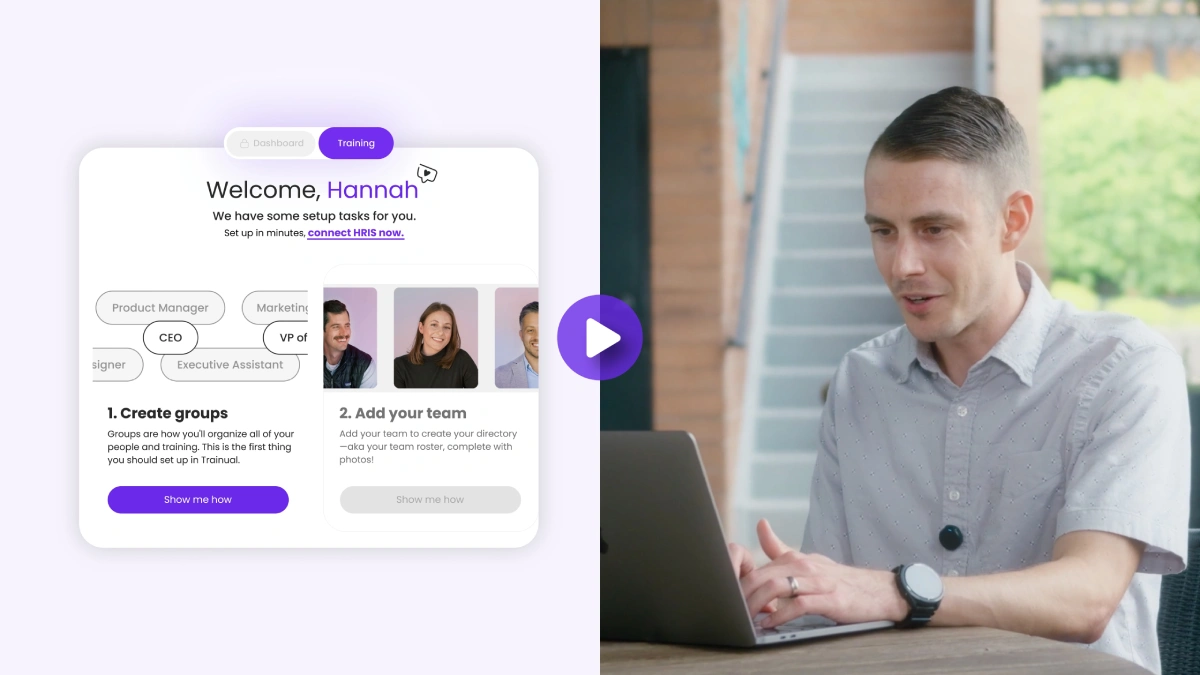
Trainual gives growing companies the operating system to fix this. AI-powered search that returns answers, not just matching documents. Role-based context that calibrates answers to who's asking. Always-current content because version history keeps everything fresh. Mobile and Slack access that surfaces the assistant where the team already works.
Imagine a team where every operational question gets answered in seconds — by the system, with citations, on whatever device the team member is using. Senior employees stop being the help desk. New hires ramp faster. Repeat questions stop reaching senior employees. The AI assistant compounds in usefulness as the team uses it. That's what's possible when knowledge search runs on a real system instead of a search bar over a folder of docs.
Ready to see how Trainual works?
👉 Book a demo and experience how Trainual turns your operating knowledge into an AI assistant the whole team can use.
Want a sneak peek?
👉 Explore real customer stories from teams who've made AI-powered knowledge search actually work.