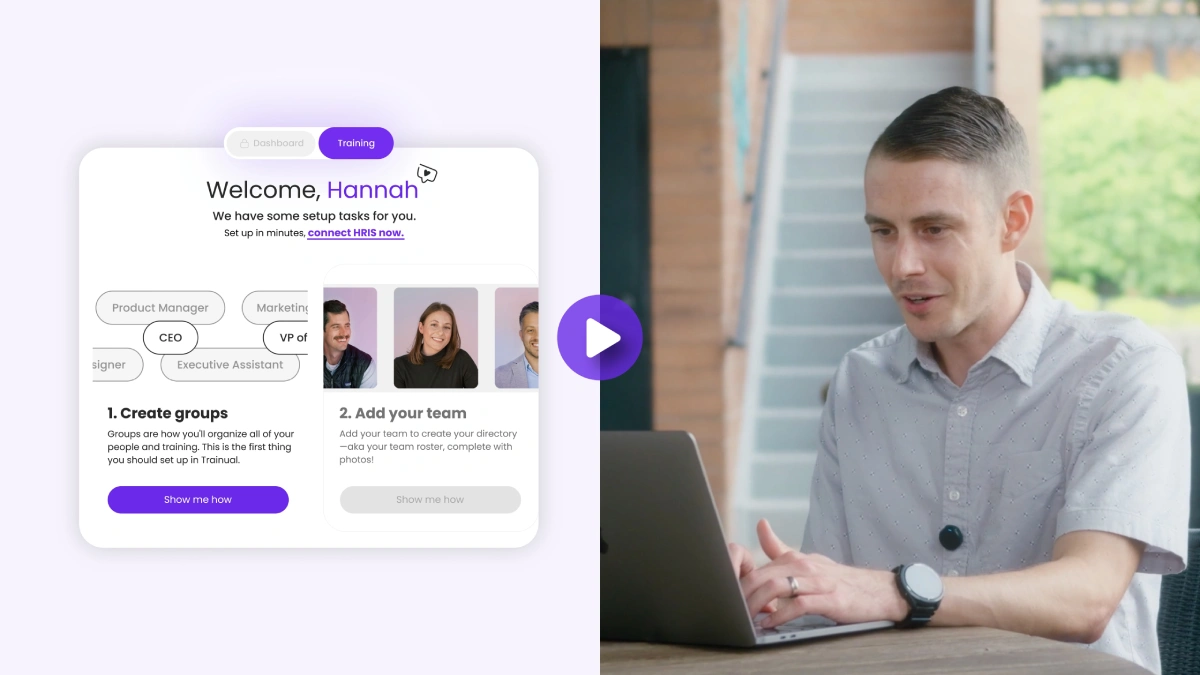






Picture this: you've just spent three weeks building the new compliance module — scripted videos, branching scenarios, a final assessment, the works. Launch day comes, you push it to 200 employees, and by Friday the completion dashboard reads 23%. The next Friday: 31%. You add a reminder email. You ping the managers. By month-end you hit 87% — but you know, deep down, that most of those last 50 completions were people clicking through as fast as the platform would let them during a Zoom call, just to make the badge appear in the HRIS. The training isn't training anyone. It's completion theatre. And next Tuesday at the QBR, leadership is going to ask you why engagement scores still haven't moved.
For L&D leaders, training managers, and learning designers, this is the quiet trap of the role. You're hired to build capability across the company. What you spend your time doing is shipping courses that get completed but not learned, updating compliance content that nobody re-reads, answering "where can I find the…" questions from the same dozen managers every week, and watching your authoring tool take 45 minutes to publish a single slide change. The platform you have wasn't built for the work you're being asked to do — and the gap shows up everywhere, from completion rates to the credibility of your function.
This guide walks through what L&D leaders actually need from training software, how to evaluate the right platform, and how to roll it out so training stops being a box people check and starts being a system that genuinely changes how the team works. With the right tool in place, your content gets used, your authors stop being the bottleneck, and L&D moves from completion theatre to a measurable driver of how well the company performs.
The real cost of training programs running on the wrong software
When your training runs on a platform built for a different era — long-form e-learning, scheduled instructor-led sessions, annual compliance modules — you pay for it in ways that don't always show up on a dashboard. Until they do.
Start with the engagement gap. 52% of employees say their training has left them feeling undertrained — and 80% of those undertrained employees plan to leave their employer soon. That's not an L&D problem you can solve with more content; it's a signal that the content you have isn't reaching people in a form they can use. Long modules nobody finishes. Annual courses that only get watched once. Information stored where the moment of need can't reach it.
Then the platform-fit problem. 83% of organizations are running on an LMS today — and 37% of them plan to replace it. The most common complaint? 52% of buyers cite poor integration with the rest of their stack as the top reason their LMS underdelivers. The platform sits in a corner, disconnected from the HRIS, the docs, the everyday tools the team uses — and adoption pays the price.
Then the leadership development gap. 75% of organizations rate their leadership development programs as "not very effective," and 83% of managers receive no formal training before stepping into people-management roles. L&D teams know this. They're often building manager development content faster than they can keep up with — and in software that wasn't designed for the always-on, always-current resource managers actually need.
Then the ROI question. The global LMS market sits at $30.51B in 2026 and is projected to reach $54.86B by 2031 — companies are spending real money on training tech. But L&D leaders are increasingly being asked to prove the return on that spend, and most legacy platforms don't make that proof easy to pull. Completion rates aren't impact. Hours-of-training isn't capability. The metrics the platform gives you aren't the metrics the company is asking about.
Training software — the right kind — is the fix. It takes the content you build and puts it where the team actually works: searchable, role-based, in the flow of the job. It gives you the authoring speed to keep up with how fast the company is changing. And it gives you the visibility to show leadership not just who completed what, but how training is connecting to the outcomes the company cares about.
What training leaders need from training software
Training software for L&D isn't the same as a corporate LMS or a content authoring suite. A traditional LMS is built for course delivery and compliance tracking. An authoring suite is built for course production. What training leaders need is something connecting the two — and extending into the daily flow of how people work — so training shows up at the moment of need, not just the moment of assignment. Here's what to look for.
1. A single home for every type of content
The L&D function isn't just compliance courses. It's onboarding. It's role-specific training. It's policy acknowledgment. It's the searchable knowledge base your team references mid-task. Good training software gives you one single source of truth where every type of content lives — courses, SOPs, policies, training paths — and where employees can find it the same way every time. No more "is the harassment training in the LMS or the wiki?" The answer is always: it's in the platform.
2. Role-based assignment that scales with the team
Your sales team doesn't need the warehouse safety training. Your engineers don't need the customer service playbook. Modern training software lets you assign content by role — so every employee sees exactly what applies to their job, and nothing that just clutters their queue. For an L&D team supporting hundreds or thousands of employees, this is the difference between a program that scales and one that drowns under its own weight.
3. Author-friendly content creation that doesn't bottleneck the team
Most legacy LMS authoring tools turn content updates into multi-week projects. Slide changes need to be re-published. Quizzes need to be rebuilt. The workflow assumes a dedicated production team — which most L&D functions don't have. Modern training software treats content creation like writing a doc: open, edit, publish. Add a video. Embed a screenshot. Push the change to every assigned employee in seconds. 97% of content teams now use AI to accelerate content creation — and the best training platforms bring that same acceleration to your team's authoring workflow with built-in AI-powered SOP creation and content drafting.
4. Searchable, in-the-flow access for the moment of need
Training that only happens at assignment is training that gets forgotten. The real value comes when an employee can pull out their phone mid-task, search for the procedure, and get the answer in 10 seconds. A searchable knowledge base — fast, mobile, AI-powered — turns your training library from an event-based system into a daily resource. That's where retention and behavior change come from.
5. Reporting that maps to outcomes, not just completions
The L&D leader's KPI isn't "courses completed." It's "did training move the needle on retention, ramp, performance, compliance posture?" The right platform gives you the data to draw those lines — completion plus comprehension plus version history plus role-level reporting — so when leadership asks for the ROI of L&D, you can answer with something better than activity counts.
Six features to look for in training software for L&D teams
Beyond the core capabilities, certain features make a real difference in how well training software supports an L&D function day-to-day. Here are the six that matter most.
Feature #1: A deep template library
Your team doesn't have time to build everything from scratch. A library of proven templates — for onboarding, role playbooks, compliance policies, SOPs — gets you from zero to a working program in days instead of weeks. Templates aren't a replacement for your expertise; they remove the blank-page friction that kills most program rollouts before they start.
Feature #2: Role-based training paths
Modular content is good. Modular content organized into training paths is better. A new sales rep follows one path. A new manager follows another. A promoted IC follows a third. Paths turn your library from "a stack of courses" into "a structured learning system" — and they're what stakeholders see when they ask "what does our onboarding actually look like?"
Feature #3: AI-assisted content creation
The best modern platforms include AI-powered authoring — turning a transcript into a structured SOP, summarizing a long policy into key points, drafting quiz questions from existing content, refreshing dated language. For an L&D team of one or two trying to serve hundreds, AI features compress content production timelines from weeks to hours. They don't replace L&D judgment; they multiply it.
Feature #4: Knowledge checks and quizzes
Completion is not comprehension. Built-in quizzes let you verify that employees actually internalized the content — not just that they clicked through. For compliance-sensitive material (harassment prevention, data handling, safety), this is the difference between a defensible training record and a liability dressed up as a completion certificate.
Feature #5: Version history and audit trails
When a regulator, an auditor, or an employment lawyer asks "what version of the policy did this employee acknowledge, and when?" — you need a clean, timestamped answer. Version history keeps a full record of every content change and every acknowledgment, so the audit trail is one click away instead of one painful spreadsheet rebuild away.
Feature #6: Reporting that connects training to outcomes
The L&D leader's pitch to leadership has to be more than completion rates. The right platform lets you slice completion by role, by location, by manager, and connect those completions to the outcomes the company cares about — onboarding ramp time, compliance posture, role-level retention. That's how L&D moves from cost center to strategic function in the eyes of the rest of the company.
How the wrong training software fails L&D leaders
Most L&D leaders have inherited a system that wasn't built for the way training actually works today — usually a legacy LMS, an authoring suite stitched to a delivery tool, or a wiki masquerading as a knowledge base. Each one fails in predictable ways.
Trap #1: A legacy LMS built for annual compliance
The problem: Traditional enterprise LMS platforms were designed for a world where training happened once a year, in long modules, mostly for compliance. They're slow to update, hard to search, and your team treats them as quarterly obligations rather than daily resources. The cost-per-module is high, the time-to-publish is long, and the analytics are stuck on completion rates.
The fix: Look for software designed for the way modern teams actually work — fast to update, searchable, role-based, and built for daily reference. The best platforms prioritize utility over polish: a clean authoring experience over animated course builders, fast search over branching navigation, and reporting tied to outcomes over hours-of-seat-time.
Trap #2: Separate authoring and delivery tools
The problem: You author in one tool. Deliver in another. Track in a third. Every update means re-publishing through three systems. Half of L&D's time goes to wrangling vendors instead of building content.
The fix: Consolidate. The right platform handles authoring, delivery, role assignment, and reporting in a single workflow. Edit a policy and it pushes instantly. Add a quiz and it shows up in the next assignment. Less integration tax, more time for the work that actually moves the needle.
Trap #3: Building courses for content that doesn't need to be a course
The problem: Every piece of content gets force-fit into the course format — narrated slides, branching scenarios, scored assessments — even when the content is really just a policy, an SOP, or a reference doc. The result is a mountain of underused modules and no good way to search across them.
The fix: Match the format to the content. Courses for sequenced learning experiences. SOPs for procedures. Policies for acknowledgments. Searchable knowledge base entries for reference content. Modern training platforms blend all of these into one experience — so your team gets the right format for the right purpose.
Trap #4: Optimizing for completion rates
The problem: Your dashboards show 92% completion. Your engagement scores haven't moved. Your team behaviors haven't shifted. You're winning the metric, losing the outcome. This is what people mean when they call training "compliance theatre."
The fix: Move beyond completion as the primary metric. Add knowledge checks to verify comprehension. Build in spaced reinforcement. Make content searchable so it's used in-the-flow, not just at assignment. The metric you want isn't "did they finish the course" — it's "did the work change after."
Trap #5: L&D as the only content owner
The problem: You're a team of two trying to author, update, and govern content for a company of 500. Every SOP, every policy, every training path runs through you. The pipeline backs up. The content goes stale. You burn out.
The fix: Decentralize authoring with clear ownership. HR owns the handbook. Department leads own role-specific content. Operations owns process docs. L&D becomes the architect of the system — setting standards, reviewing for quality, owning the training paths and high-stakes compliance content — instead of the bottleneck for every piece of writing in the platform.
What rolling out training software should look like for L&D leaders
Software is half the job. Rollout is the other half. Here's how to drive real adoption across the company in the first 30 days.
Week 1: Audit and prioritize
Map every piece of training content currently in flight — what's assigned, what's getting completed, what's stale, what's missing. Rank by frequency, stakes, and pain. Your top five — the ones that hit every employee, the ones tied to compliance, the ones managers complain about — are where you start.
By the end of Week 1, you should have:
- A ranked list of content priorities across the company
- The top 5 pieces identified and assigned to owners (often a mix of L&D, HR, and department leads)
- A shared definition of "done" for each — what good looks like, format, audience, and review cadence
Week 2: Document your top 5
Block focused time for owners to draft. Don't chase perfection — a rough first draft covering 80% of the content is more valuable than a polished draft covering 40%. Use Looms, screenshots, real examples wherever they help. If AI authoring is part of the platform, use it to accelerate first drafts and free your team for review and refinement.
Week 3: Assign and train
Load content into the software and assign by role. Require sign-offs on the compliance-sensitive pieces. Run a short manager session — virtual if your team is distributed — to show how to assign, track, and follow up with their direct reports. Set the expectation that the platform is the source of truth.
Week 4: Track and refine
Review completion data and comprehension checks. Follow up with anyone behind. Collect feedback from managers and employees on where content is unclear or missing. Make a first round of updates. This is when the software stops being a project and starts being how training actually runs.
Month 2
Expand. Add role-specific training paths, manager development content, and function-specific SOPs. Each new piece gets easier because the team has seen what good looks like — and your decentralized owners are starting to author independently.
Month 3
Shift focus to measurement. Track ramp-up time, role-level retention, completion by department, comprehension scores on high-stakes content. Bring those metrics to your next leadership review. The goal isn't a library full of content — it's a training program leadership can see, measure, and trust.
Getting started: quick wins you can implement this week
You don't need a full rollout plan to see value. A few focused actions this week will build real momentum.
Quick win #1: Audit your content for staleness
Pull every piece of training content in your library. For each one, ask: when was this last updated? Who's the owner? Is it still accurate? Most L&D libraries have 30-50% of content that's outdated, redundant, or unowned. Retiring or refreshing those pieces will do more for your program's credibility than adding new content.
Quick win #2: Pull comprehension data on one high-stakes course
Pick your most important compliance or operational course. If it has a quiz, pull the score data. If it doesn't, add one this week. The gap between completion rates and comprehension scores is your single most useful piece of evidence — both for your own program decisions and for the next leadership conversation.
Quick win #3: Identify your top 5 most-asked manager questions
Every L&D leader has the same list — the questions managers Slack you over and over. PTO process. Performance review timing. How to handle a remote-hire equipment request. Document those five answers once, post them in the platform, and start redirecting future questions there. Volume drops in days.
Quick win #4: Pick one underused course and rebuild it as an SOP + quiz
Find a course with low engagement. Strip the slides. Rebuild the content as a one-page SOP with embedded video and a short quiz. Reassign it. Compare engagement and comprehension to the original. The shorter version almost always wins — and it frees up format thinking across the rest of the library.
Quick win #5: Map content owners by function
Every piece of content needs an owner outside L&D. HR for the handbook. Ops for procedures. Department leads for role content. Map it on a whiteboard, assign each piece, and set a quarterly review rhythm. The audit alone will surface a dozen ownership gaps you can close immediately.
Small steps like these compound fast. Tackle even two of them this week and your program starts shifting from "L&D as content factory" to "L&D as the architect of how the company learns" — and the conversations with leadership change accordingly.
How do you measure training software success as a training leader?
Training software isn't worth the investment unless it's moving metrics leadership cares about. A few simple measurements tell you whether it's working.
1. Comprehension scores on high-stakes content
Completion is table stakes. Comprehension is the metric that matters. Track the average score on knowledge checks for compliance, role-specific, and safety content. A rising comprehension score is direct evidence that training is moving from content delivery to actual capability.
2. Time-to-publish on content updates
Log how long it takes to push a content change live — from when a policy needs to update to when every assigned employee sees the new version. A measurable drop is one of the strongest indicators that the platform is supporting the L&D function instead of slowing it down.
3. New hire ramp-up time
Track how long it takes a new hire to reach first independent productivity. Better onboarding content, better role-based assignment, and faster updates all compound here. Structured onboarding programs drive 82% better retention and 70% higher productivity than ad hoc onboarding — but only when the content is current and the team uses it.
4. Role-level retention
Compare 90-day and 12-month retention by role, before and after rollout. The roles with the strongest training paths should see the biggest retention lifts. That data is the foundation of the L&D ROI story you'll bring to leadership.
5. Self-serve search volume
Track how often the team searches the platform for answers — and how often those searches return useful content. Rising search volume means training has become a daily resource, not a one-time event. That's when the platform stops being a cost center and starts being part of how the company runs.
Beyond documentation: how Trainual's Operations Suite connects training to outcomes
Documentation is the foundation. But for an L&D leader, building great training is only half the job — the other half is showing leadership that training is connecting to the outcomes the company cares about. That's where Trainual's Operations Suite comes in. Same platform your training already lives in, extended into the daily rhythm of running the company: meetings, goals, updates, and scorecards — all connected.
Here's what each surface does.
Meetings
Run structured meetings with shared agendas everyone can contribute to — L&D program reviews, manager development cohorts, training stakeholder syncs. Capture discussion topics and action items with clear owners and due dates inside the meeting itself, so program follow-ups don't get lost between sessions. Action items can be deferred to the next meeting or moved to a different one. Every meeting connects back to scorecards and goals, so conversations tie directly to accountability. Two-way calendar sync with Google Calendar and Outlook keeps everything in one place — and a built-in notetaker joins your calls to produce transcripts and summaries automatically.
Updates
Set custom questions on whatever cadence works for the team — weekly L&D progress updates, monthly stakeholder summaries, quarterly program reviews. Everyone submits in one central place, building a searchable history of progress over time. Stakeholders can comment, ask follow-ups, and give praise without chasing anyone down. Visibility settings let you decide who sees each update — direct manager, executive sponsor, or wider leadership team.
Goals
Multi-level goal tracking with clear owners, targets, and due dates — for completion targets, comprehension benchmarks, role-level retention goals, manager development milestones. Pick how progress gets calculated and choose cumulative or trend-based tracking. Goals can be nested as parent and child, so a company-level capability goal connects to the team and individual training goals rolling up to it. Every goal carries a comments and activity feed for context, status updates, and ownership history.
Scorecards
Track your most important L&D metrics over time — completion by role, comprehension scores, ramp-up time, retention by program, manager engagement — and view them side-by-side against targets. Add rows manually, or link directly to existing goals so the data flows in automatically. Connect scorecards back to meetings so the numbers that matter are the ones being discussed. Color thresholds make it instantly clear when a metric is on or off track.
Team Pulse
AI-generated insights that surface what needs attention across goals, updates, meetings, and training content. Four signal types — change (something just shifted), stall (something that should be moving but isn't), pattern (the same theme showing up across multiple sources), and prep (something coming up soon with a gap). Each insight comes with a clear next action, so instead of digging through five surfaces to figure out what to focus on, the synthesis is done for you.
A connected home and profile experience
The Home dashboard becomes a single hub for goal progress, upcoming meetings, team updates, action items, and discussion topics — fully customizable with a widget library you can drag, drop, and reorder. Each profile gets an Operations tab showing that person's active goals, upcoming meetings, recent updates, and action items, alongside their existing Training tab. And the AI Assistant can answer questions across all of it: what's the latest on our manager development goal?, what did we cover in last week's L&D stakeholder sync?, summarize what my team said in their updates this week.
For an L&D leader, this is the layer that turns training from a function leadership has to take on faith into a function with visible, measurable outcomes — every program, every goal, and every weekly update tied to the metrics the company actually cares about.
Make training a system, not a series of events
When your training program runs on a platform built for a different era of learning — and on the heroic effort of an L&D team trying to manually bridge the gap — every quarter is a little bit of a gamble. On whether the new module will get used. On whether the compliance numbers will hold up under audit. On whether leadership will renew the budget for another year. That's not a foundation you can build a function on.
Trainual gives L&D leaders the software to turn training into infrastructure. Document your courses, your SOPs, your role paths, your compliance acknowledgments — assign them by role, require sign-offs where it matters, and track who's on the latest version. Every update is version-controlled. Every employee knows exactly what's expected. Every leadership review gets answered with data tied to the outcomes the company cares about.
Imagine a training program where authors ship content in hours instead of weeks, employees self-serve answers from the platform daily, comprehension scores tell a real story about capability, and your leadership conversations stop being about completion rates and start being about how training is moving the company forward. That's what's possible when L&D gets an operating system behind it.
Ready to see how Trainual works?
👉 Book a demo and see how Trainual can help your team build a training program that actually changes how the company performs.
Want a sneak peek?
👉 Read customer stories from teams who've built training programs that scale across roles, locations, and time zones.
Frequently asked questions
What is the best training software for L&D leaders?
Trainual is a strong fit for L&D leaders because it's purpose-built for the full range of content L&D supports — onboarding, SOPs, role-based training paths, policies, and compliance — in one searchable, role-assignable, audit-ready platform. Unlike legacy LMS platforms designed for annual compliance courses or authoring suites built for content production, Trainual is designed for the daily operational knowledge employees actually use. For L&D teams managing multiple roles, locations, or compliance jurisdictions, it turns training from an event-based program into a daily resource.
What's the difference between a traditional LMS and modern training software?
A traditional LMS is built for course delivery and completion tracking — long-form modules, annual compliance, formal certifications. Modern training software is built for the daily operational knowledge teams need to do their jobs — onboarding, SOPs, role-based paths, policies, in-the-flow search. Both have a place. But for L&D leaders trying to make training stick beyond completion rates, modern training software is the foundation. The course library is one format among several, not the whole platform.
How do you measure if training is actually working — beyond completion rates?
Completion is necessary but not sufficient. The metrics that tell you training is working are: comprehension scores on knowledge checks, time-to-productivity for new hires, role-level retention rates, self-serve search volume on the platform, and falling escalation or "where do I find" question volume to managers. Modern training software gives you all of these in one place — completion plus comprehension plus role-level reporting plus search analytics — so you can show leadership a real impact story instead of activity counts.
How long does it take to see ROI from training software?
Most L&D teams see meaningful ROI within the first 60 to 90 days — faster content publishing, higher comprehension on high-stakes content, falling ramp-up time, better retention in roles with strong training paths. The biggest gains come when software is paired with decentralized content ownership: HR owns the handbook, ops owns process docs, department leads own role content, and L&D owns the architecture and high-stakes compliance pieces. Software alone doesn't drive results — the combination of the right platform and the right ownership structure does.
How do you keep content current when L&D is a small team?
The answer is two-part: decentralize authoring and use software that makes updates fast. Every piece of content needs a named owner outside L&D — HR for handbooks, ops for procedures, department leads for role content. The software should let any owner update content and push it to assigned employees in minutes, not weeks. The combination of distributed ownership and fast-publishing software is what keeps training current without burning out a small L&D team.