



🤩 Your team’s best year inside
January 14, 2026

How’s all that “circling back” going this month?
If you’re still digging out of the seventh circle of emails, with a calendar that filled itself while you were gone, you’re not alone. While you climb back toward Inbox Zero, let’s reset with what actually makes your team more productive:
Trainual resources to plan, budget, and delegate for 2026, a real example of team buy-in done right, and what to do if your training sucks.
Fresh start — let’s get into it!
SOS FOR AN SOP
Tell us your training sucks. (Not yours... probably.)
Let's be real. If you’re reading this, there’s a good chance your training doesn’t suck.
But you definitely know someone who's got NSFW training.

We launched a little campaign where anyone can anonymously spill the tea on their company’s training — and we’ll send a brutally honest report back to that company. (But helpful, of course, we're not monsters.)
Consider it a public service.
👉 Send it to a friend. Or an enemy. We won’t judge.
WHAT HAPPENS AFTER THE TOAST?
Forget 'new year, new me'
Only about 25% of people still have their resolutions intact by the end of January. If you’re still on track, congrats — you’re in rare company.
To help you keep it that way, here’s a simple toolkit to clear the three most common roadblocks: planning the year, setting meaningful goals, and tracking what matters.

Three templates to make 2026 a masterpiece:
- Annual planning framework. Less chaos, more focus. Align the year around a few high-impact priorities — and stick to them.
- Strategic visualization & goal execution framework. Turn big goals into something your team can easily execute.
- KPI & metrics guide. If everything’s a priority, nothing is. Define what matters, assign ownership, and track progress without noise.
While the rest of the world is still hibernating, give your squad a head start.
ALL RISE
The fastest way to improve productivity? Earn buy-in.
In law, some might argue there’s no room for gray area.
“I think this is right” doesn’t cut it — and no one knows that better than Summit Law.
They work in high-stakes legal practice, where accuracy matters, timelines are tight, and details can’t slip. But behind the scenes, training lived in too many places: scattered documents, project management tools, and people’s heads.
So when questions came up, the team didn’t go searching. They went straight to leadership. And that worked… until interruptions piled up and productivity started depending on who was available to answer.
Summit Law realized the problem wasn’t their people — it was the system. So they rebuilt how training and knowledge lived across the firm using Trainual.
🧑 Inside the story:
- One trusted place for how work actually gets done.
- Fewer interruptions because answers don’t live with leadership anymore.
- A system built on shared accountability, not micromanagement.

Five adjustments Summit Law made, and why they worked:
- Make the system the first stop for answers.
Set the expectation that questions get answered in the system before they go to a manager. By clearly positioning Trainual as the starting point — not a backup — Summit Law reduced constant interruptions. - Consolidate scattered knowledge into one trusted home.
If SOPs live in PDFs, shared drives, or inboxes, pull them into one place and retire the duplicates. A single source of truth only works if it’s actually singular. - Plan for coverage, not just roles.
Summit Law documented workflows so anyone could step in when someone was out — without pulling leadership into the moment. - Treat documentation as something that evolves.
Instead of “set it and forget it,” Summit regularly revisits processes and asks, does this still make sense? That’s how documentation stays useful. - Build buy-in through shared ownership.
The team is expected to use the system — and leadership is accountable for keeping it accurate. That two-way commitment is what turns documentation into a habit, not homework.
👉 See how Summit Law improved productivity and earned real team buy-in with Trainual.
YOU GOT THIS (OFFICIALLY)
Because 'I thought you had that?' isn’t a system
This time of year brings renewed energy, shifting priorities, and plenty of “Wait… are you owning that, or am I?” moments. And without clear ownership, even the best plans stall out.
Now that the big goals are set, it’s time to make sure your team’s responsibilities still line up. Because clarity on who does what (and how) is what turns big ideas into actual progress.
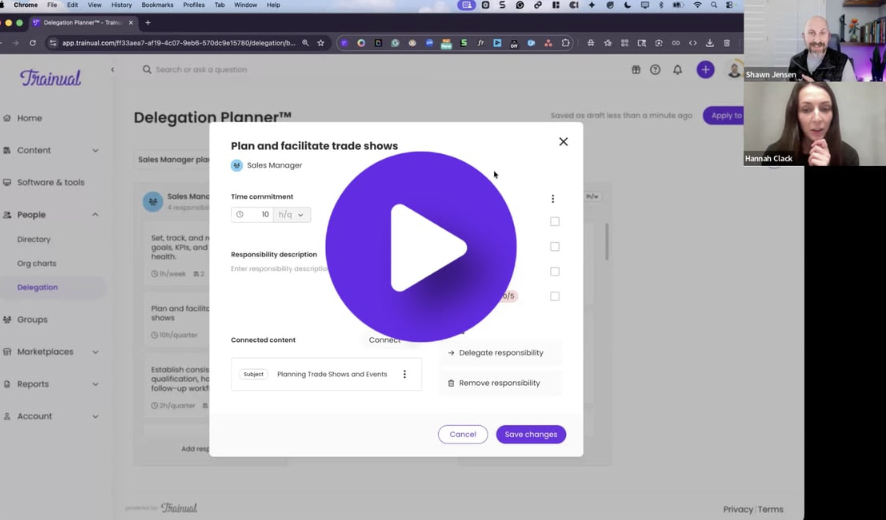
So how do you get there? It starts with a conversation. One manager, one employee. Sitting down to look at what’s on their plate. Then, mapping out what needs to change together:
- Step 1: Review current responsibilities. What’s clear? What’s changed? Decide what still fits — and what needs to evolve.
- Step 2: Spot any gaps or overlaps. Is something missing? Floating with no clear owner? This is your chance to clean up the gray areas and close the gaps.
- Step 3: Add the “how.” Whether it’s a doc or a full video walkthrough — make sure they’ve got what they need to follow through.
Of course, this is a whole lot easier when it’s not happening across a dozen tools, folders, and files. Perhaps we’re a bit biased (or just allergic to chaos), but the Delegation Planner™ is hands-down the easiest way to connect the what, the who, and the how — all in one place.
👉 Watch how top teams work together to clarify responsibilities in real time.
When people know what they own — and how it connects to their growth and the company — they don’t just do the work. They help turn your 2026 vision into reality.
👉 Get a demo.

