





The hardest thing about running a healthcare practice isn't the medicine. It's the operational complexity layered on top of it — HIPAA compliance, OSHA requirements, DEA documentation, payer rules, credentialing, infection control, patient communication standards, billing accuracy. Every one of those operates under regulations where the cost of getting it wrong is measured in fines, lost licenses, or patient harm.
And almost none of it gets taught in clinical training.
Most healthcare practices run on a mix of formal SOPs (often outdated), unwritten institutional knowledge (often locked in one or two senior staff members' heads), and "the way we've always done it" (often what regulators discover during an audit). When a senior nurse or practice manager leaves, the practice loses years of operational know-how — the kind that doesn't fit into a clinical training module but determines whether the practice runs smoothly or limps from one near-miss to the next.
This guide covers the 10 SOPs every healthcare practice needs to run without breaking. It's written for the practice managers, clinic administrators, medical directors, and healthcare operations leaders trying to standardize care, stay compliant, and onboard new staff without losing two senior employees worth of scattered know-how with every departure. We've covered the broader pattern in 4 healthcare providers using Trainual for compliance and training, and the role-specific persona pain piece in training software for HR leaders for the people running this work day-to-day.
Why Healthcare Practices Need More SOPs Than Most Industries
Healthcare practices sit at the intersection of three operational pressures that few other industries face simultaneously:
- Regulatory complexity. HIPAA. OSHA bloodborne pathogen standards. DEA scheduling and documentation. CMS reimbursement rules. State-specific licensing and scope-of-practice rules. Each has its own audit trail and acknowledgment requirements.
- High-stakes consistency. A retail employee who handles a transaction differently from their colleague creates inconvenience. A clinical staff member who handles a medication reconciliation differently creates patient harm. The standard has to hold across every shift, every location, every staff member.
- High-turnover staffing reality. Healthcare has historically run high turnover rates across nursing, medical assistant, and front-desk roles. New hires arrive constantly. Each one needs to be ramped to full capability fast — and to the same standard as the senior staff they're replacing.
The combination is why healthcare practices typically need 80-150 SOPs once they're past 25 employees, with another 50-100 added for each additional location or service line. That's roughly double what a similarly-sized non-healthcare practice needs. We've broken down the broader thinking on SOP scaling in what is an SOP — the 2026 guide to standard operating procedures.
The 10 SOPs below aren't a complete library. They're the foundational set every healthcare practice should have in place before adding the role-specific, service-line-specific, and compliance-specific procedures that build on top.
The 10 SOPs Every Healthcare Practice Needs
1. Patient Intake and Registration
The first interaction every patient has with the practice is intake. Inconsistency here cascades into every downstream process — from clinical accuracy to billing accuracy to patient satisfaction. A solid intake SOP covers:
- Information collection sequence and required fields
- Insurance verification process and benefits check
- Identity verification standards
- HIPAA notice acknowledgment workflow
- Forms collection (medical history, consent, financial responsibility)
- Handoff from front desk to clinical team
Every staff member who touches intake — front desk, medical assistants, nurses doing rooming — needs to follow the same sequence. The cost of inconsistency shows up in incomplete charts, billing rejections, and the kind of small errors that compound into larger ones.
2. HIPAA Privacy and Security Compliance
HIPAA isn't a one-time training. It's an ongoing operating standard that has to be embedded in every workflow that touches protected health information. The HIPAA SOP needs to cover:
- What constitutes protected health information (PHI) at your practice
- Authorized vs. unauthorized disclosures
- Incidental disclosure handling (waiting rooms, phone calls, screens)
- Secure messaging and email standards
- Mobile device and remote work policies
- Breach reporting workflow (who to notify, when, how)
- Annual HIPAA training requirements and acknowledgment tracking
Documented HIPAA SOPs aren't just for the audit. They're how new staff understand the operating standards on day one. Recharge Clinic uses Trainual for exactly this — keeping HIPAA, OSHA, and DEA-relevant content current and acknowledged across 4 locations and 4 service lines.
3. Infection Control and OSHA Compliance
OSHA requires healthcare practices to maintain documented infection control protocols, bloodborne pathogen procedures, and hazard communication standards. These can't live in a binder no one reads. They have to be operational. A good infection control SOP covers:
- Hand hygiene standards and audit cadence
- PPE selection and use by clinical situation
- Bloodborne pathogen exposure response
- Sharps disposal and biohazard handling
- Cleaning and disinfection protocols by area
- Equipment sterilization standards
- Annual OSHA training requirements and acknowledgment tracking
The audit trail matters here. When OSHA shows up, "we trained everyone" needs to be backed by documentation showing who completed what, when, and what they acknowledged.
4. Medication Management and Documentation
For practices that prescribe, dispense, or administer medications, the medication management SOP is non-negotiable. It covers:
- Prescription writing and verification standards
- Controlled substance handling and DEA documentation
- Medication reconciliation at every patient encounter
- Sample medication inventory and tracking
- Storage and security requirements
- Disposal protocols
- Reporting workflow for errors and near-misses
The DEA documentation requirements alone create an audit trail that has to be maintained meticulously. A documented medication SOP isn't optional — it's how you stay licensed.
5. Clinical Documentation Standards
Inconsistent clinical documentation creates compliance risk, billing risk, and care continuity risk. Every clinical staff member needs to document to the same standard. The SOP covers:
- Required elements of every clinical note
- Documentation timing standards (point-of-care vs. end-of-shift)
- Communication of findings to other providers
- Standardized terminology and abbreviation policies
- Late entry and addendum procedures
- Audit standards and review cadence
This is one of the SOPs most likely to drift as the practice grows. New providers come in with their own documentation habits. Without a clear SOP and ongoing reinforcement, the chart quality varies by provider rather than reflecting practice-wide standards.
6. New Hire Onboarding and Credentialing
Healthcare practices have higher onboarding stakes than most industries because new hires step into compliance-bound roles immediately. A solid onboarding SOP covers:
- Pre-start credentialing verification (licenses, certifications, background checks)
- First-day orientation sequence
- Required compliance training (HIPAA, OSHA, sexual harassment, role-specific)
- Role-specific training paths and competency demonstrations
- Mentorship pairing and check-in cadence
- 30/60/90-day milestones
The cost of getting onboarding wrong shows up in compliance gaps, slower time-to-productivity, and higher early turnover. We've covered the broader playbook in how to onboard a new hire in their first 30 days, and the healthcare-specific compliance angle in the home care agency SOP piece and dental team SOP piece.
7. Patient Communication and Phone Protocols
How the practice communicates with patients is the practice's brand — and a major driver of satisfaction scores. The communication SOP covers:
- Phone answering standards (greeting, identification, hold protocols)
- Triage protocols for symptom-based calls
- Appointment scheduling rules (urgency, provider preference, walk-ins)
- Message routing and response time standards
- Patient portal communication standards
- Difficult conversation frameworks (delays, denials, sensitive results)
- Documentation of patient communications
A documented standard turns "good phone manner" from a personality trait into a trainable skill. Every new front-desk hire and clinical staff member can ramp to the practice standard rather than improvising from their previous practice's habits.
8. Billing, Coding, and Claims Management
Revenue integrity depends on consistent billing and coding practices. A billing SOP covers:
- Coding standards (ICD-10, CPT) and verification process
- Claim submission timing and tracking
- Denial management workflow
- Payment posting and reconciliation
- Patient billing communication standards
- Collections protocols
- Audit preparation and documentation
Inconsistent billing practices create both revenue leakage (missed charges, denied claims) and compliance risk (upcoding, miscoding). A documented billing SOP makes the standard auditable and trainable.
9. Emergency Response and Incident Reporting
Healthcare practices need documented procedures for the events nobody wants to think about happening. An emergency response SOP covers:
- Medical emergency response (codes, equipment locations, role assignments)
- Fire and evacuation procedures
- Active threat protocols
- Power outage and system failure response
- Patient incident reporting workflow
- Staff incident and injury reporting
- Required regulatory notifications
The audit trail matters here too. When something goes wrong, the documentation showing trained response protocols is the difference between a contained incident and a regulatory escalation. We've covered an analog in how Ironsmith Fire builds systems that save lives — the same principle applies in healthcare: documented response protocols save lives and protect the organization.
10. Continuous Quality Improvement and Compliance Audits
The practices that stay compliant and improve over time are the ones with documented quality improvement processes. The QI SOP covers:
- Internal audit cadence (chart review, compliance review, quality metrics)
- External audit preparation
- Patient satisfaction measurement and follow-up
- Incident review and root-cause analysis
- Quality metric tracking (clinical outcomes, wait times, no-show rates)
- Continuous training updates based on audit findings
- Annual SOP review and revision cadence
This is the SOP that makes the other 9 stay current. Without a documented QI process, the SOPs above drift over time as regulations change, new staff arrive with different habits, and "the way we've always done it" replaces "the way the SOP says we do it."
How Healthcare Practices Build SOPs That Actually Get Used
Documenting 10 SOPs is the starting point, not the finish line. The harder challenge is making sure those SOPs are findable, current, and used — not buried in a binder no one references after orientation.
Three things separate healthcare practices that run on their SOPs from practices that have SOPs but run on institutional knowledge anyway:
1. Role-Based Assignment
Different clinical and operational roles need different content. Front desk staff don't need the medication management SOP; medical assistants don't need the billing SOP. Role-based assignment ensures every staff member sees what's relevant to their job — without having to dig through a content library.
2. Searchable, Mobile-Accessible Documentation
A clinical staff member who needs to confirm an infection control protocol mid-shift can't open a 200-page binder. They need a searchable platform where the answer comes up in seconds — ideally on a mobile device they can reference at the point of care.
3. Documented Acknowledgment and Training Trails
For HIPAA, OSHA, DEA, and similar compliance requirements, "we trained everyone" needs to be backed by documentation. Trainual handles e-signatures, completion tracking, and audit-ready reports — the difference between passing an audit and scrambling for evidence.
The healthcare practices that get this right typically use a training and operations platform that connects all three: role-based content delivery, searchable knowledge, and built-in compliance audit trails.
What Healthcare Practices Are Building (and What You Can Copy)
The pattern shows up across healthcare practices that have built operating systems around their SOPs:
- Recharge Clinic keeps training and HIPAA, OSHA, and DEA-relevant compliance aligned across 4 locations and 4 service lines — built by a first-time L&D leader using 400+ pre-built courses as a foundation
- Multi-location healthcare providers using Trainual have standardized care delivery across geographies while maintaining the audit trails compliance demands
- Dental practices use the same approach for HIPAA, OSHA, and clinical SOPs in a sub-segment of healthcare with similar regulatory complexity
- Home care agencies apply the same pattern to in-home patient care with even more variability in delivery context
Different sub-segments, similar shift: SOPs stop being documents nobody opens and become the operating system of the practice. We've covered the cross-vertical pattern in 5 multi-location companies scaling operations with Trainual and 5 companies cutting onboarding time.
Quick Wins to Start Documenting This Week
Quick win #1: Audit your current SOP library against this list
Run through the 10 above. For each one, mark: documented and current, documented but outdated, undocumented but practiced consistently, or undocumented and inconsistent. The "undocumented and inconsistent" rows are your immediate priority.
Quick win #2: Pick the SOP where one staff departure would hurt most
Most practices have one or two operational SOPs where a single senior staff member is the only point of consistency. That's your single highest-risk gap. Document it this month — before the departure happens. We've covered the broader playbook in how to document institutional knowledge before your senior employees leave.
Quick win #3: Use AI to draft SOPs from existing documentation
You almost certainly have something — staff training materials, compliance binders, internal wikis — that contains the raw material. AI-powered SOP creation can convert that raw material into structured, role-assignable SOPs in minutes rather than weeks.
Quick win #4: Set up acknowledgment tracking for your top 3 compliance SOPs
HIPAA, OSHA, and any role-specific clinical compliance content need acknowledgment trails. Even if you only get the top 3 set up this month, you've covered the SOPs most likely to be audited.
Quick win #5: Pilot search-first culture with one team
Pick one role (front desk, medical assistant team, billing) and run a 2-week experiment: when team members have a question whose answer exists in the SOP library, they search the platform first before asking. The behavior shift is the foundation of an SOP system that gets used.
How to Know Your Healthcare SOP System Is Working
Five measurable signals tell you whether the SOPs are operational, not just documented:
1. Time-to-Answer at the Point of Care
Can a staff member confirm a protocol in seconds when they need to? Search analytics in your platform tell you what's getting found and what isn't.
2. New Hire Time-to-Productivity
How long until a new hire can perform their role to standard without ongoing senior-staff supervision? Healthcare benchmarks vary by role, but the trendline matters more than the absolute number — is it improving over time?
3. Audit Readiness on Demand
Can you produce, at any moment, the acknowledgment trail showing who completed which compliance training and when? If yes, audits become routine. If no, every audit becomes a fire drill.
4. Compliance Incident Rate
Are HIPAA breaches, OSHA incidents, and DEA documentation issues trending down over time? This is the most concrete proof that the SOPs are operational, not just documented.
5. Staff Confidence in Edge Cases
Surveys and pulse checks: do staff feel confident they can find the answer when an unusual situation comes up? High confidence means the SOP system is the trusted source. Low confidence means staff are still relying on senior colleagues' memory.
Stop Running on Scattered Know-How
The hard truth about healthcare practice operations: you cannot scale care, stay compliant, or onboard new staff at the speed the practice needs by relying on senior staff to be the source of every answer. You scale by building the SOP system that captures the standard once — and lets every staff member, every shift, every location operate to that standard.
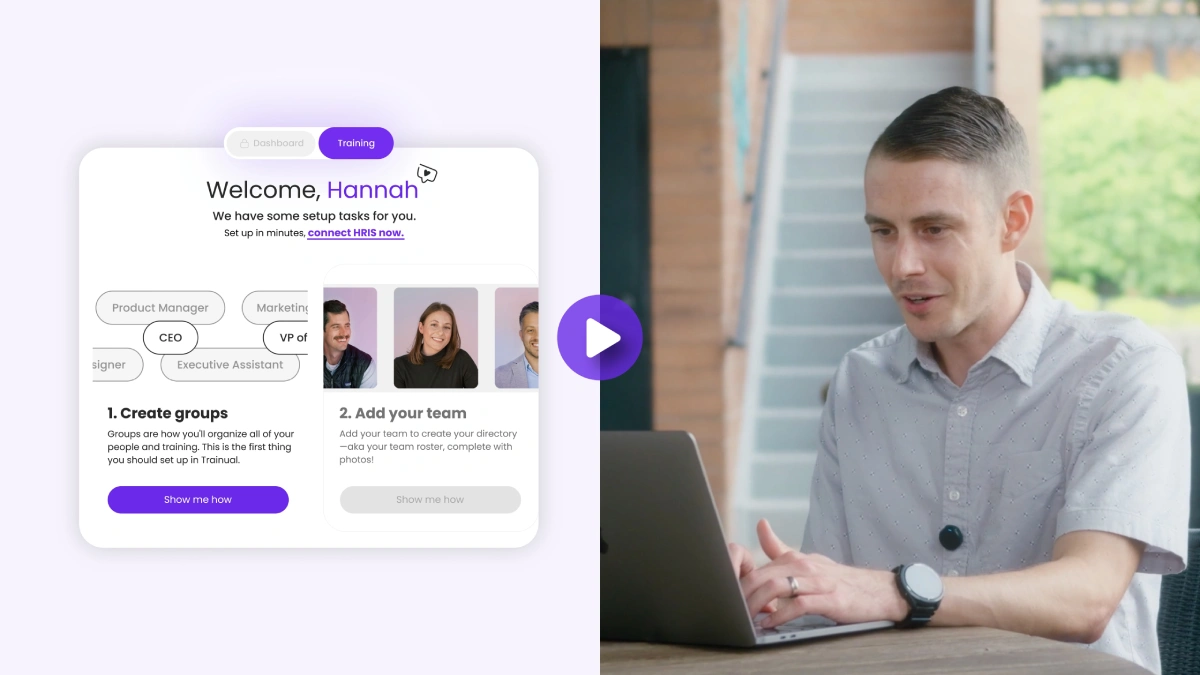
Trainual was built for exactly this. Document the way your practice really runs. Connect every SOP to the role responsible for it. Train new hires through a structured onboarding system that doesn't require senior staff in every loop. Use AI-powered search so clinical and operational staff can find the right protocol in the moment of care. And maintain the audit trails that compliance requires without scrambling every time an auditor walks in.
The healthcare practices that run cleanly don't have better staff — they have better systems. The SOPs above are the foundation. The platform that holds them is what makes them operational.
Ready to build your healthcare practice's SOP system?
👉 Book a demo and see how Trainual helps healthcare practices turn scattered protocols into a connected, compliant, scalable operating system.
Want proof from healthcare practices that have built it?
👉 Browse customer stories from healthcare providers who built the operating system before the next audit.
Frequently Asked Questions
How many SOPs does a healthcare practice really need?
A practice with 25 employees typically needs 80-150 SOPs covering the foundational 10 above plus role-specific, service-line-specific, and compliance-specific content. Practices with multiple locations or service lines typically add 50-100 SOPs per location or service line. The 10 above are the foundation; the broader library builds on them.
What's the difference between an SOP and a policy in healthcare?
A policy states what the practice's rule is (e.g., "all patients must complete a HIPAA acknowledgment before treatment"). An SOP describes how that rule is operationalized step-by-step (e.g., the specific intake sequence for collecting and documenting the acknowledgment). Most healthcare practices need both — but the SOP is what staff really follow during the workday. We've covered the distinction in what is an SOP — the 2026 guide.
How do healthcare practices keep SOPs current as regulations change?
The practices that keep SOPs current have three structural pieces in place: a designated SOP owner for each major area (a clinical lead for medication management, an HR lead for OSHA, a practice manager for billing), a quarterly review cadence built into the platform itself, and an inline flagging system so any staff member can flag outdated content the moment they spot it. Without these, SOPs go stale within 6-12 months of being written.
What's the right format for a healthcare SOP?
Every healthcare SOP should include: title and version, owner and last review date, regulatory basis (which regulation it's responding to, if applicable), purpose and scope, step-by-step procedure, definition of done, related SOPs and dependencies, and acknowledgment requirement. We've covered the broader format in how to write an SOP that people use.
How does AI help with healthcare SOP creation?
AI dramatically lowers the cost of converting existing knowledge into structured SOPs. Recording a senior nurse explaining a protocol once, then converting the transcript to a structured SOP, takes minutes instead of the hours it takes to write from a blank page. The senior staff member becomes the reviewer rather than the author — preserving their judgment without consuming their time. We've covered the workflow in how to use an LMS for AI-powered SOP creation.
Can a single platform handle clinical SOPs, compliance training, and operational documentation?
Yes — and it should. The healthcare practices that have separate systems for clinical training, HR compliance, and operational SOPs end up with content silos that contradict each other and create extra audit burden. A unified training and operations platform keeps everything in one searchable, role-assignable system with shared audit trails. Recharge Clinic does this across 4 locations; the same pattern applies to any healthcare practice past 25 employees.
What if our practice already uses an EMR — do we still need an SOP platform?
Yes. EMRs handle clinical documentation and patient records. They don't handle staff training, role-based learning paths, compliance acknowledgment trails, or operational SOPs (front desk procedures, billing workflows, emergency response, hiring, performance management). Most healthcare practices need both: the EMR for patient-facing clinical work, and a separate SOP and training platform for everything else. The two systems can coexist without overlap.