




Most growing teams hit the same three problems at once. People aren't sure how the work is supposed to be done. The way work happens drifts from the standard that was set. And no one can see whether the team is getting better over time. If you're weighing Trainual against Google Docs, that's usually the real problem underneath — how your company runs lives in a pile of docs and a Drive folder nobody can navigate, and once the process is written down, whether the right people read it, whether it's still accurate, and who owns it now is anyone's guess.
Google Docs is the best document editor there is — a fast, familiar place to write, format, collaborate in real time, and store what your team knows. Trainual is one connected platform that fixes all three problems: it's where your team learns how you do things, runs the day to day against that standard, and keeps getting better. Both let you write things down. They're built for very different jobs after that.
Trainual is a G2 Leader in Training Management, SOP Software, and Knowledge Management, with a 4.7 rating across 2,000+ reviews on G2, Capterra, and Trustpilot. How are you handling this today?
🔎 At a glance
- Google Docs is a document editor; Trainual is a knowledge operating system. Docs stores what you write. Trainual documents how work gets done, trains the team on it, and keeps people accountable to it.
- Documentation. Google Docs writes and stores; Trainual adds a content owner, scheduled verification reminders, and learner feedback so documentation stays current after it's written.
- Training. Google Docs has no course builder, quiz, or completion record; Trainual assigns role-based training paths, tests it, and tracks who finished.
- Accountability. Google Docs draws an org chart as a static picture; Trainual keeps a living org chart, roles and responsibilities, and a Delegation Planner™ tied to real people.
- Compliance. Google Docs signs contracts with an audit trail; Trainual ties a dated e-signature to a specific policy version sitting next to the training completion record.
- One system. Trainual runs training, operations, and performance in one connected loop; Google Docs is one app inside a productivity suite you assemble yourself.
- Where Google Docs wins. For real-time co-editing, offline writing, and living inside Gmail, Sheets, Slides, and Meet, Google Docs is hard to beat — and inexpensive to start.
📚 Documentation that stays current, owned, and trusted
Google Docs is a phenomenal place to write; Trainual is built to keep that writing trustworthy once the team depends on it. Real-time co-editing, comments and @mentions, suggestion mode, a deep template gallery, and version history with named versions and one-click restore make Docs excellent for creating and refining a document. Both platforms let you write down how the work gets done, store files, and search what you've written.
The difference shows up after you hit share:
- A clear owner on every process. Every process in Trainual's documentation has a named owner, so there's always someone accountable for keeping it right — not a file that belongs to whoever created it and left.
- Reminders that keep content honest. Scheduled verification reminders nudge the owner when a process is due for review, instead of a homemade reminder in someone's calendar.
- Feedback from the people using it. Learners flag what's confusing or out of date inline, so gaps get fixed fast rather than festering in a doc no one revisits.
- Answers that point to the current version. AI-powered knowledge search answers a question in plain language and links to the live, owned process — not the third copy of a doc you found in Drive.
- Visual maps and a home for the tools. Map how work flows with flowcharts and diagrams, and keep a central hub for the software and equipment your team runs on — what each tool is, who owns it, and how to get access.
Paste the contents of this file here as a Webflow HTML Embed.
Google Docs stores the words. Trainual keeps them current, owned, and trusted long after they're written.
🎓 Onboarding and training, not just a place to read
Google Docs puts information in front of people; Trainual makes sure people are trained on it and proves it. Share a doc and a new hire can open it, read the policy, and leave a comment — which works fine for reference reading. But reading a page isn't the same as being trained on it, and Docs has no native way to assign a learning program, confirm someone understood it, or prove it later.
Where Trainual goes further:
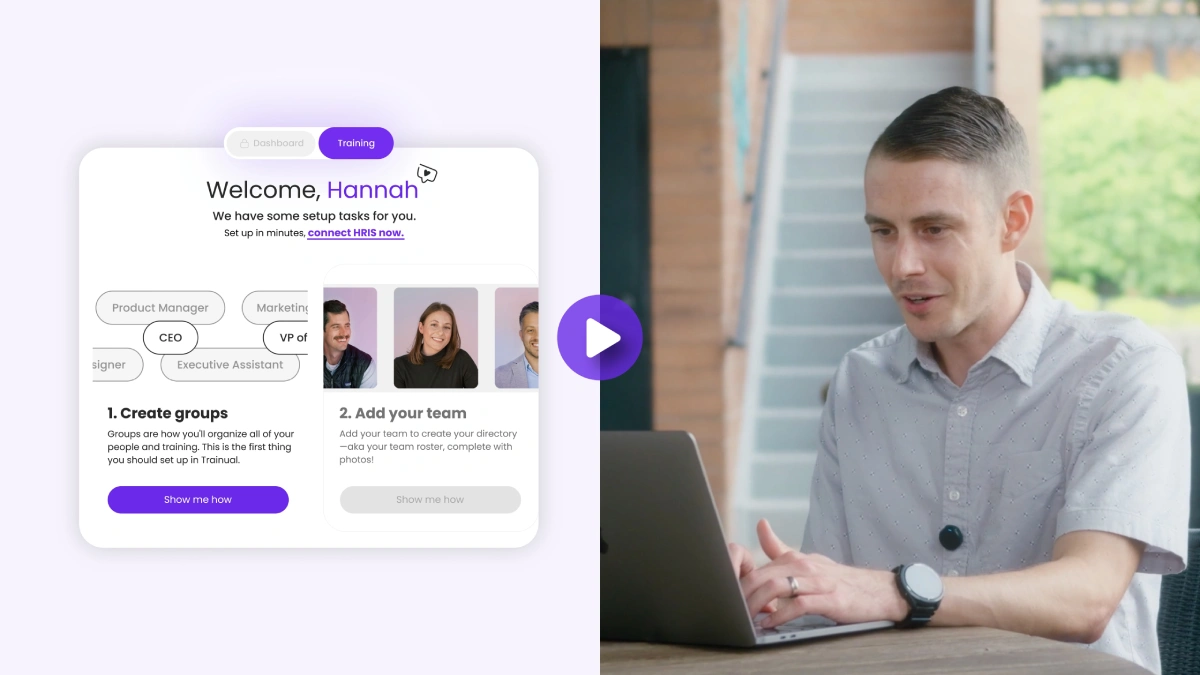
- Training assigned by role, not by hoping people read it. Bundle the right processes, policies, and SOPs into reusable onboarding and training paths and assign them automatically by role, department, or location.
- Knowledge that's tested and tracked. Add knowledge checks, set due dates and time estimates, and see completions and scores in one view with testing, tracking, and reporting — not a spreadsheet you maintain by hand.
- Ready-made expertise. Roll out 400+ expert-built HR, compliance, and development courses, plus SCORM uploads and required-watch hosted video, without building every course from scratch.
Google Docs helps your team find an answer. Trainual makes sure they learned it — and shows you who did.
🧭 Roles, accountability, and who owns what
Google Docs maps who does what on a page; Trainual keeps it in sync with your real people. You can sketch org structure in Docs — drop in a drawing, build a table, or pull an org-chart add-on from the Marketplace — and Workspace has a people directory. If you want a page that lays out who's responsible for what, you can make one.
The catch is that a drawing is a snapshot you maintain by hand as people move, leave, and change roles. Trainual treats roles as a living system:
- A real roles and responsibilities builder. Define roles and responsibilities once, then bulk-assign the right training and accountability to everyone in that role — connected to the documentation that explains how each responsibility gets done.
- An org chart and accountability chart that reflect reality. Visualize reporting lines and ownership with an org chart built from your people, not redrawn on a whiteboard every reorg.
- A plan for when work moves. The Delegation Planner™ shifts responsibilities during PTO, growth, or role changes — and hands off the exact training the next person needs, not just a list of tasks.
Google Docs lets you map who does what on a page. Trainual connects who does what to how it's done — and keeps the two in sync as the team changes.
✅ Compliance you can prove, not just store
Google Docs signs and stores; Trainual proves accountability to a specific policy. Credit where it's due: Google Workspace carries SOC 2 and ISO 27001, sharing permissions are granular, version history on a doc is complete, and Google now offers native e-signatures that send a contract for signature and keep an audit trail of who signed. For secure storage, access control, and executing the occasional agreement, that's a solid baseline.
Compliance usually asks a harder question: can you prove a specific person read, understood, and agreed to a specific version of a policy — and completed the training around it — months later, in front of an auditor? Signing a contract and proving accountability to a policy are different jobs.
- Sign-off tied to the training, not just the document. A Trainual e-signature is a dated, legally-binding acknowledgement attached to the exact policy — sitting right next to the completion record for the training that explains it.
- Completion as a record, not a guess. Testing, tracking, and reporting show who completed required training and how they scored, ready to export when someone asks.
- Courses that stay legal for you. The expert-built course library covers HR, safety, and regulated topics, updates as regulations change, and connects to your own policies rather than living in a separate app.
Both can hold your policies safely. Trainual turns compliance from a folder of documents into an audit-ready program you can stand behind.
🔁 Train, operate, and improve on one connected system
Google Docs documents the work; Trainual runs the work and develops the team that does it — from one place. Workspace gives you adjacent pieces — a spreadsheet to track goals, a Form to gather updates, Chat and Meet to talk it through — if you're willing to assemble and maintain them. Trainual brings that operating layer into the same system your documentation, training, and roles already live in, so the whole loop connects:
- Train — set the standard. Documentation, SOPs, and role-based training capture how work should be done, so everyone learns the same way.
- Operate — run the day to day. The Operations suite ties meetings and agendas, decisions and action tracking, team updates, and goals and scorecards to the documented knowledge and roles behind them.
- Perform — turn the record into growth. The Performance suite runs review cycles, expectations, growth areas, and feedback grounded in the roles you built and the work the team really did — so the review builds from real evidence instead of memory.
Google Docs documents one step. Trainual runs the loop — set the standard, run against it, and improve — on one connected system.
🤖 AI that knows how your company works
Both invest in AI, but they're grounded in different things. Gemini lives inside Google Docs and is excellent for the writing itself — drafting from a prompt, summarizing a long doc, matching tone across contributors, and pulling context from your Drive files and Gmail. It knows your documents.
Trainual AI is grounded in the connected system your company runs on:
- Answers from the live, owned source. Ask a question in plain language and Trainual AI answers from your documented processes, roles, and training — with a link back to the current version, not a stale copy.
- Creation and upkeep built in. Describe the training you need and Trainual drafts the steps, structure, and a quiz ready to assign the same day, and flags where content is going stale.
- Grounded in your whole system. Because training, operations, and roles live together, Trainual AI answers and insights span who owns what, what's blocked, and where the team stands — not just what a document says.
- Connect your own agents and knowledge. Pull scattered knowledge in through built-in connectors (including Google Drive), and connect custom AI agents to Trainual's MCP server so they answer with the context of how your company really works.
- Integrations. Trainual has a ChatGPT integration and Claude coming shortly!
Gemini helps you write the document faster. Trainual AI answers from the system your team is trained on, owns, and runs.
🌟 Where Google Docs has the edge
This isn't one tool being better at everything — it's two tools built for different centers of gravity. Google Docs is the stronger fit when the work revolves around creating and collaborating on documents themselves. Real-time co-editing is best-in-class, it works offline, it handles around a hundred languages, and it lives inside a full productivity suite — Sheets, Slides, Gmail, Meet, and near-limitless Drive storage — with a vast Marketplace and Apps Script to extend it however you like. It's free to start and inexpensive to run. For a team whose core need is writing, sharing, and storing documents — especially one already all-in on Google — that gravity is real. Plenty of teams keep Google Workspace for everyday productivity and add Trainual for the training and accountability layer on top; the two sit comfortably side by side, and Trainual even connects to Google Drive, Google Calendar, and Google sign-in.
💰 Pricing
Google Workspace bills per user per month across Business Starter, Standard, and Plus tiers; Trainual's pricing is scoped to your team size and needs through a demo.
✅ Choose Trainual if…
- You need documentation that stays accurate, owned, and verified — not written once and left to rot in a Drive folder.
- You want onboarding and training assigned by role, completed, tested, and tracked — with proof of who finished.
- Compliance has to be provable — signed against a policy, completed, and audit-ready — not just stored.
- You want roles, accountability, and org structure tied to real people and the work they own, and kept current as the team shifts.
- You want meetings, goals, scorecards, and reviews living in the same system that trains the team.
🎯 Choose Google Docs if…
- You're a small team with a handful of processes, and writing them down and finding them again is the whole job.
- Your core need is writing, formatting, and collaborating on documents in real time, and you want the best editor for that.
- You're already all-in on Google and want documents next to Sheets, Slides, Gmail, and Meet in one suite.
- Budget is the deciding factor today, nothing has to happen after a doc is shared, and you're not yet rolling training out across locations or tracking who completed it.
💡 Know what you're solving for
Google Docs is a superb place to write things down, and for a small team with simple needs it's the right call — we'll say that plainly. But needs rarely stay small. So the question to sit with before you choose is a simple one: is your real problem writing knowledge down and finding it again — or is it making sure every person, across every location, learns it, completes it, owns it, and is held accountable to it as the team grows?
🏆 Our pick: Trainual
If your priority is long-term clarity — knowing how work gets done, who owns it, and whether the team has truly learned it — Trainual is the better fit. It combines documentation, training, accountability, operations, and performance in one connected system, so knowledge doesn't just get written down; it gets taught, completed, verified, and kept current through growth, PTO, and turnover.
And it does that alongside the Google tools your team already uses, not by ripping them out. Want to see it in action? Book a demo and see how your team can stay aligned, accountable, and confident — or browse real customer stories first.
❓ Frequently asked questions
Does Google Docs have training or course tracking?
No. Google Docs is a document editor with no native course builder, quiz, or completion tracking. You can share a doc for someone to read, but you can't assign a learning path, confirm understanding, or prove completion. Trainual assigns role-based training paths, adds knowledge checks, and tracks who finished and how they scored.
Can Google Docs do e-signatures?
Yes. Google Workspace offers native eSignature in Docs and Drive PDFs on Business Standard and up, with an audit trail for completed contracts. It's built for named signers by email. Trainual e-signatures are legally-binding and attach a dated acknowledgement to a specific policy version — sitting next to the training completion record that explains it.
Does Google Docs have version history?
Yes. Google Docs has strong version history with named versions and one-click restore. Trainual also keeps version history with restore, but ties it to the exact content people are assigned to learn — so a change to a process updates the training around it, not just a file in Drive.
Is Trainual better than Google Docs for SOPs?
Google Docs is excellent for writing an SOP; Trainual is built to keep it true. Trainual gives every SOP a named owner, scheduled verification reminders, inline learner feedback, and AI answers that link to the current version — governance a document in a folder doesn't have.
Can Trainual replace Google Docs?
For most teams, Trainual replaces the shared drives and stray docs where processes, policies, and training live, while Google Docs stays your everyday document editor. Trainual even connects to Google Drive, Google Calendar, and Google sign-in, so the two work side by side.
Does Google Docs have an org chart or roles and responsibilities?
Not natively. You can draw a chart in Docs or add one from the Marketplace, but it's a static picture you maintain by hand. Trainual keeps a living org chart, a roles and responsibilities builder, and a Delegation Planner™ tied to your real people.
How much do Trainual and Google Docs cost?
Google Workspace bills per user per month, starting at Business Starter and rising with storage and features; Google Docs is included in every Workspace plan. Trainual's pricing is scoped to your team through a demo. See Trainual pricing and Google Workspace pricing.
Does Google Docs have AI?
Yes. Gemini is built into Google Docs for drafting, summarizing, and matching tone, grounded in your Drive files and Gmail. Trainual AI is grounded in your connected system — processes, roles, training, and operations — so it answers from the live, owned source and can build training and quizzes for you.
Can Trainual prove compliance training for an audit?
Yes. Trainual pairs a dated e-signature on a specific policy version with completion and score reporting you can export. Google Docs can store a policy and sign a contract, but it can't prove a specific person completed the training tied to that policy.
Is Trainual or Google Docs better for onboarding across multiple locations?
Trainual. It assigns the same role-based onboarding to every location, tracks completion, and keeps the experience branded and consistent. Google Docs shares the same file everywhere but can't confirm each new hire learned it or hold them accountable.