







Location 1 follows the official SOP. Location 4 follows the version the shift lead learned from his predecessor. Location 7 follows whatever the team decided made sense at the time. Every site is "doing it the right way" — and none of them are doing it the same way. That's the standardization problem most multi-location operators don't catch until it shows up in an audit, a customer complaint pattern, or a turnover spike. Growing companies are turning to LMS platforms built for cross-location standardization because the alternative is one brand operating as five companies. In this guide, we'll show you how to choose the right LMS for standardizing operations — from defining your metrics to running a pilot that proves real consistency.
Understanding the role of an LMS in operational standardization
An LMS built for operational standardization does more than centralize content. The right system enforces one canonical version of every SOP across every location, automates role and location-based assignment, tracks acknowledgment per person per site with an audit trail, and extends standardization beyond training to the operational rhythm that runs the company day to day.
Compared with running standardization on shared drives, email, and "ask the regional manager" workflows, an integrated approach delivers:
- Single source of truth — every location runs off the same canonical SOPs and policies.
- Automatic role and location assignment — new hires at every site get the right content on day one.
- Audit-grade acknowledgment tracking — version control and timestamps that survive regulatory review.
- Operational rhythm at every site — meetings, goals, scorecards, and updates running consistently.
The result: less drift, faster change distribution, and an operating layer that scales across the footprint.
Defining your success metrics for multi-location standardization
Before comparing platforms, define what success looks like. Clear metrics keep the evaluation focused on operational lift, not feature checklists.
Common standardization success metrics include:
Identify current gaps — SOPs that have drifted between locations, policy updates that never reached half the team, ramp time that varies wildly by site — and set concrete goals like "Lift SOP consistency rate from 60% to 95%" or "Cut time-to-distribute a process change from 3 weeks to 3 days." These benchmarks become the baseline for evaluating any platform.
Essential features of an LMS for operational standardization
Not every learning platform is built for multi-location enforcement. To genuinely close drift, focus on features that combine canonical content, automatic assignment, audit-grade tracking, and the operational rhythm layer that ties training to how every site actually runs.
Core features to look for:
- Single canonical SOP and policy library — one version per topic with location-specific layers added on top, not as forked versions.
- Automatic role and location-based assignment — the right hire at the right location gets the right content automatically.
- Audit-grade acknowledgment tracking — every SOP version tracked, every acknowledgment timestamped per person per site.
- Operational rhythm at every site — meetings, goals, scorecards, and async updates running on consistent cadences.
- Cross-location consistency reporting — dashboards showing which locations are caught up, behind, or drifting.
The goal isn't enterprise feature depth. It's a system where standardization is enforced, not just enabled.
Mapping technical requirements and integration needs
Selecting an LMS for multi-location standardization isn't only about features — it's about fit with your stack across every site. Begin with a quick audit.
Common connections include:
- HRIS for role and location data that drives automatic content assignment.
- SSO for seamless logins across distributed teams.
- Slack or Microsoft Teams for in-workflow notifications across locations.
- Compliance and audit tools for regulated industries (HIPAA, OSHA, DEA, state regulations).
Also review mobile compatibility for non-desk teams, multi-language support for international locations, and the device profile per site. A clear technical audit prevents the location-specific gaps that derail most rollouts.
Evaluating LMS platforms: what to look for in demos and trials
A real evaluation tests vendor promises against multi-location realities. Always include team members from multiple locations and at least one regional leader in your demos.
Targeted demo questions to ask:
- "Show me how a new hire at Location A and a new hire at Location B both get their role-specific training plus location-specific compliance — without anyone manually customizing the assignment."
- "Walk through how an SOP update pushes to every required reader at every location with acknowledgment tracking per person per site."
- "Show me a cross-location consistency report — which locations are caught up, behind, or drifting."
Apply the "coffee shop test": if a new hire at any location can complete assigned training, search a process question, and acknowledge a policy update on a phone with no instructions, the platform works at every site. Capture findings in a comparison matrix to keep the decision grounded in evidence.
Piloting your LMS: measuring drift reduction and acknowledgment rate
Before rolling out company-wide, pilot the shortlisted platform with two or three locations for 30 days. Single-location pilots miss the cross-location consistency questions that matter most.
During the pilot:
- Audit drift on three of your most-used SOPs across pilot locations.
- Replace location-specific versions with the canonical version in the platform.
- Track SOP consistency rate, cross-location acknowledgment rate, and ramp time variance against the previous baseline.
Teams running this pilot typically see SOP consistency climb from under 50% to over 90%, cross-location acknowledgment climb from under 30% to over 80%, and ramp time variance compress significantly within 30 days.
Scaling your LMS usage beyond initial standardization
The right LMS doesn't stop at the first round of canonical SOPs. Once documentation and acknowledgment are standardized, the same system can carry role-based training paths per location, AI search for "how do we do this now" during change, and the operational rhythm that scales standardization beyond training.
Many teams begin with documentation consolidation and basic role assignment, then expand to operational rhythm standardization (meetings, goals, scorecards, updates running consistently at every site), AI insights that flag drift before it shows up in audits, and the full operating layer tying every location to one source of truth. Over time, the platform becomes both a training system and the operating manual that enforces consistency at scale.
How Trainual delivers multi-location operational standardization
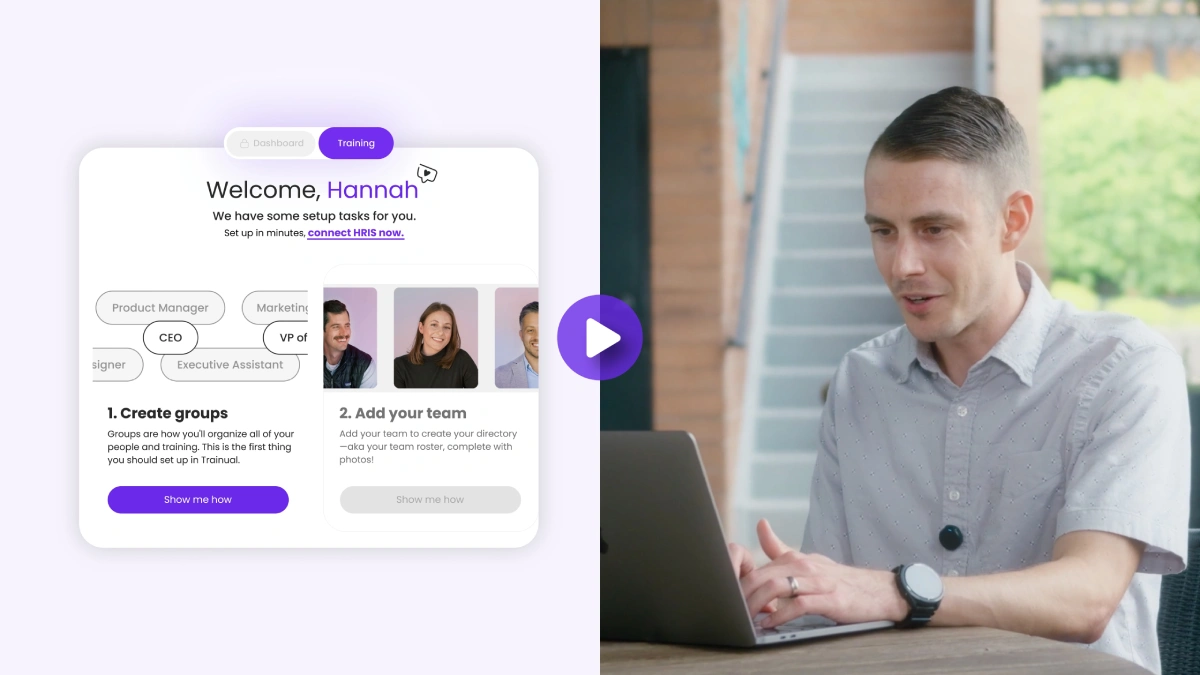
Trainual combines canonical SOPs, automatic role and location-based assignment, audit-grade version control, and the full operational rhythm in one platform built for growing multi-location operators. Its documentation platform holds one canonical version of every SOP and policy, the role chart drives automatic assignment by role and location, and version history timestamps every acknowledgment per person per site for audit-grade tracking.
A mobile-first interface covers the device profile non-desk and multi-location teams actually use. Operations Suite standardizes the operational rhythm — meetings, goals, scorecards, and async updates running consistently at every location. The AI Assistant answers "how do we do this here" in plain language, scoped to the asker's role and site.
For teams looking to move from one brand operating as five companies to one connected operating layer running at every site, Trainual offers a system where canonical content, role assignment, audit trails, and operational rhythm reinforce each other across the footprint.
Frequently asked questions
How do I start evaluating LMS platforms for multi-location standardization?
Audit drift on three of your most-used SOPs across locations, count acknowledgment rates from recent policy updates, and define outcomes like a higher SOP consistency rate or faster time-to-distribute a change.
What core features matter most for multi-location standardization?
Prioritize a single canonical SOP library, automatic role and location-based assignment, audit-grade acknowledgment tracking, operational rhythm standardization, cross-location consistency reporting, and mobile-first delivery.
How does an LMS handle location-specific compliance?
The right LMS layers location-specific requirements (state regulations, franchise-mandated policies) on top of the canonical SOP — not as forked versions. Role and location attributes drive the scoping automatically.
What are common pitfalls to avoid?
Buying enterprise-tier feature depth without testing whether the platform handles your actual cross-location drift. The smartest configuration fails when it doesn't get adopted at the locations farthest from HQ.
How do I ensure successful adoption across all locations?
Pilot with two or three locations including the one with the most cultural resistance to corporate standards. If the platform can standardize the hardest location, it'll standardize the rest. If it can't, the rollout will fail at scale.