




Ever realize that your team in HQ is operating on one version of the company and your remote team or second office is operating on another — and the gap got there slowly, without anyone noticing, until you spotted it in customer feedback or a process audit? The HQ team picks up information by osmosis. Hallway conversations. Quick check-ins. Senior leaders responding to questions in real time. The remote and satellite teams piece things together from Slack, periodic Zoom calls, and whatever was actually written down. By six months in, you're running two slightly different operating systems under one logo — and the people on the wrong side of the gap don't know they're on the wrong side until something breaks.
That's the knowledge sharing problem most growing distributed companies live in. It's not a tooling problem. Slack works. Email works. Zoom works. The problem is that real-time tools weren't designed to carry institutional knowledge — and most companies' knowledge bases are out of date, inconsistent, or just slow enough that nobody trusts them. So the team falls back on real-time human contact, and only the people in the right time zone or the right office stay current.
The data is brutal. Knowledge workers spend an average of 3 hours and 43 minutes a day communicating — half the workday spent trying to align with other people instead of doing the work. 38% of new remote hires hit technical issues, 29% feel isolated, 27% struggle to build authentic relationships. Only 12% of employees say their organization excels at onboarding — and for distributed teams, weak knowledge sharing is the root cause.
This guide walks through how a learning management system (LMS) — used the right way — turns knowledge sharing from a real-time coordination problem into an async-first system. Not just a wiki. A shared source of truth that closes the HQ-vs-remote gap, scales across time zones, and makes distributed work actually work.
Why knowledge sharing breaks across distributed teams
At a co-located company of 25 people, knowledge sharing is informal — everyone is in the same room, hearing the same context, operating on the same intuitions. At a distributed company of 25, the same approach already creaks. Nobody's in the same room. Context arrives unevenly. Intuitions diverge. By 50, the gap is observable. By 100+, it's structural.
The pattern is consistent. The reason isn't bad management. It's that real-time, in-person communication doesn't scale across time zones, locations, or remote arrangements. The teams who happen to be in the same room as senior leaders absorb context. The teams who aren't, don't. Without an explicit system for closing that gap, drift compounds.
The cost of that drift shows up everywhere:
- HQ team and remote team operating on different versions of the same policies
- New hires in different locations getting different ramp-up quality
- Process drift across regions because nobody's documented the central standard
- Senior employees burning out as the only async help desk for everyone in different time zones
- Customer experience inconsistency that traces back to internal knowledge inconsistency
- Talent retention drops in remote/satellite locations because employees feel left out
A good LMS — used as the central knowledge layer — fixes this. Here's how.
What an LMS does for distributed knowledge sharing
An LMS turns knowledge sharing from real-time coordination into async-first infrastructure. Here's what changes:
The combination is what closes the HQ-vs-remote gap. Real-time tools optimize for proximity. Async-first knowledge platforms optimize for distribution.
The 6-step framework for using an LMS for distributed knowledge sharing
Here's the framework — start to finish.
Step 1: Identify the highest-leverage knowledge gaps
Before documenting anything, identify where the gaps actually are. Where are the HQ team and remote team operating differently? Where do new remote hires consistently struggle that HQ hires don't? What knowledge currently lives only in HQ heads?
A useful framing: ask senior team members in each location, "What do you know about how the company works that the team in [other location] doesn't?" The answers are your documentation backlog. They're also the most valuable content you'll ever capture.
Step 2: Document the cultural and operational content HQ absorbs by osmosis
This is the step most companies skip. The cultural content — how the team handles disagreements, what "done" means, how decisions get made, what tone we use with customers — usually lives only in HQ heads. It's the most important content and the easiest to forget.
Capture it explicitly. Short docs. Loom videos from leadership. Examples of how the team has handled common situations. Async communication norms. The cultural foundation that HQ employees absorb in their first month becomes documented content every new hire — anywhere — accesses on day one.
Step 3: Move every shared decision and framework to a single platform
Decisions made in meetings tend to die in Slack threads. Frameworks shared in 1-on-1s never reach the rest of the team. This is the single biggest source of knowledge drift across distributed teams.
Move all of it to a searchable, shared platform. When a decision is made, it goes in the platform — with the rationale, the constraints, and the date. When a new framework is introduced, it's documented and assigned. The platform becomes the canonical home for "how we do things" — accessible to anyone, regardless of location.
Step 4: Assign content by role across locations
Use role-based assignment so every team member sees the same role-relevant content, regardless of where they sit. A customer success lead in HQ and a customer success lead in your second office both see the same playbooks, the same SOPs, the same updates. The role becomes the addressing system, not the location.
This is what closes the HQ-vs-remote drift structurally. Role-based assignment means the answer to "what does this role know?" is "the same thing, everywhere."
Step 5: Make content mobile and async-friendly
Distributed teams aren't always at desks. Make sure content works on mobile devices, in low-bandwidth environments, and in different time zones. Async-friendly means: comprehensive enough to stand alone (no "ping me if you're confused"), structured for skimming, accessible without live context.
The test: can a new hire in a different time zone, working in their own evening, ramp up on the content without scheduling a Zoom? If yes, the content is async-ready. If no, it's still dependent on real-time human contact — and that dependency is what creates the gap.
Step 6: Establish ownership and update cadence
Distributed knowledge platforms go stale faster than co-located ones because nobody is physically near them. Counter that by assigning explicit ownership for every key area of content. Set a quarterly review cadence. Use version history to track every update.
Without explicit ownership, every contributor assumes someone else is keeping content current. With it, the platform stays alive.
Common mistakes to avoid
The framework works. The implementation is where teams stumble.
Mistake #1: Treating documentation as one-and-done
The trap: You build a beautiful knowledge base. Six months later, half of it is stale.
The fix: Documentation is a living system. Set a quarterly review cadence. Use version history. Treat updates as routine, not exceptional.
Mistake #2: Documenting the easy stuff and skipping the cultural content
The trap: You document SOPs, policies, and processes. You skip the cultural content that's harder to articulate.
The fix: The cultural content is the most valuable content for distributed teams. Document it explicitly: tone, decision frameworks, async norms, how the team handles hard moments.
Mistake #3: Making the platform optional
The trap: "Look in the platform first, but if it's not there, ping someone." The team optimizes for "ping someone."
The fix: Make the platform the default. The first answer to any "how do we do X?" question is "search the platform — let me know if you can't find what you need."
Mistake #4: Letting HQ stay informal
The trap: HQ keeps absorbing content by osmosis. The platform is treated as a remote-only resource.
The fix: The platform is the source of truth for everyone. HQ employees use it the same way remote employees do. The discipline of writing things down for the platform serves the whole team.
Mistake #5: Underinvesting in async communication norms
The trap: You move documentation async but keep operating on real-time communication norms — expecting fast Slack replies, scheduling lots of Zoom calls.
The fix: Async-first culture and async-first documentation reinforce each other. Document the async norms. Make async the default for non-urgent communication.
What rolling this out should look like
Software is half the job. Rollout is the other half.
Week 1: Audit the gaps
Identify the top 5 knowledge gaps between HQ and remote/satellite teams. Ask senior team members in each location what they know that others don't. Build the priority list.
Week 2: Document the cultural foundations
Capture the cultural content that's hardest to scale: tone, decision frameworks, async norms, key examples. Short docs and Loom videos. The 5-10 pieces of foundational content every new hire needs.
Week 3: Move recent decisions and frameworks to the platform
Look at recent meeting decisions and 1-on-1 frameworks that haven't been documented. Move them to the platform with role-based assignment.
Week 4: Assign owners and set cadence
Every key content area gets an owner. Quarterly review cadence is set. Update protocols are documented. The system is alive.
Month 2
Expand. Document the next tier of content. Layer in more role-based paths.
Month 3
Track distributed metrics — ramp-up time by location, retention by location, support volume by region.
Quick wins you can implement this week
You don't need a full rollout to see value.
Quick win #1: Document one decision your team keeps re-litigating
Pick a decision that keeps coming up — usually because the original rationale wasn't documented. Capture the decision, the rationale, and the constraints. Push it to the platform.
Quick win #2: Capture one piece of HQ-only knowledge
Ask a senior HQ team member: "What do you know about the company that the remote team probably doesn't?" Document one item. Push it to the platform.
Quick win #3: Audit your last week of Slack DMs
Look at last week's DMs. How many were async questions that should have been findable in a doc? Each one is a documentation backlog item.
Quick win #4: Document async communication norms
Write a one-page guide to your team's async communication norms. Tone. Response time. Channel use. When to escalate to Zoom. Push it to every new hire on day one.
Quick win #5: Pick one role and document its full playbook
For one role on your team, document the complete playbook every team member in that role should know. Use role-based assignment to push it to everyone in that role across every location.
How to measure distributed knowledge sharing success
You can't fix what you can't measure.
1. Time to find an answer
Survey your team across locations: "How long does it take to find the answer to a typical work question?" Track quarterly. Aim for measurable improvement.
2. Ramp-up time consistency by location
Track new hire ramp-up time by location. The gap between HQ and remote ramp-up time should narrow as the platform takes hold.
3. Async question volume
Track how often the same async question reaches senior employees across time zones. A falling number means the platform is working.
4. Cross-location consistency
Audit how consistently the team is executing on key workflows across locations. Less variation = healthier distributed knowledge.
5. Retention by location
Track retention rates by location. If remote/satellite retention has historically lagged HQ, a lift after rollout is the strongest possible ROI signal.
One source of truth, every location
Most growing distributed companies have a knowledge sharing problem they can't see clearly until it's hard to fix. HQ absorbs content by osmosis. Remote and satellite teams piece things together. Both halves are doing their best, but the gap quietly widens with every hire and every change. The team isn't bad. The system around how knowledge actually flows is.
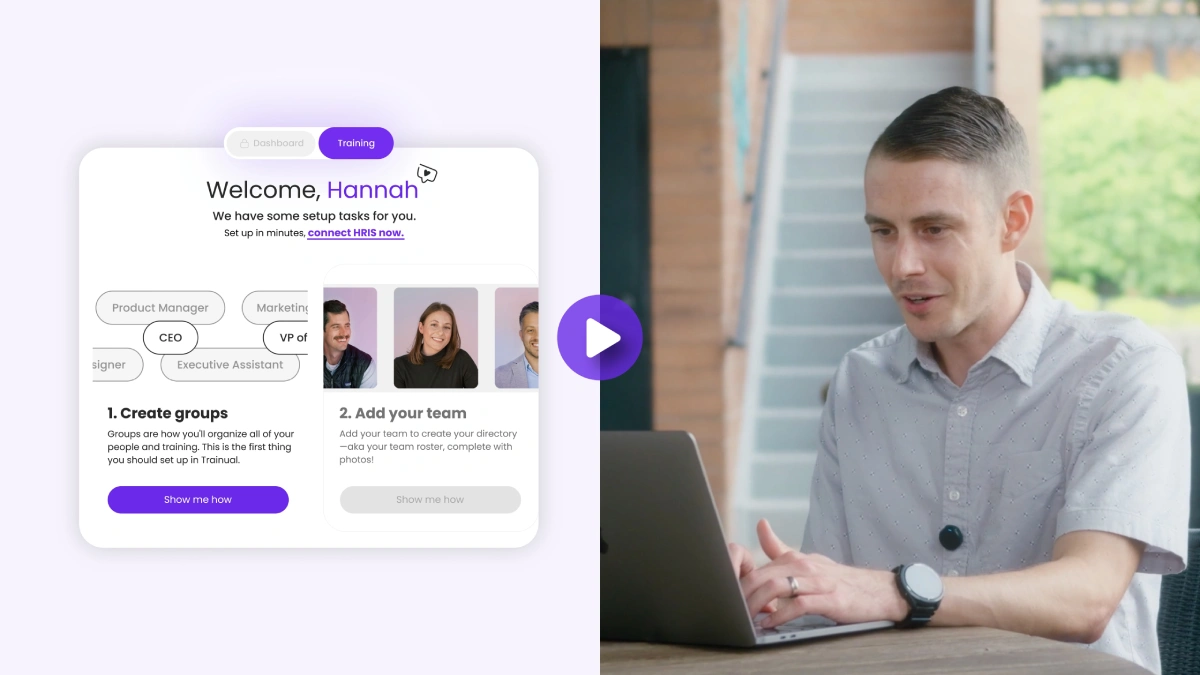
Trainual gives distributed companies the operating system to fix this. Searchable content every team member accesses, regardless of location. Role-based assignment that flows knowledge by role, not by location. Version history that pushes updates to everyone simultaneously. Mobile access for field, remote, and traveling team members. The async-first infrastructure that makes distributed work actually work.
Imagine a team where the content the HQ employee knows is the same content the remote employee knows — where new hires in any location ramp up on the same proven path, decisions don't get re-litigated, and your distributed team operates as one team across time zones. That's what's possible when knowledge sharing runs on a system instead of running on proximity.
Ready to see how Trainual works?
👉 Book a demo and experience how Trainual closes the HQ-vs-remote gap for distributed teams.
Want a sneak peek?
👉 Explore real customer stories from distributed teams who've built one shared source of truth.