






The Definitive Guide to Choosing an LMS for Knowledge Sharing Across Multi-Location and Remote Teams
The senior tech at Location 3 retires next quarter, taking 14 years of unwritten know-how with him. The new hire at Location 7 has been waiting two days for an answer her manager doesn't have. The remote support specialist in another time zone is rebuilding a process from memory because the SOP that exists at HQ never made it to her. That's the cost of fragmented knowledge in multi-location and remote teams — and it's why growing companies are turning to LMS platforms built for cross-location knowledge sharing. In this guide, we'll show you how to choose the right LMS for multi-location and remote teams — from defining your metrics to running a pilot that proves real lift.
Understanding the role of an LMS in multi-location knowledge sharing
An LMS built for multi-location knowledge sharing does more than store documents. The right system delivers role-scoped answers to any team member on any device — searchable in plain language, accessible offline when service drops, and grounded in your documented SOPs. It carries the knowledge that used to live with the senior employee at HQ to every location and every remote desk.
Compared with shared drives, Slack threads, and "ask your manager" workflows, an integrated approach delivers:
- Mobile-first access — field, healthcare, and retail teams find answers on a phone.
- AI search across all content — natural language queries return the right passage with the source linked.
- Role and location scoping — each team member sees what's relevant to their role and site.
- Audit-grade governance — every version tracked, every acknowledgment timestamped per location.
The result: faster answers, fewer interruptions to senior employees, and an operating layer that reaches every site equally.
Defining your success metrics for multi-location knowledge sharing
Before comparing platforms, define what success looks like. Clear metrics keep the evaluation focused on operational lift, not feature counts.
Common multi-location knowledge sharing success metrics include:
Identify current gaps — knowledge stuck with one senior person, SOPs that exist at HQ but never made it to satellite locations, remote team members rebuilding processes from memory — and set concrete goals like "Lift self-serve answer rate from 25% to 75%" or "Cut time-to-find from 12 minutes to under 1." These benchmarks become the baseline for evaluating any platform.
Essential features of an LMS for multi-location knowledge sharing
Not every learning platform is built for distributed teams. To genuinely shift how knowledge moves across locations, focus on features that handle mobile-first delivery, role and location scoping, and the AI search that turns documented content into instant answers.
Core features to look for:
- Mobile-first delivery — full search, content, and acknowledgment workflows on a phone.
- AI search with source linking — answers in plain language tied back to the SOP they came from.
- Role and location-based content scoping — each team member sees what's relevant to where they work.
- Audit-grade version history — every update tracked, every acknowledgment timestamped per location.
- Offline access for field teams — content cached for the moments service drops.
The goal isn't the platform with the most documentation features. It's the system that delivers the right answer to the right team member at the right location in the moment they need it.
Mapping technical requirements and integration needs
Selecting an LMS for multi-location knowledge sharing isn't only about features — it's about fit with your stack and the device profile of each site. Begin with a quick audit.
Common connections include:
- HRIS for role and location data that drives content assignment.
- SSO for seamless logins across sites and remote workers.
- Slack or Microsoft Teams for in-workflow notifications across remote teams.
- Mobile device management for non-desk teams using shared or BYOD phones.
Also review multi-language support for international locations, offline access for field teams, time zone awareness for distributed scheduling, and security standards (SOC 2, HIPAA where applicable). A clear technical audit prevents the adoption gaps that derail most distributed rollouts.
Evaluating LMS platforms: what to look for in demos and trials
A real evaluation tests vendor promises against the realities of distributed work. Always include team members from multiple locations — and at least one remote employee — in your demos.
Targeted demo questions to ask:
- "Open the platform on a phone. Have me search for an answer the way a field tech or remote support specialist would."
- "Show me how a team member at Location B sees content scoped to their role and site, while a team member at Location A sees something different."
- "Walk through what happens when service drops — can the field tech still access cached SOPs?"
Apply the "coffee shop test": if a remote team member can sign in from a phone, search a process question in plain language, and get the right answer with the source linked in under a minute, the platform fits how distributed knowledge actually moves. Capture findings in a comparison matrix to keep the decision grounded in evidence.
Piloting your LMS: measuring self-serve rate and cross-location lift
Before rolling out company-wide, pilot the shortlisted platform with two or three locations and at least one remote cohort for 30 days. Single-location pilots miss the cross-location questions that matter most.
During the pilot:
- Load 30-50 of your most-needed SOPs and role-scope them by location.
- Track self-serve answer rate and time-to-find against the previous baseline.
- Measure manager interruptions on knowledge questions and mobile usage share across cohorts.
Teams running this pilot typically see self-serve rate climb from under 25% to over 70%, time-to-find drop from 10-15 minutes to under 1, and manager interruption volume cut roughly in half within 30 days.
Scaling your LMS usage beyond knowledge search
The right LMS doesn't stop at search. Once team members at every location trust the platform for answers, the same system can carry role-based training paths, policy acknowledgment workflows, onboarding for new sites, and the connection back to SOPs that drive consistent operations across the footprint.
Many teams begin with a mobile-first knowledge base for one cohort, then expand to multi-location onboarding, AI-surfaced documentation gaps, and the operational rhythm that scales across sites. Over time, the platform becomes both a search tool and the operating layer that ties distributed teams to one source of truth.
How Trainual delivers multi-location and remote knowledge sharing
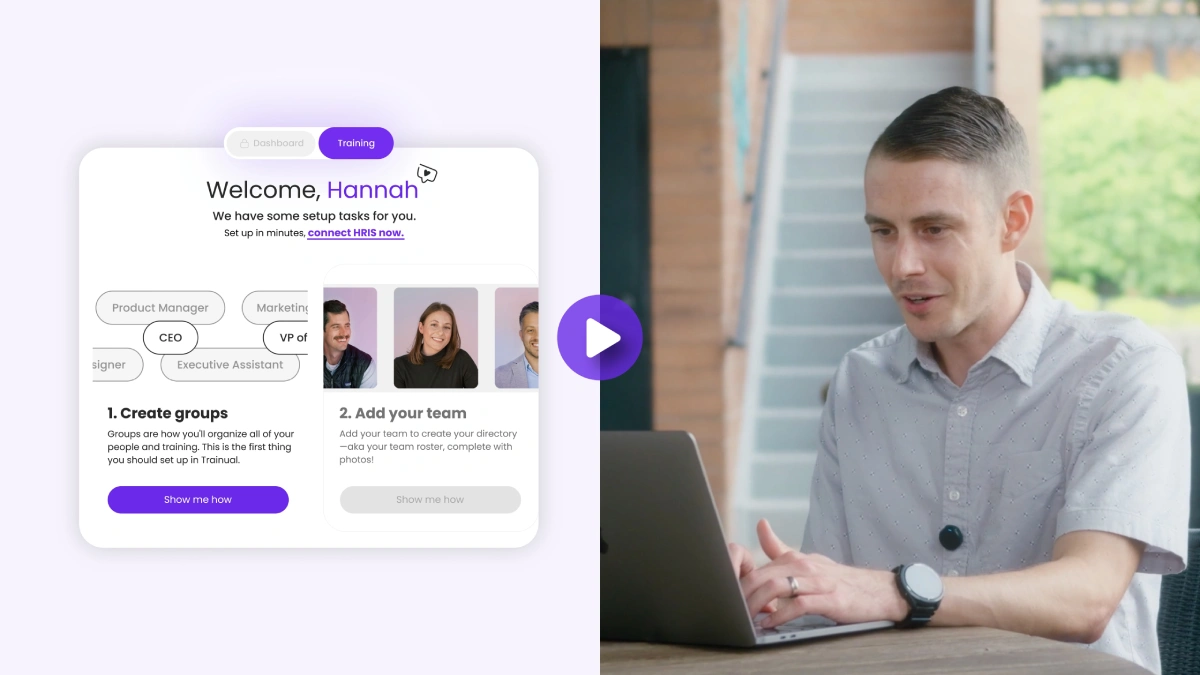
Trainual combines a mobile-first AI assistant, role-scoped content delivery, and version-controlled documentation in one platform built for growing distributed teams. Its searchable knowledge base and AI features let any team member ask a question in plain language and get the answer from your real SOPs — with the source linked on every response.
A mobile-first interface keeps the platform accessible on job sites, in clinic hallways, between calls, and across time zones. The role chart scopes answers and content to each team member's role and location, version history tracks every acknowledgment per person, and integrations with Slack, Microsoft Teams, and HRIS systems keep the platform available where distributed teams already work.
For teams looking to move knowledge from "stuck with one senior employee at HQ" to "available to every team member at every location," Trainual offers a grounded, role-aware, mobile-first knowledge layer that scales with the footprint.
Frequently asked questions
How do I start evaluating LMS platforms for multi-location knowledge sharing?
Audit how knowledge currently moves across locations, identify where it's getting stuck, and define outcomes like a higher self-serve rate or faster time-to-find for remote and field teams.
What core features matter most for distributed knowledge sharing?
Prioritize mobile-first delivery, AI search with source linking, role and location-based scoping, audit-grade version history, and offline access for field teams.
How does multi-location scoping work?
The right LMS lets the same SOP show up differently at different locations — standard procedure with location-specific layers — without forking the canonical content. Role-based and location-based attributes drive the scoping.
What are common pitfalls to avoid?
Buying for features without testing mobile experience. The smartest knowledge base fails when field teams can't use it on their phones in the moments knowledge matters.
How do I ensure successful adoption across distributed teams?
Pilot with multiple locations and at least one remote cohort, measure self-serve rate and mobile usage share, and roll out broadly only after the platform proves it shifts the default first stop from "ask a senior employee" to "search the platform."