




Ever wrap up a Friday and look back at the week realizing you spent half of it on Slack — typing context, answering questions about how things work, summarizing decisions you've already made, repeating the same answers to different teammates in different time zones, scheduling "quick syncs" to align on things that should have been written down once? You worked 50+ hours. You moved real work forward, but it took twice as long as it should have. By the end of the week, you can't tell the difference between productive collaboration and the metawork that fills the gaps in your async system. That's not a remote team problem. That's a system problem.
For remote teams at growing companies — fully distributed, hybrid with team members in multiple time zones, or even just an HQ with a growing remote contingent — this is the quiet tax that adds up week after week. Every interaction that worked fine in an office becomes a coordination problem. Every bit of context that lived in a senior employee's head becomes invisible to people in different time zones. Every new hire's first week gets shaped by who happened to be online when they logged on. The team's doing its best, but the standard keeps depending on real-time access — and remote work isn't real-time.
The data is brutal. Knowledge workers spend an average of 3 hours and 43 minutes a day communicating through emails, instant messages, video calls, and phone calls — half the workday spent trying to align with other people instead of doing the work. 38% of new remote hires hit technical issues, 29% feel isolated, 27% struggle to build authentic relationships, and 18% cite time zone coordination as a significant challenge. Only 12% of employees say their organization excels at onboarding — for remote-first teams, that gap translates directly into ramp time, retention, and the HQ-versus-remote drift that quietly fragments scaling companies.
This guide walks through the five things remote teams waste the most time on — and what to do instead. Each one is fixable. Each one tightens async coordination, closes the HQ-vs-remote gap, and gets the team back to actual work.
Time waster #1: Repeating the same context across time zones
The trap. Someone in HQ runs a meeting at 2pm Eastern. Decisions are made. Context is established. The team in Pacific catches up the next morning by reading meeting notes — if they're written down — and pinging the meeting attendees with questions. The team in Europe catches up at the start of their next day, often after the Pacific team has already moved forward. By the time everyone's aligned, three days have passed, four people have had to re-explain the same context, and at least one decision has been re-litigated because the right person wasn't in the original room.
The hidden cost. Knowledge workers spend 3 hours and 43 minutes per day communicating — for distributed teams, a meaningful chunk of that is re-establishing context that's already been established somewhere else. The cumulative cost shows up everywhere: slower decision-making, more meetings, more 1-on-1 catch-ups, more "let me explain that again" Slack threads. The work moves at the speed of context propagation, not at the speed of the work itself.
The fix. Get every important decision, framework, and piece of context into a searchable, shared platform the whole team accesses asynchronously. The strategic context that someone in HQ would absorb by osmosis becomes a doc the team in Lisbon can read at their desk. Decisions get documented when they're made — once. Frameworks live in one place that's findable from any time zone. The context propagation problem stops being a coordination challenge and starts being a writing-things-down problem, which is much easier to solve.
Time waster #2: Onboarding remote hires through ad-hoc Zoom marathons
The trap. A new hire joins remotely. Their first week is a calendar full of Zoom calls — 1-on-1s with HR, the manager, every senior team member, every cross-functional partner. Each call is supposed to deliver context. Each ends up being about 30% useful information and 70% chitchat. The new hire takes notes. Half the notes don't make sense by week two. The new hire isn't sure what they're supposed to know vs. what they'll figure out. Meanwhile every senior team member loses 1-2 hours of focused work per onboarding round.
The hidden cost. 82% better retention and 70% higher productivity come from structured onboarding — but only 12% of employees say their organization excels at it. For remote teams, where the margin for error is smaller and the cost of a disengaged new hire is higher, weak onboarding translates directly into turnover within the first six months. 38% of new remote hires face technical issues alone, before you even get to the human onboarding work.
The fix. Build a structured, async-first onboarding path every new remote hire works through self-serve in their first week. Tools setup. Company context. Role expectations. Team norms. Each piece happens at a predictable time, in a predictable order, with knowledge checks to verify it landed. Live sessions are reserved for relationship-building and coaching — the moments that actually need a human. Senior team members come in for the high-leverage conversations instead of delivering content the system could deliver. The new hire ramps up as fast in Lisbon as they would in HQ. The senior team's calendar comes back.
Time waster #3: Documenting decisions that immediately get lost
The trap. Your team makes a decision in a meeting. Someone takes notes. Notes get pasted into a Slack thread. Slack thread scrolls off. Two weeks later, someone needs the decision. They search Slack. They scroll. They eventually find the thread, but they're not sure if it's the latest version or if the decision got revised in a follow-up meeting. So they ping the original decision-maker for confirmation. The decision-maker confirms — but now you've spent 45 minutes of three people's time finding something that was supposedly documented.
The hidden cost. Knowledge workers spend 30% of their workday searching for information — and for remote teams, the version of this problem is "searching for decisions and context that should be findable but aren't." The compound cost: when context isn't findable, teams default to scheduling sync meetings to re-establish it, which kills async productivity. The reason remote teams over-meet is rarely that they need real-time conversation — it's that the async docs aren't reliable enough to answer the question.
The fix. Move important decisions, frameworks, and context out of Slack threads and into a structured platform with version history. Decisions get documented when they're made — in a findable place, with a timestamp, with the rationale. When something updates, the new version replaces the old one. The team doesn't have to scroll Slack hoping to find the right thread; they search the platform and find the current version. The "did we decide this?" question becomes a 30-second search instead of a 45-minute investigation.
Time waster #4: HQ and remote teams operating on different versions of the same company
The trap. Your HQ team absorbs company norms by osmosis — they overhear conversations, sit in on impromptu hallway chats, see how senior leaders respond to questions in the moment. Your remote team doesn't have access to any of that. So they piece together how things work from Slack threads, occasional Zoom calls, and the documented content that exists. Six months in, the HQ team is operating on one version of the company and the remote team is operating on another. The gap shows up in execution drift, in different interpretations of the same strategy, in remote employees feeling slightly out of sync without being able to point to why.
The hidden cost. This is the silent cost most growing remote-first companies don't see until it's hard to fix. The team isn't bad. The remote employees aren't underperforming. But the company is slowly running on two different operating systems, and the gap quietly widens as headcount grows. Customer-facing inconsistency follows. So does retention friction — remote employees who feel like they never quite caught the full picture eventually leave to work somewhere they understand better.
The fix. Document the cultural and operational content that HQ employees absorb by osmosis. Async communication norms. Decision-making frameworks. How the team handles disagreements. What "done" means. Strategic context. Leadership operating principles. Move it all to a shared platform every team member accesses, regardless of location. The HQ-vs-remote drift closes because everyone's operating from the same source — not because the remote team finally caught up to HQ, but because HQ stopped relying on osmosis and started writing things down for everyone.
Time waster #5: Async communication that defaults back to sync because no one trusts the docs
The trap. You're trying to run an async-first team. You ask people to read the docs first, then escalate to Slack if they have questions. But the docs aren't reliable — they're outdated, hard to find, or only partially useful. So team members default back to "let me ask in Slack" because Slack is faster than searching docs they don't trust. Slack becomes the de facto async system. Slack overflows. The async-first promise fails not because async-first is wrong, but because the underlying documentation isn't strong enough to support it.
The hidden cost. 54% of work time goes to creating or updating documents — for remote teams, much of that is re-explaining things in Slack that should have been in docs. The deeper cost: the team never builds the muscle for async-first work because the system underneath isn't reliable enough. Every team member's default move stays "ask in Slack" instead of "search the doc," and the meeting load stays higher than it needs to be because the async layer can't bear the weight.
The fix. Invest in making your documentation actually reliable — and then enforce the search-first norm. Use a searchable, role-based, version-controlled platform the team trusts. Owners assigned to every key doc. Update cadence built in. The first time someone asks a question in Slack and the answer is "the doc says X, search it next time," it feels harsh. By the tenth time, the team has built the muscle. The platform becomes the fastest path to the right answer because it actually is — and the async-first promise starts working because the system underneath finally supports it.
What time-rich remote work looks like
When your team stops paying the daily tax of bad async systems — repeating context across time zones, ad-hoc Zoom onboarding, decisions getting lost in Slack, HQ-vs-remote drift, sync defaulting because docs aren't trusted — remote work changes. The Lisbon hire ramps up as fast as the HQ hire. The team works at the speed of decisions, not the speed of context propagation. The HQ-vs-remote gap stays closed. Senior team members stop being the async help desk for every time zone. The team operates like one team across time zones, not several loosely affiliated ones. That's what remote work at scale actually looks like. And it's not about working more hours — it's about building the right system once and getting back the time it gives you forever.
How to stop wasting time this week
You don't need a six-month transformation to see results. A few focused actions this week will start the unwinding.
Quick win #1: Audit your last week of Slack DMs
Look at your last week of Slack DMs. Identify the messages that were really "context that should have been written down once." That backlog is your documentation roadmap.
Quick win #2: Pick the top 3 decisions that keep getting re-litigated
Identify three decisions your team keeps revisiting because no one can find the original rationale. Document the decision, the rationale, and the constraints in your platform. Reference it next time the topic comes up.
Quick win #3: Build a structured first-week path for your next remote hire
For the next person joining your remote team, build a self-serve first-week path before they start. Tools setup. Company context. Role expectations. Team norms. The doc becomes the foundation for every future remote hire.
Quick win #4: Document your team's async communication norms
Every remote team has implicit norms — tone, response time, channel use, when to escalate to Zoom. Write them down. One page. Share with the team. Assign to every new hire on day one.
Quick win #5: Identify the senior team member who's the async help desk
Pick the team member who answers the most cross-time-zone questions. Sit with them for 30 minutes. Capture the questions they answer most often. Document them in your platform. Their async help desk role drops noticeably within two weeks.
How to measure remote time recovery
Tracking time recovery is how you prove the system is working — to your team, leadership, and yourself.
1. Hours per week on async coordination vs. focused work
Pick a representative week and log how you actually spend your time. Set a baseline. Track quarterly. Aim to flip the ratio so focused work takes the majority within a quarter.
2. Time-to-decision across time zones
Track how long it takes the team to make decisions that require alignment across regions. A measurable drop is direct evidence async documentation is working.
3. Remote new-hire ramp-up time
Track how long it takes a new remote hire to operate independently. A measurable drop — especially compared to HQ hires — is direct evidence onboarding is closing the location gap.
4. Repeat question volume
Log how often the same async questions come back. A falling number means the team is using the platform — and your time is coming back.
5. Retention by location
Compare retention rates across regions — HQ, remote, international. If remote retention has historically lagged HQ, a lift after rollout is one of the most meaningful ROI signals you can get.
Stop coordinating. Start working.
Most remote teams at growing companies are stuck in coordination overhead because the system underneath them was built for an HQ team — or no system at all. The context repeated across time zones. The Zoom marathons for new hires. The decisions lost in Slack. The HQ-vs-remote drift. The async-first promise that defaults back to sync. None of it is wrong — it just doesn't scale to a team that's trying to operate as one across time zones.
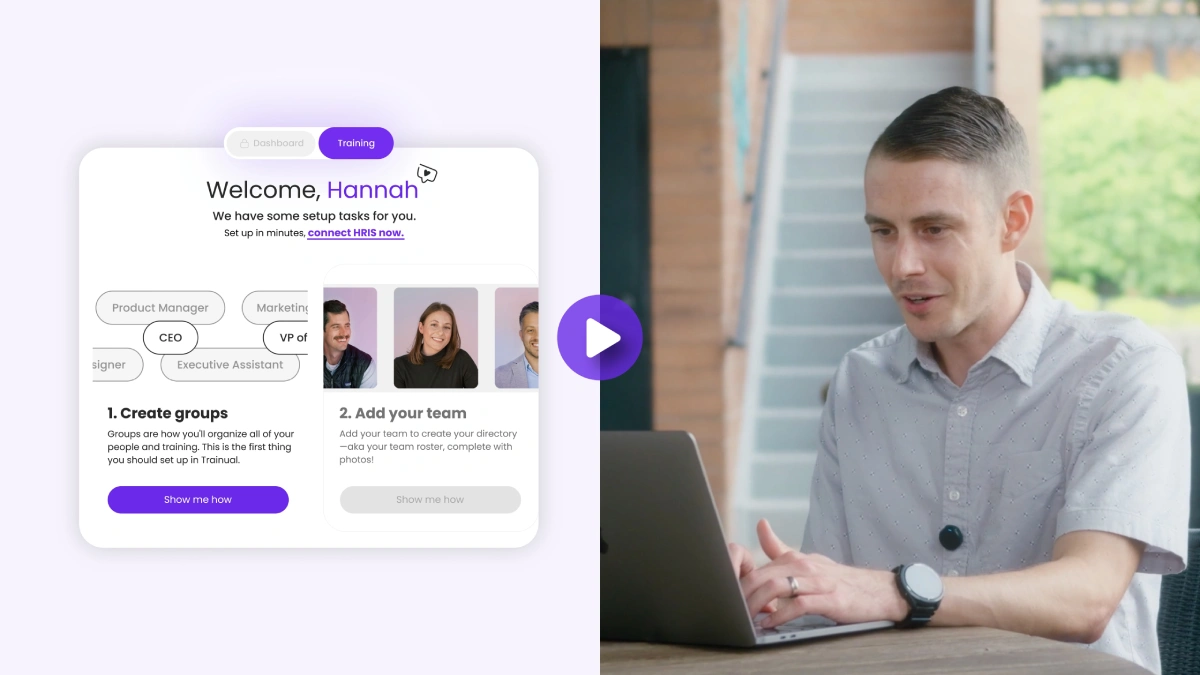
Trainual gives remote teams the operating system the work actually needs. Searchable, role-based content every team member accesses regardless of location. Structured async onboarding that doesn't depend on senior team member availability. Version history that turns decisions into findable artifacts. Shared documentation that closes the HQ-vs-remote gap. The kind of reliable async layer that finally supports the async-first promise. The time zones don't disappear — but the coordination tax around them does.
Imagine a remote week where the team operates at the speed of decisions, not the speed of context propagation — where new hires in any time zone ramp up as fast as the HQ hire, async-first actually works, and the HQ-vs-remote gap quietly closes. That's what's possible when remote work runs on a system built for distributed teams.
Ready to see how Trainual works?
👉 Book a demo and experience how Trainual gives remote teams their time back — with documentation, onboarding, and shared context running on a system instead of scattered tools.
Want a sneak peek?
👉 Explore real customer stories from remote teams who've reclaimed their async productivity.