





Ever sit down on a Monday morning with a clear list of strategic priorities — process redesign, vendor consolidation, capacity planning, the cross-functional initiative that's been on your roadmap for two quarters — and by Tuesday at noon, you've answered 17 Slack messages about how a process works, walked two new managers through onboarding, fielded a "quick question" from finance that took 45 minutes, and approved three workflow exceptions that should have been self-serve? You'll get to the strategic work after lunch. Then after the 2pm. Then tomorrow morning. Then "next week, for sure." The strategic work never moves. The operational work always shows up. And every operations leader at a growing company has lived this exact week, on repeat, for years.
For ops leaders running operations at 50, 200, 500 employees — COOs, ops directors, heads of operations, integrators, chiefs of staff — this is the quiet ceiling on your impact. Every individual interruption feels small. A two-minute answer here, a five-minute approval there, a thirty-minute walkthrough every time someone new joins. But the math compounds across a week, a month, a quarter. The frameworks you wanted to build, the processes you wanted to redesign, the cross-functional alignment you wanted to drive — they all get pushed because the daily operational chaos keeps showing up first.
The data backs it up. Knowledge workers waste over 40% of their time on manual administrative processes. Office workers spend 41% of their time on tasks that are "low value, repetitive, or lack meaningful contribution to their core job function." For operations leaders specifically — the people who own how work gets done — the burden is even higher. You're not just doing the operational work yourself; you're answering questions about how everyone else should do theirs.
This guide walks through the five things operations leaders waste the most time on — and what to do instead. Each one is fixable. Each one gives you back hours that compound into real strategic capacity over time.
Time waster #1: Being the answer key for how work gets done
The trap. You know how every process at your company actually works. You've documented some of it in your head, some of it in a Notion doc, some of it in the EOS workbook from three years ago, and the rest lives only in conversations with the people who built it. So when anyone — finance, sales, CS, HR, the new hire who started Tuesday — has a question about how something works, they come to you. Because you're the one who knows. Each question is reasonable. None of them feel like a problem. Until you realize you've spent half your week being the human help desk for the company's operating system.
The hidden cost. 82% of people don't have a time management system in place — and the average worker spends 51% of their workday on tasks of little to no value. For ops leaders, the cost compounds because every interruption isn't just the answer time; it's the context-switching tax. The strategic work requires deep focus, and you can't reach deep focus when you're getting interrupted 60 times a day, which is the average. Multitasking alone costs employees 6 hours of productivity per week.
The fix. Get every recurring "how does X work" question into a searchable, role-based operating manual the team can find on their own. The processes you've been answering questions about. The workflows the team needs to execute. The decision trees for common exceptions. When someone asks, the answer isn't "let me explain" — it's "search for it, ping me if you can't find what you need." The first redirect feels uncomfortable. By the tenth, you've trained the org to look first and ask second. The questions don't go away — they go to a system that doesn't get tired of answering them.
Time waster #2: Approving workflow exceptions that should be self-serve
The trap. Your team has a workflow for handling refund requests over $500. For renewing vendor contracts. For approving travel over a threshold. For handling customer escalations. The workflow exists. It's documented somewhere. But because the documentation isn't clear, or isn't trusted, or isn't current, every exception gets routed back to you for "quick approval." You approve it in 30 seconds. The person feels confident. You move on. And then it happens again, and again, and again — sometimes on the same exception, sometimes from the same team member who already asked you last week.
The hidden cost. The time on each approval is misleading. The actual cost is in the bottleneck you create. Every workflow that ends at your inbox is a workflow that stops moving when you're in a meeting, on PTO, or focused on strategic work. Your team learns that the fastest path is "just get the ops leader's approval" — which means more requests come to you over time, not fewer. 73% of companies waste time on manual tasks that automation could handle. Workflow exceptions are exhibit A.
The fix. Document every exception path with clear criteria for who has authority to approve what — and put that authority in writing. Use role-based content delivery to make sure every team member sees exactly which decisions they own and where their authority ends. The default question shifts from "can you approve this?" to "the doc says I can approve this myself — am I missing something?" Your role becomes the strategic backstop for genuinely novel situations, not the rubber stamp for routine exceptions.
Time waster #3: Walking every new manager through how the company works
The trap. When a new manager joins — whether through hire or promotion — you spend hours over their first month walking them through how the company actually operates. The org structure. The decision-making framework. The cross-functional dependencies. The "here's what's documented and here's what isn't." You know the content cold. You can deliver it well. But you're delivering it to every new manager, one at a time, every time someone new joins.
The hidden cost. Almost 60% of first-time managers never receive management training. Less than half of managers overall are formally trained — yet 70% of team engagement variance is attributable to the manager. The cost of this gap isn't just your time walking them through; it's the downstream cost when managers without proper context make decisions that ripple through the organization. Bad management decisions compound. Inconsistent context multiplies.
The fix. Build a structured training path for new managers that covers the company-wide context every leader needs — org structure, decision frameworks, cross-functional dependencies, escalation paths. Include knowledge checks to verify comprehension. Include role-specific content for what they own. Your time stops being "delivering the manager onboarding curriculum" and starts being "showing up for the strategic 1-on-1 conversations that actually need a human." You scale your influence without scaling your calendar.
Time waster #4: Maintaining processes that exist in five different places
The trap. Your refund SOP lives in a Notion doc. The escalation process is documented in Slack. The vendor onboarding flow lives in a Google Doc. Some workflows have a Loom from 18 months ago. Others are tribal — the team just knows. When something changes — a new approval threshold, a new tool, a regulatory update — you have to remember every place a process is referenced and update each one. You inevitably miss some. Six months later, two team members are working off two different versions of the same SOP, and the cleanup is more work than the original update.
The hidden cost. The time isn't just maintenance; it's the downstream cost of inconsistency. Conflicting answers depending on which doc someone found. New hires learning from outdated content. Decisions made on stale information. 27% of cybersecurity incidents trace back to paper-based documents that are misfiled or fall into the wrong hands — and 57% of employees feel restrained by legacy tech. For ops leaders, the meta-cost is that your operating system isn't actually a system. It's a collection of artifacts you have to remember.
The fix. Consolidate every process, SOP, and workflow into one platform with version history. One source of truth. One place to update. Every change captured with a timestamp. When something updates, the new version pushes to everyone who's affected, and the old version is replaced — not buried somewhere it can resurface. The platform becomes the actual operating system, not a metaphor for one.
Time waster #5: Rebuilding the same processes after every reorg, system change, or new hire wave
The trap. Every six to twelve months, something changes. A reorg. A new tool. A team realignment. Each time, you spend significant time rebuilding processes that already mostly worked — re-documenting workflows, re-training teams, re-introducing the operating system to people who've been at the company for years. The processes themselves haven't changed much. The wrapper around them has. And every wrapper change costs weeks of your time.
The hidden cost. 73% of companies waste time on manual tasks that automation could handle. Among the most common: re-documenting and re-training on processes that already exist somewhere. Rebuilding from scratch instead of evolving from a foundation. Each cycle eats the time you should be spending on the strategic initiatives the reorg or system change was supposed to enable in the first place. The reorg doesn't deliver its full ROI because the operations leader spent the next quarter rebuilding documentation.
The fix. Build your operating system on a foundation that evolves rather than restarts. Use templates and pre-built content for the processes that don't actually change between reorgs. Use role-based assignment so when teams shift, the underlying SOPs stay attached to the new roles automatically. Use version history to track changes incrementally instead of starting over. The reorg becomes a structural change to the operating system — not a reason to rebuild it.
What time-rich operations leadership looks like
When you stop spending the majority of your week as the company's human help desk, your job changes. You become the strategic operator the company actually needs — driving cross-functional alignment, redesigning processes that aren't working, building the operating system that scales. Not because you stopped caring about the day-to-day, but because the day-to-day finally runs on a system that doesn't require you in every loop. That's what operations leadership at scale actually looks like. And it's not about working harder — it's about building the right system once, and getting back the time it gives you forever.
How to stop wasting time this week
You don't need a six-month transformation to see results. A few focused actions this week will start the unwinding.
Quick win #1: Audit your last 30 days of Slack DMs and emails
Look at what people have asked you in the last month. Categorize: how many were genuinely strategic vs. how many were "how does this work" questions someone else could have answered? The second bucket is your documentation backlog.
Quick win #2: Pick the top 5 workflows you approve most often
Identify the five exception types that route to you most. Document the criteria for who has authority to approve what. Push that authority down explicitly. The first month is awkward; the second month, the requests stop.
Quick win #3: Block one hour a day for documentation
Take a page from leaders who've done this well: block 8-9am or another protected hour for documentation. Write the SOPs. Build the playbooks. Update the workflows. The hour you protect now compounds into the ten hours you reclaim later.
Quick win #4: Map every place a single SOP currently lives
Pick one important workflow and find every place it's documented — Notion, Google Docs, Slack, Loom, email. The list will be longer than expected. That list is your consolidation roadmap.
Quick win #5: Identify the next manager hire or promotion
For the next person stepping into a leadership role, document the company context they'll need before they start — not during their first month. The doc you build for them becomes the foundation for every future leader.
How to measure operations time recovery
Tracking time recovery is how you prove the system is working — to leadership, to your team, and to yourself.
1. Hours per week on strategic vs. operational work
Pick a representative week and log how you actually spend your time. Set a baseline. Track quarterly. Aim to flip the ratio so strategic work takes the majority of your time within a year.
2. New manager ramp-up time
Track how long it takes a new manager to operate independently. A measurable drop is direct evidence the operating system is doing the lifting your calendar used to.
3. Repeat question volume
Log how often the same question recurs. A falling number means the team is using the system — and your time is coming back.
4. Cross-functional decision speed
Track how long it takes for cross-functional decisions to move through your team without your direct intervention. Faster decisions = healthier operating system.
5. Strategic project completion rate
The most important metric. Are you actually finishing the strategic work you set out to do each quarter? If yes, the operating system is giving you back the time the daily chaos used to consume.
Stop being the help desk. Start operating at scale.
Most operations leaders at growing companies are stuck running the day-to-day because the system underneath them was built for a smaller team. The processes in scattered docs. The workflows that route to your inbox. The new managers who can't ramp without your weekly time. The reorgs that require rebuilding instead of evolving. None of it is wrong — it just doesn't scale to where you're trying to go.
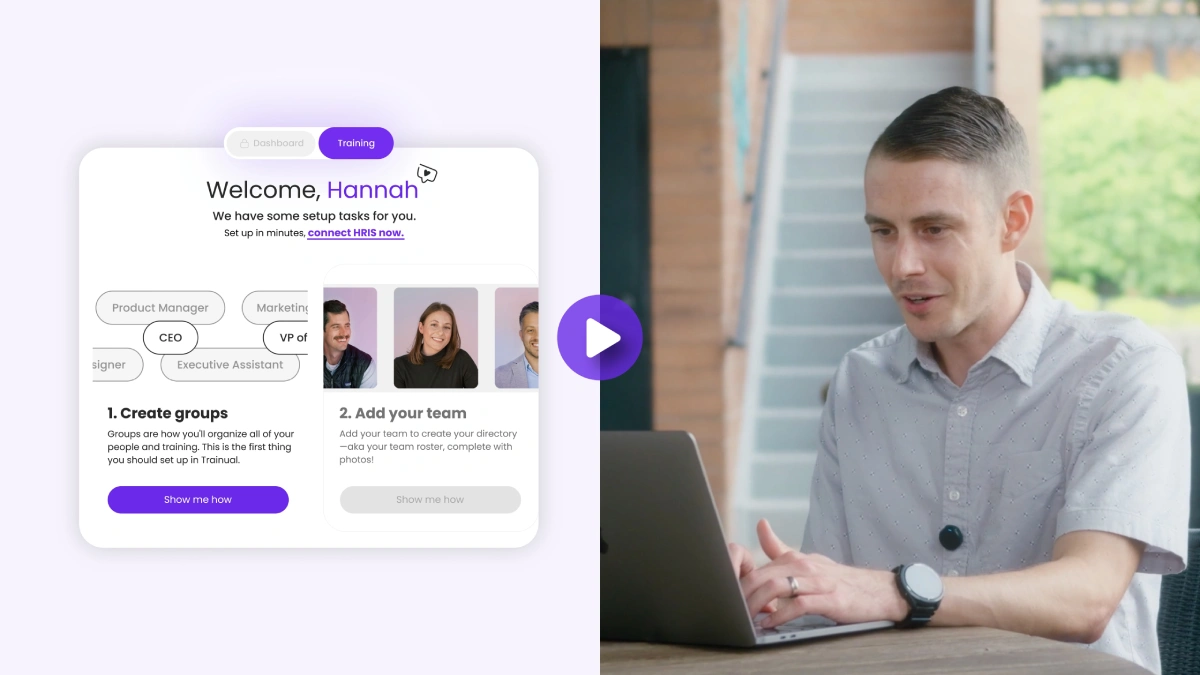
Trainual gives operations leaders the operating system to stop being the human help desk. Documented processes and SOPs in one searchable place. Role-based content so every team member sees what applies to them. Manager onboarding paths that scale without your calendar. Version history that turns updates into incremental changes, not full rebuilds. The day-to-day work doesn't disappear — it stops requiring you to make it happen.
Imagine an operations week where you spend more time on strategy than on Slack replies — where new managers ramp themselves on day one, processes update once and reach everyone instantly, and your operating system actually operates without you in every loop. That's what's possible when ops runs on a system instead of running through your calendar.
Ready to see how Trainual works?
👉 Book a demo and experience how Trainual can give operations leaders their time back — with processes, roles, and onboarding running on a system instead of your inbox.
Want a sneak peek?
👉 Explore real customer stories from operations leaders who've reclaimed their time.