




Ever sit down at 9am with a clear plan for the day — three deep-work blocks, one focused project, a deadline by EOD — and by 11am realize you've spent the morning hunting for a doc you know exists somewhere, asking three people to confirm a process, sitting through a status meeting that could have been a Slack message, and refreshing the same dashboard four times waiting for something to update? You've technically been "working" for two hours. You've moved nothing forward. By 5pm, the deadline is still looming, the focused project never got opened, and tomorrow starts with the same backlog plus everything that came in today. That's not a desk-based team problem. That's a system problem.
For desk-based teams at growing companies — engineers, designers, marketers, finance, operations, account managers, anyone whose primary work happens at a screen — this is the quiet trap. The work itself is knowledge work. But the day keeps getting eaten by the metawork around the work — searching for information, asking the same questions, sitting in meetings that exist because no one documented the answer. Each interruption feels small. Stacked across a week, they consume the time you're actually being paid for.
The data is brutal. Knowledge workers spend 1.8 hours every day — nearly a quarter of their workweek — searching for information. McKinsey put it bluntly: businesses hire 5 employees but only 4 show up to work, because the fifth is off searching. A more recent enterprise search survey found the average worker spends 3.2 hours each week just searching for information — over 166 hours a year, more than a full month of work lost to redundant searching. For a team of 50, that's 8,320 hours a year gone — the equivalent of four full-time employees doing nothing but hunting.
This guide walks through the five things desk-based teams waste the most time on — and what to do instead. Each one is fixable. Each one gives you back hours that compound into real focused work over time.
Time waster #1: Searching for information that already exists somewhere
The trap. You need a doc. You're 80% sure it exists. You search Slack. You search Google Drive. You search Notion. You search your inbox. You ask the person who probably wrote it. They search their own files. After 15 minutes, someone finds it — buried in a folder no one would have guessed. You bookmark it, knowing you'll forget where the bookmark is in three months. The doc is fine. The system around it isn't.
The hidden cost. Knowledge workers spend 30% of their workday searching for information. Workers take up to 8 searches to find the right document. 21.3% of productivity is lost to document-related challenges, costing the average business $19,732 per information worker per year. Beyond the time, every search is a context switch — pulling you out of focused work and dropping you back in. The compounded interruption tax is bigger than the search time itself.
The fix. Get every important reference document into one searchable platform — processes, policies, playbooks, role expectations, standard operating procedures. One platform, one search bar, one source of truth. The 8-search hunt becomes a 1-search find. The bookmarks no one can find become a structured library. The 15-minute "where's that doc" question becomes a 30-second answer. Multiply that by every desk worker on your team and you're talking about hours per person per week — quietly given back.
Time waster #2: Sitting in meetings that exist because no one documented the answer
The trap. Every desk-based team has a calendar full of meetings that exist because the alternative is worse. The weekly sync that mostly recaps things people should already know. The cross-functional meeting where 80% of the time is one person catching everyone else up. The status meeting where each person reads their update aloud. The "quick alignment" meeting that takes 45 minutes because no one wrote down the decision from last time. None of these meetings are wrong. They exist for real reasons. But the underlying need — shared context — could be served much more efficiently in writing.
The hidden cost. Office workers spend 41% of their time on tasks that are "low value, repetitive, or lack meaningful contribution to their core job function." A meaningful chunk of that is meetings that exist as a substitute for documentation. Multitasking — the thing people do in meetings that don't fully apply to them — costs 6 hours of productivity per week. And the cost of the meetings themselves: a one-hour meeting with five people is five hours of human time. Most teams hold a dozen of these per week without anyone tracking the actual cost.
The fix. Document the things that currently require a meeting. Decision frameworks. Process walkthroughs. Project context. Status update templates. When the underlying information lives in a searchable, role-based platform, the meeting can become an async update or — even better — go away entirely. The hour you saved isn't just an hour of meeting time; it's an hour of focused work that compounds across the team. The teams that win the meeting wars don't fight harder; they make meetings unnecessary by writing things down.
Time waster #3: Onboarding that depends on shadowing senior team members
The trap. A new desk-based team member joins. The first week is mostly tools setup, account creation, and a series of "shadowing" sessions where they sit next to someone senior and watch how the work gets done. The senior team member explains what they're doing and why. The new hire takes notes — sometimes. The senior team member loses 2-3 hours of their own focused work per session. A week in, the new hire has notes that are 60% complete, 30% confusing, and 10% missing entirely.
The hidden cost. 50% of organizations report managers lack the support they need to facilitate onboarding well. 1 in 3 new hires said they began looking for other jobs soon after starting due to a poor onboarding experience. Beyond the new hire's lost productivity in their first month, you're paying a hidden tax on every senior team member who was pulled out of focused work to be the onboarding curriculum. Multiply that across every new hire your team makes, and shadowing-based onboarding silently becomes the most expensive thing your team does.
The fix. Build a structured, self-serve onboarding path that every new desk-based team member works through in their first week — without senior team members serving as the curriculum. Tools setup. Process walkthroughs. Role expectations. Team norms. Each piece happens at a predictable time, in a predictable order, with knowledge checks to verify it landed. Senior team members come in for the high-value moments — coaching, judgment, context — instead of delivering content the system could deliver. The new hire's first month gets faster. The senior team's focused-work hours come back.
Time waster #4: Repeated handoffs across teams that lose context every time
The trap. Engineering hands off to product. Product hands off to marketing. Marketing hands off to sales. Sales hands off to customer success. Each handoff loses about 30% of the original context. So the next team comes back with questions that should have been answered already. You sit in alignment meetings to re-establish the context. Documents get rewritten. Slack threads get re-summarized. The work moves forward, but slower than it should — and every cross-functional initiative pays the same context-loss tax.
The hidden cost. 50% of work time goes to creating or updating documents — much of it because the previous version of the doc didn't survive the handoff intact. Beyond the time, the cost shows up in slower decisions, misaligned execution, and the creeping sense that every cross-functional project is harder than it should be. The team isn't bad at handoffs; the system around handoffs makes losing context the default.
The fix. Create shared documentation that lives across teams, not within a single team's tools. The product context that engineering and marketing both need. The customer context that sales and CS both need. The strategic rationale that everyone needs. When the documentation is a shared source of truth instead of team-specific files, handoffs stop being context-rebuilding exercises. They become handoffs to a doc that already has the context. The cross-functional initiatives that used to take three meetings to align take one — or none.
Time waster #5: Updating the same information in five different places
The trap. A policy changes. You update the Notion page. Then the Google Doc. Then the Slack canvas. Then the team wiki. Then the PDF in someone's email. Sometimes you forget one. Three months later, two people are working from two different versions of the same policy and the cleanup is more work than the original update. This is true for every shared document a team maintains — process docs, role expectations, decision frameworks, internal FAQs.
The hidden cost. Office workers spend over 50% of their work time creating or updating documents. The average employee performs over 52,000 copy-paste activities each year. A meaningful chunk of that is maintaining the same content in multiple places. The compound cost: when content lives in five places, it goes stale in at least one of them, and stale content quietly poisons the team's trust in any documentation. The ROI on writing new docs falls when the old docs can't be trusted.
The fix. Consolidate every shared team document into one platform with version history. Update once. The change reaches everyone. The old version is replaced — not buried somewhere it can resurface. The platform becomes the single source of truth, and the maintenance time drops dramatically. The team builds trust in the documentation because there's only one version, and the trust compounds: the more reliable the docs, the more the team uses them, the less time everyone spends rebuilding context.
What time-rich desk-based work looks like
When you stop spending the majority of your week as your team's human help desk — searching for docs, sitting in alignment meetings, walking new hires through systems, rebuilding context across handoffs — your work changes. You actually do the work. The deep-focus blocks become real. The deadlines stop slipping. The cross-functional initiatives move at the speed of decisions, not the speed of meetings. That's what desk-based work at scale looks like. And it's not about working harder — it's about building the right system once, and getting back the time it gives you forever.
How to stop wasting time this week
You don't need a six-month transformation to see results. A few focused actions this week will start the unwinding.
Quick win #1: Time-track one full workday
Just one day. Track what you actually spend time on in 30-minute increments. Categorize: focused work, meetings, search, coordination, breaks. The numbers will be ugly. They're also the baseline for what's possible to recover.
Quick win #2: Pick the top 5 docs you and your team rely on
Identify the five reference documents your team uses most often. Find them all. Move them to one searchable platform. Set the expectation: search before asking. Within two weeks, the "where's that doc" questions drop noticeably.
Quick win #3: Audit your meeting calendar for documentation gaps
Look at every recurring meeting on your calendar. For each one, ask: would this exist if the underlying information lived in a doc? Identify the top three meeting-killers — meetings that could be replaced by good documentation — and start there.
Quick win #4: Build one structured onboarding path
For your team's next hire, build a self-serve first-week path before they start. Tools setup. Process walkthroughs. Team norms. The doc you build for them becomes the foundation for every future hire.
Quick win #5: Identify your single most cross-functional document
Pick one document that multiple teams rely on. Move it to a shared platform with version history. Set update protocols. Watch how much faster cross-functional work moves when the source of truth is shared.
How to measure desk-based time recovery
Tracking time recovery is how you prove the system is working — to your team, your boss, and yourself.
1. Hours per week on focused work
Pick a representative week and log how you actually spend your time. Set a baseline. Track quarterly. Aim to flip the ratio so focused work takes the majority of your day within a quarter.
2. Time spent searching for information
The most direct measure. Track how often the team has to ask "where's the doc?" or "do we have this written down?" The falling number is the ROI on consolidated documentation.
3. Meeting time per week
Audit your team's calendar. Track meeting hours per person per week. Aim for a measurable drop within a quarter as documentation replaces alignment meetings.
4. New hire ramp-up time
Track how long it takes a new desk-based team member to operate independently. A measurable drop is direct evidence onboarding is working without senior team members serving as the curriculum.
5. Cross-functional handoff speed
Track how long it takes for cross-functional projects to move between teams without re-alignment. Faster handoffs = healthier shared documentation.
Stop searching. Start working.
Most desk-based teams at growing companies are stuck in metawork because the system underneath them was built for a smaller team — or no system at all. The docs in scattered places. The meetings that exist because no one documented the answer. The onboarding that depends on shadowing. The handoffs that lose context. The five-places-to-update problem. None of it is wrong — it just doesn't scale to where you're trying to go.
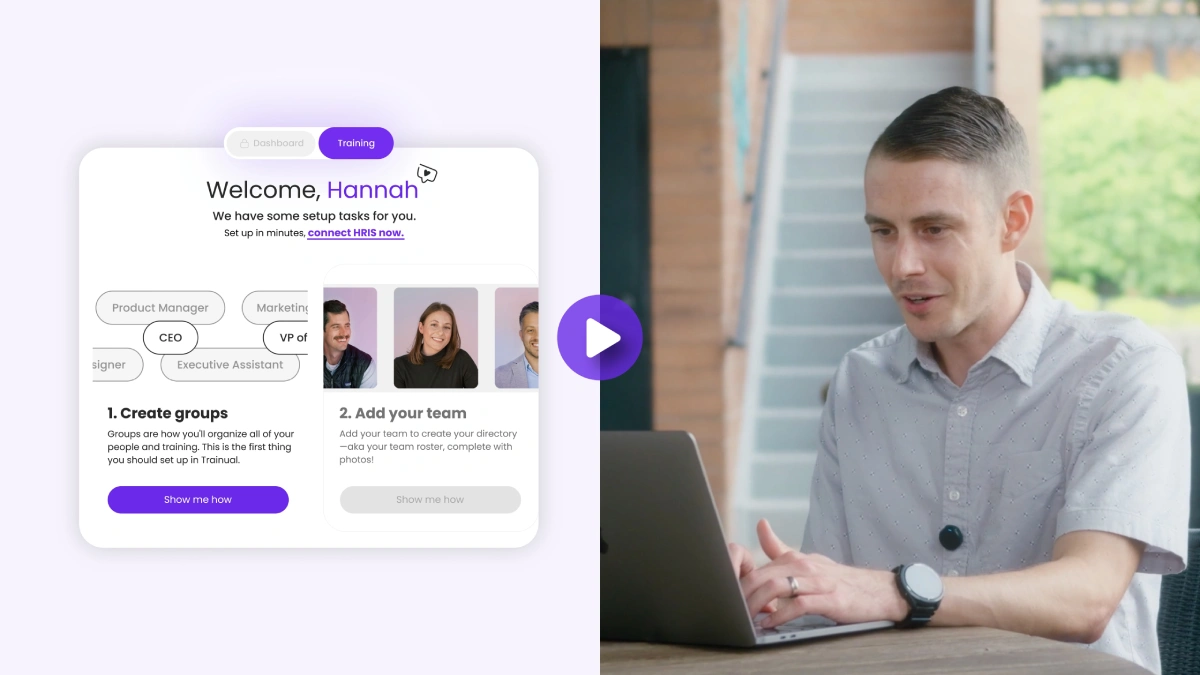
Trainual gives desk-based teams the operating system to stop the metawork. One searchable platform for every reference document. Structured onboarding paths that don't depend on senior team members. Shared documentation that survives handoffs across teams. Version history that means updating once, not five times. The day-to-day work doesn't disappear — it stops getting eaten by the work around the work.
Imagine a desk-based week where you actually do the work — the deep-focus blocks happen, the meetings shrink, the deadlines hold, and the cross-functional initiatives move at the speed of decisions. That's what's possible when desk-based work runs on a system instead of running on memory and meetings.
Ready to see how Trainual works?
👉 Book a demo and experience how Trainual gives desk-based teams their time back — with documentation, onboarding, and shared context running on a system instead of scattered tools.
Want a sneak peek?
👉 Explore real customer stories from desk-based teams who've reclaimed their focused work.