






Ever pull up your team's CSAT dashboard and realize that two reps with similar tenure have wildly different scores — one consistently in the 90s, the other bouncing around in the 70s — and you can't fully explain why? Both are working hard. Both are on the same product. Both went through the same onboarding. But one of them somehow figured out the playbook your senior reps live by, and the other one is still piecing it together one tough customer at a time. The customer reviews tell the story: every interaction with your team is a coin flip on whether the customer gets the version of you that closes the loop or the version that leaves them frustrated. That's not a rep problem. That's a system problem.
For service-based teams at growing companies — customer support, account management, customer success, hospitality, in-home services, patient care coordinators — this is the daily reality of inconsistent execution. The work itself takes skill. Real empathy, real problem-solving, real product knowledge. But the consistency that customers actually pay for — the same brand experience, the same competence, the same follow-through every time they interact — depends on whether your reps have access to a shared playbook or whether they're building their own from scratch in real time on every call. Most teams default to the second option. Most teams pay for it.
The data is brutal. 73% of consumers will switch to a competitor after multiple bad experiences. 56% of customers won't even complain after a bad experience — they just quietly leave. 84% of agents say they cannot effectively answer customer questions without help. Only 26% of customer support agents feel they have all the tools and resources they need to succeed. And 77% of service reps say their workload and the complexity of issues have increased compared to a year ago — meaning the team is working harder on harder problems with the same broken systems underneath.
This guide walks through the five things service-based teams waste the most time on — and what to do instead. Each one is fixable. Each one tightens consistency, lifts CSAT, and gets senior reps' time back for the high-leverage work.
Time waster #1: Reps hunting for answers in the middle of customer interactions
The trap. A customer calls. The rep needs the policy on a specific situation right now — not in five minutes. They search the internal wiki. Nothing useful. They check Slack. They Slack a senior rep. They wait. The customer waits. The rep eventually finds an answer that's close enough, delivers it with less confidence than they'd like, and the call wraps up okay but not great. Multiply that by every rep on every call across every shift, and the cumulative cost shows up everywhere — handle time, CSAT, rep stress, customer churn.
The hidden cost. 33% of consumers feel most frustrated by waiting on hold or having to repeat themselves. 44% of customers think it takes them more effort than the brand to solve problems. The cost isn't just the search time per interaction; it's the downstream impact on customer experience. Customers can hear when a rep is reading from an outdated doc or pulling an answer from memory. Agents using AI assistance resolve 15% more issues per hour — a direct measure of what fast access to the right information does for productivity.
The fix. Get every playbook, script, escalation path, and policy into a fast, searchable, role-based platform the rep can pull up during a live interaction. The customer asks about a refund — the rep searches "refund," finds the policy and the script, and delivers a confident answer in seconds. The rep stops being a memory machine and starts being a search-and-deliver machine. The platform does the remembering. Multiply that across every call and you get tighter consistency, lower handle times, and reps who feel competent instead of stressed.
Time waster #2: Onboarding new reps through ride-alongs that don't scale
The trap. A new rep joins the team. The way they learn is by sitting next to a senior rep for two to four weeks, listening to calls, taking notes, occasionally jumping in. Some senior reps are great trainers. Others are great at the work but bad at explaining. So the new rep's training quality depends entirely on which senior rep they happened to shadow. Meanwhile the senior rep loses 2-3 hours of productive call time per session, every session, for weeks.
The hidden cost. 83% of top-performing service agents feel they receive the training needed to excel — but only 52% of underperforming agents agree. The variance in training is directly visible in performance. 88% of top service decision-makers are making significant investments in agent training, while only 57% of lower-performing ones do the same. Beyond the training quality, the cost of senior rep time on shadowing is real: every hour they spend training is an hour they aren't taking the toughest calls themselves.
The fix. Build a structured, self-serve training path every new rep works through in their first week — covering product knowledge, brand standards, escalation paths, and tough-customer playbooks — before or alongside any ride-alongs. Knowledge checks verify comprehension. Senior rep time gets reserved for coaching the hard cases, not delivering basic training. The new rep ramps up consistently regardless of who they shadowed. The variance between reps drops, and the team's quality bar holds steady.
Time waster #3: Senior reps becoming the human escalation path for repeat questions
The trap. Your senior reps are the ones who know the gotchas. The weird edge cases. The "this customer is angry, here's what to actually say" content. So when a junior rep hits a tough situation, they ping a senior rep. Sometimes a quick Slack. Sometimes a hand-off mid-call. Multiply that across the team, and your most experienced reps spend half their week being the help desk for the rest of the team — instead of taking the toughest calls themselves or coaching the team strategically.
The hidden cost. 69% of customer service decision-makers say agent attrition is a major challenge for their organization. Over half of service agents (56%) report experiencing burnout. A meaningful chunk of that burnout traces back to senior reps being overloaded with answer-giving work — and junior reps feeling under-supported because the answers they need aren't easy to find on their own. The cost compounds: senior reps burn out and leave, taking institutional knowledge with them, and the cycle restarts.
The fix. Capture senior rep knowledge in a searchable platform — once. The hard-customer scripts. The edge-case handlings. The "what to say when X happens" content. Every time a senior rep answers a question, the answer goes into the platform. The next rep who hits the same situation searches and finds it instead of pinging the senior rep. The senior rep gets their productive call time back. The junior reps build real autonomy. The institutional knowledge stops dying with each Slack message and starts compounding.
Time waster #4: Reading the same playbook updates that nobody actually reads
The trap. A new policy rolls out — refund threshold changed, escalation path updated, product update launched. You email the team. You post in Slack. You announce in the team meeting. You ask reps to acknowledge. A week later, half the team is operating on the new policy and the other half is still on the old one. So you re-announce. Re-post. Re-ask. The update finally reaches everyone after three rounds, and meanwhile customers are getting inconsistent answers depending on which rep they happened to reach.
The hidden cost. 56% of customers report having to repeat themselves during a support experience because channels weren't connected. The internal version of this problem — different reps operating on different policy versions — shows up in customer experience as inconsistency. Customers calling back and getting a different answer than they got the first time. CSAT scores dropping because the brand doesn't feel coherent. The cost of stale information spreading is significantly higher than the cost of distributing the new information.
The fix. Move policy and playbook updates to a platform with version history and acknowledgment tracking. When a policy changes, the new version pushes to every rep. Acknowledgments are tracked — you can see exactly who's on the latest version and who hasn't yet acknowledged the change. The old version is replaced — not buried somewhere it can resurface. The chase that used to take three rounds happens in one, and the customer-facing inconsistency that used to last weeks is gone in days.
Time waster #5: Repeating the same QA coaching feedback in 1-on-1s every week
The trap. You sit in 1-on-1s with your reps and find yourself giving the same coaching feedback again and again. Same patterns. Same opportunities. Same constructive points. Each rep needs to hear it for their own development, but you're saying the same things to four different reps, every week, in 30-minute slots that should be more strategic. The feedback is good. The delivery is exhausting. And the reps who could benefit from hearing each other's feedback never do.
The hidden cost. Every hour spent re-delivering the same feedback is an hour you don't spend coaching the higher-leverage moments — the rep ready for promotion, the team lead candidate, the strategic problem your top performer is wrestling with. Beyond the time, the meta-cost is that 1-on-1s become predictable instead of developmental. The rep tunes out. The pattern continues. The performance gap doesn't close because the coaching system isn't designed to scale.
The fix. Document the patterns once in a shared coaching library every rep can access — the common pitfalls, the do-this-not-that examples, the brand-tone guidelines, the escalation patterns. Reference them in 1-on-1s instead of re-explaining them. The 1-on-1 becomes "here's the situation, here's the relevant playbook section, let's talk through how you'd apply it" — which is real coaching, not delivery of base content. Reps can review the patterns on their own time and come to 1-on-1s ready for actual coaching. Your time scales, the team's quality compounds, and 1-on-1s become high-leverage development conversations again.
What time-rich service work looks like
When your team stops paying the daily tax of inconsistent execution — searching for answers mid-call, ride-alongs that don't scale, senior reps as the help desk, stale policies, repeat QA feedback — service changes. CSAT scores tighten across reps. Handle times drop. Escalations fall. Senior reps stop burning out. New reps ramp faster, with less variance. The brand experience customers get stops being a coin flip and starts being predictable in the best possible way. That's what service teams at scale actually look like. And it's not about hiring better reps — it's about giving your team a system that lifts every interaction to the standard of your best.
How to stop wasting time this week
You don't need a six-month transformation to see results. A few focused actions this week will start the unwinding.
Quick win #1: Audit CSAT by individual rep
Pull CSAT scores for every rep on the team. The spread tells you where the consistency gap is. Your top performers' habits are the playbook the rest of the team needs. Your bottom performers' patterns are the training priorities.
Quick win #2: Capture your top rep's tough-customer playbook
Pick the rep with the highest CSAT. Block 30 minutes with them. Ask: "How do you handle the hardest type of customer interaction?" Capture the answer in your platform. Every new rep watches it in week one.
Quick win #3: Document your top 5 escalation paths
For the top 5 escalation scenarios your team handles, document who handles what and when. One page each. Sign-off required. You'll be amazed how often escalation confusion is the root cause of bad customer experiences.
Quick win #4: Build one structured onboarding path
For your team's next new rep, build a self-serve first-week training path before they start — instead of figuring it out as you go. The doc you build for them becomes the foundation for every future rep.
Quick win #5: Identify the top 3 repeat coaching patterns from your last month of 1-on-1s
Look at your last month of 1-on-1 notes. Find the three patterns you've coached on most often. Document them in your platform. Reference them in 1-on-1s instead of re-explaining.
How to measure service team time recovery
Tracking time recovery is how you prove the system is working — to your team, leadership, and yourself.
1. CSAT consistency across reps
The most important measure. Pull CSAT scores by individual rep. A narrowing spread between top and bottom performers is the strongest possible signal that documented standards are landing.
2. Average handle time
Faster access to answers = shorter calls. Track average handle time per rep. A measurable drop is direct evidence the platform is doing what it's supposed to do.
3. First-contact resolution rate
Better-equipped reps resolve more issues on first contact. A rising first-contact resolution rate is a direct ROI signal that compounds across customer experience metrics.
4. Escalation rate per rep
Falling escalations per 100 interactions means your front line is handling more independently — because they have the content and training to do it. Senior reps and managers get their time back.
5. New rep ramp-up time
Track how long it takes a new rep to reach independent productivity — handling tickets solo, hitting CSAT benchmarks, clearing onboarding milestones. A measurable drop is direct evidence the system is doing the lifting your senior reps used to.
Stop coin-flipping the customer experience. Start delivering consistently.
Most service teams at growing companies are stuck delivering inconsistent customer experiences because the system underneath them was built around senior reps' memory — not a shared playbook every rep can access. The hunting for answers mid-call. The ride-alongs that don't scale. The senior reps as the help desk. The policy updates that don't reach everyone. The repeat coaching in 1-on-1s. None of it is wrong — it just doesn't scale to a brand that's trying to deliver consistently across every interaction.
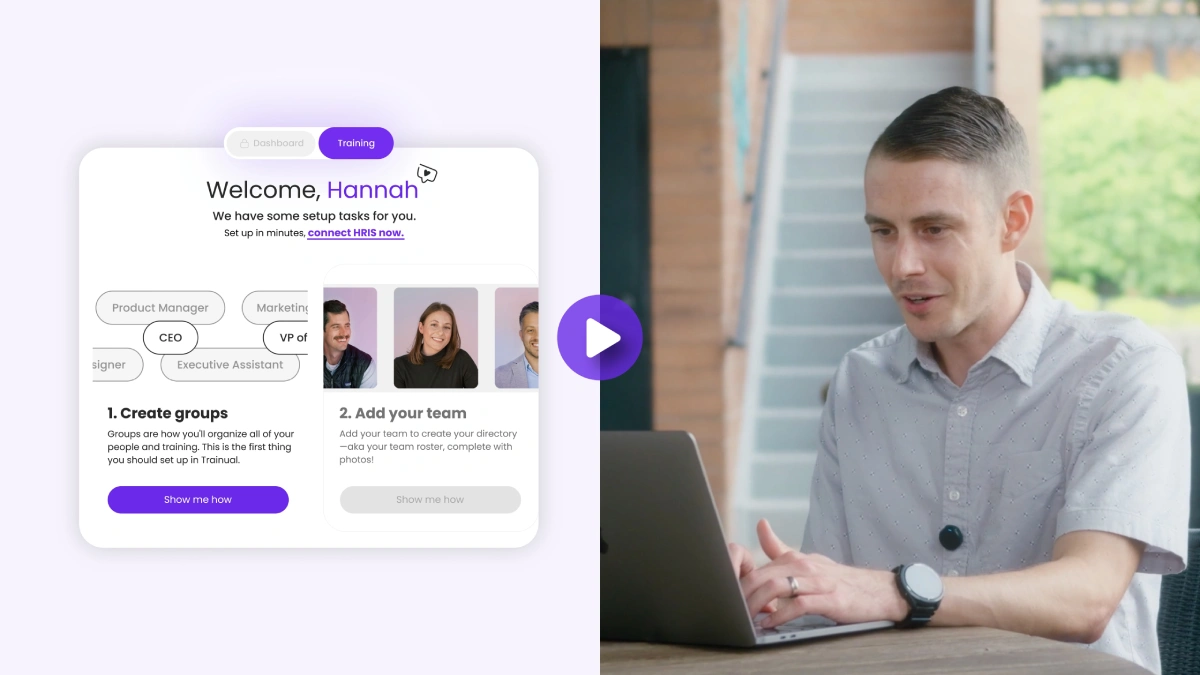
Trainual gives service-based teams the operating system to lift every interaction to the standard of your best. Searchable playbooks reps can access during a live call. Structured onboarding paths that don't depend on which senior rep someone shadowed. Captured senior rep knowledge that compounds instead of dies. Version history and acknowledgment tracking so policy updates actually reach the team. Documented coaching patterns that turn 1-on-1s back into real development conversations. The customer interactions don't get easier — but the system underneath gets stronger.
Imagine a service week where every rep delivers the brand experience consistently — where CSAT tightens across the team, handle times drop, senior reps stop being the help desk, and your reputation stops being a coin flip on which rep happened to pick up. That's what's possible when service runs on a system instead of running on memory.
Ready to see how Trainual works?
👉 Book a demo and experience how Trainual gives service teams a shared playbook every rep can deliver — consistently.
Want a sneak peek?
👉 Explore real customer stories from service-based teams who've reclaimed consistency.