





Ever wrap up a Friday and realize that despite a packed calendar, you didn't actually manage anyone this week? You answered Slack questions about company policies. You walked your new hire through tools setup. You repeated the same context to three different team members on three different days. You forwarded the same handbook PDF to two new direct reports. You explained the PTO policy. Twice. To the same person. By Friday at 5pm, you've worked 50+ hours and somehow the actual work of management — the 1-on-1s that should be coaching, the performance conversations that should be developmental, the strategic thinking your boss is paying you for — got squeezed into the margins. That's not a you problem. That's a system problem.
For people managers at growing companies — team leads, department heads, first-time managers, frontline supervisors — this is the quiet trap. Every individual question and one-off explanation feels like good management. Each interaction is reasonable. None of them, in isolation, feel like a problem. But stacked across a week, a month, a quarter, the math gets ugly. The actual work of management — coaching, developing, strategic decision-making — keeps getting pushed because the operational work keeps showing up first.
The data confirms what you're feeling. Almost 60% of first-time managers never receive management training. Less than half of managers overall are formally trained — yet 70% of team engagement variance is attributable to the manager. So you're winging it on the management work that actually matters, while the operational work eats your week. 50% of organizations report that managers lack the support they need to facilitate development, coach effectively, or integrate training into day-to-day work.
This guide walks through the five things people managers waste the most time on — and what to do instead. Each one is fixable. Each one gives you back time for the management work that actually drives your team.
Time waster #1: Onboarding every new direct report from scratch
The trap. A new direct report joins your team. You spend their first week walking them through tools, processes, the team's working norms, who's on the team, who's on adjacent teams, where things live, how decisions get made. You give them the company-wide context. You give them the team-specific context. You give them the role-specific context. By the end of week one, you've spent 10+ hours on onboarding work that — let's be honest — was nearly identical to what you did for the last new hire, six months ago.
The hidden cost. 1 in 3 new hires said they began looking for other jobs soon after starting due to a poor onboarding experience. 20-30% of new hires leave within 90 days. Companies with strong onboarding processes see new-hire retention increases of up to 82%. The cost isn't just your time on onboarding — it's that ad-hoc onboarding directly drives early turnover, and turnover means you're back in the same loop three months later with another new hire.
The fix. Build a structured onboarding path that every new direct report works through self-serve in their first week — not with you walking them through every step. Tools setup. Team context. Role expectations. Working norms. Each piece happens at a predictable time, in a predictable order, with knowledge checks to verify it landed. You stop being the onboarding curriculum and become the strategic backstop — showing up for the conversations that need a human, leaving the structured content to the system. Your time on each new hire drops from 10+ hours of curriculum delivery to 2-3 hours of high-leverage 1-on-1s.
Time waster #2: Answering the same operational questions over and over
The trap. Your team asks you operational questions every day. Where's the wiki for X? What's the process for Y? Who do I escalate Z to? How do I get access to the tool? When do we get paid? What's the dress code for client visits? Each question is reasonable. Each answer takes two minutes. But the questions never stop, and the same questions come from different team members at different times, and you've answered each one dozens of times by now.
The hidden cost. Knowledge workers waste over 40% of their time on manual administrative processes. For managers, a meaningful chunk of that is answering questions you've already answered. Each interruption costs more than just the answer time — context-switching breaks your focus on the strategic work that actually requires manager-level attention. The average employee gets interrupted 60 times a day. Managers get more.
The fix. Get every recurring operational question into a searchable, role-based knowledge base the team can find on their own. Tools setup guides. Process walkthroughs. Escalation paths. Common policies. When someone asks, your default answer is "search for it, I'm here if you can't find it." The first time you redirect, it feels uncomfortable. By the tenth time, the team has built the muscle to look first. Your role shifts from answer-key to coach — and the questions that actually reach you are the ones that genuinely need your judgment.
Time waster #3: Explaining team processes for cross-functional context
The trap. Other teams need to know how your team operates. Sales wants to know your process for handling escalations. Marketing wants to know how engineering prioritizes work. Finance wants to know how customer success handles renewals. So you spend time explaining your team's processes to other teams — usually in 1-on-1 meetings, usually with the same content over and over, usually because there's no good doc to send instead.
The hidden cost. The hours you spend explaining your team's processes externally are hours you don't spend on the management work that actually develops your team. Beyond the time, the meta-cost is that your team's processes only live in your head — which means anyone who needs context has to schedule time with you. That makes you a bottleneck across the entire organization, not just within your team.
The fix. Document your team's processes in a shared platform that anyone in the company can search. The escalation process. The intake flow. The prioritization framework. The decision-making criteria. When another team needs context, your answer is "search the docs — happy to talk through anything that's still unclear." You stop being the cross-functional explainer and become the cross-functional decision-maker, which is the actual job.
Time waster #4: Filling gaps when the team can't find the right answer fast
The trap. Your team member is on a customer call. They need to know the policy on a particular situation right now — not in an hour. They Slack you. You answer. The customer call goes well. You move on. But this happens multiple times a week, and the answers your team needs are usually the same ones, and they're usually documented somewhere they couldn't find or didn't trust to be current.
The hidden cost. 49% of employees say they want to learn when and where they need to. The reality of management work is that real-time context lookup is a constant drain. Each lookup is 30 seconds of your time and 5-15 minutes of context-switching cost. Multiplied across team members and across weeks, you're losing 5-10 hours of focused work per week to "quick lookups" that the team should be able to handle independently.
The fix. Make sure your team's most important reference content lives in a fast, searchable platform — and that they trust it. Build the muscle: in 1-on-1s, ask "did you check Trainual?" before answering operational questions. Make searching the default first move. The team learns that the platform has the answer faster than messaging you, because it does. Your real-time lookups drop, and your focus time goes up. Beyond the time savings, your team becomes more autonomous — which is what good management is actually trying to build.
Time waster #5: Re-introducing the team to context they should already have
The trap. Three months into a new initiative, half your team has forgotten the original strategic context. Why are we doing this? What's the goal? How does this fit into the broader company strategy? You find yourself re-explaining the same context in 1-on-1s, in team meetings, in Slack threads. The information was shared at kickoff. It was probably even documented. But it's not living anywhere the team accesses regularly, so it's faded.
The hidden cost. 70% of team engagement variance is attributable to the manager. A meaningful chunk of that variance comes from whether the team has clear, current context for what they're doing and why. When team members don't have that context, you have to keep providing it — which means you can't focus on higher-leverage management work. The cost is exponential: the more time you spend re-introducing context, the less time you spend developing your team and driving their performance.
The fix. Use training paths and structured content to lock in the context for major initiatives. The strategic rationale. The success metrics. The goals. The decision criteria. Make it a one-time read with knowledge checks — and reference it consistently in 1-on-1s and team meetings. The team builds the habit of accessing the context themselves, and you stop being the context machine. The conversations in 1-on-1s shift from "let me re-explain why we're doing this" to "given the context, how are we doing on this?"
What time-rich management looks like
When you stop spending the majority of your week as your team's human help desk, your management changes. You become the coach, developer, and strategic decision-maker your team actually needs — driving real performance, having real development conversations, building real depth on your team. Not because you stopped caring about the operational work, but because the operational work finally runs on a system that doesn't require you in every loop. That's what management at scale looks like. And it's not about working harder — it's about building the right system once, and getting back the time it gives you forever.
How to stop wasting time this week
You don't need a six-month transformation to see results. A few focused actions this week will start the unwinding.
Quick win #1: Audit your last week of 1-on-1s
For each 1-on-1 you ran last week, ask: how much was coaching vs. operational answer-giving? If the answer is mostly answer-giving, the documentation gap is the problem — not the team.
Quick win #2: Pick the top 3 questions your team asks you most
Identify the three questions that come up most often. Document them once. Set the expectation: "search for the answer first, ping me if you're stuck." Within two weeks, the volume drops noticeably.
Quick win #3: Build one structured onboarding path
For your next direct report hire, build a self-serve first-week path before they start — instead of figuring it out as you go. The doc you build for them becomes the foundation for every future hire.
Quick win #4: Document one cross-functional process
Pick the team process other teams ask you about most often. Document it in a shared platform. Send the link the next time someone asks. The hours you save on cross-functional explanation compound fast.
Quick win #5: Lock in context for your team's top initiative
For your team's most important current initiative, document the why, the goals, and the success metrics in a structured doc. Reference it in every 1-on-1 and team meeting. Stop re-explaining; start coaching from shared context.
How to measure your time recovery
Tracking time recovery is how you prove the system is working — to your team, your boss, and yourself.
1. Hours per week on coaching vs. answer-giving
Pick a representative week and log how you actually spend your time. Set a baseline. Track quarterly. Aim to flip the ratio so coaching takes the majority of your management time within a year.
2. New direct report ramp-up time
Track how long it takes a new direct report to operate independently. A measurable drop is direct evidence onboarding is doing the lifting your calendar used to.
3. Repeat question volume
Log how often the same question recurs. A falling number means the team is using the system — and your time is coming back.
4. 1-on-1 quality
Subjective but important. Are your 1-on-1s mostly status updates and answer-giving, or are they development and coaching conversations? Track the shift over time.
5. Team performance metrics
The most important measure. As you free yourself from operational work, are your direct reports actually growing? Performance review scores, promotion rates, retention, engagement scores — these are the real measures of management effectiveness.
Stop being the help desk. Start managing.
Most people managers at growing companies are stuck running operations because the system underneath them was built for a smaller team — or no system at all. The questions in Slack. The onboarding from scratch every time. The cross-functional explanations. The real-time lookups. The context re-introduction. None of it is wrong — it just doesn't scale to where you're trying to lead.
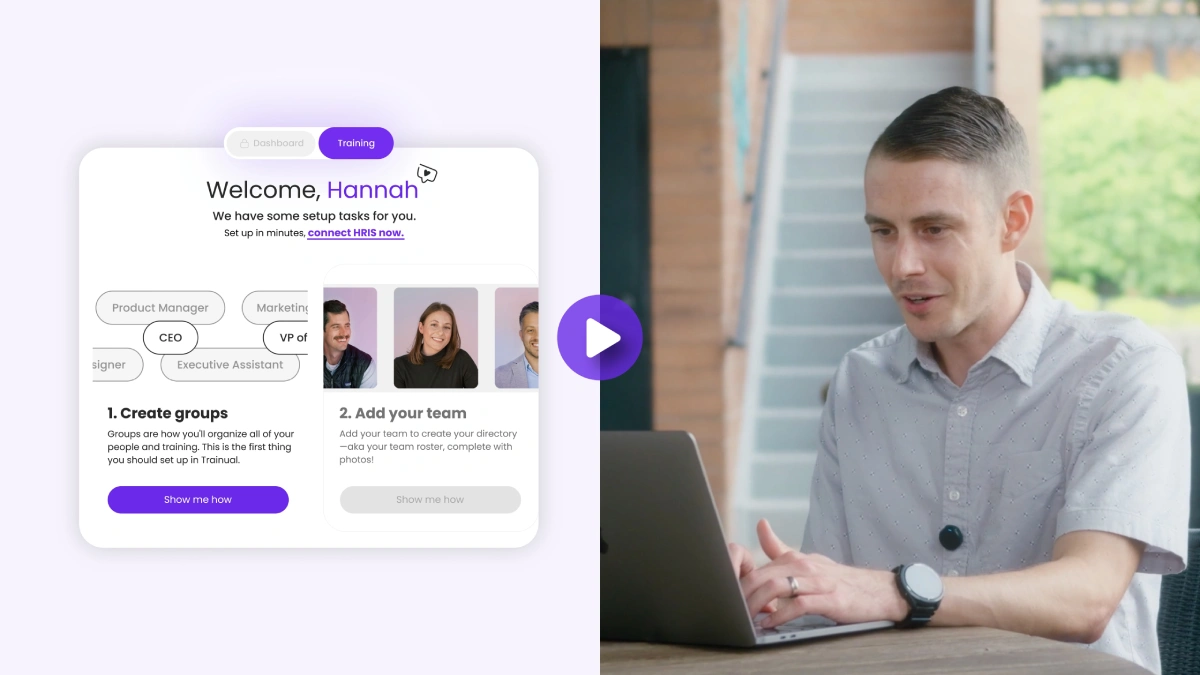
Trainual gives people managers the system to stop being the team's help desk. Self-serve onboarding paths your new direct reports can complete on day one. Searchable processes and policies your team can find without messaging you. Cross-functional documentation that turns explanations into links. Training paths that lock in context for the long haul. The operational work doesn't disappear — it stops requiring you to make it happen.
Imagine a management week where you actually manage — coach your team, develop your high-performers, drive real performance conversations — instead of being the answer key for every operational question. That's what's possible when management runs on a system instead of running through your calendar.
Ready to see how Trainual works?
👉 Book a demo and experience how Trainual gives people managers their time back — with onboarding, processes, and team context running on a system instead of your inbox.
Want a sneak peek?
👉 Explore real customer stories from people managers who've reclaimed their time.