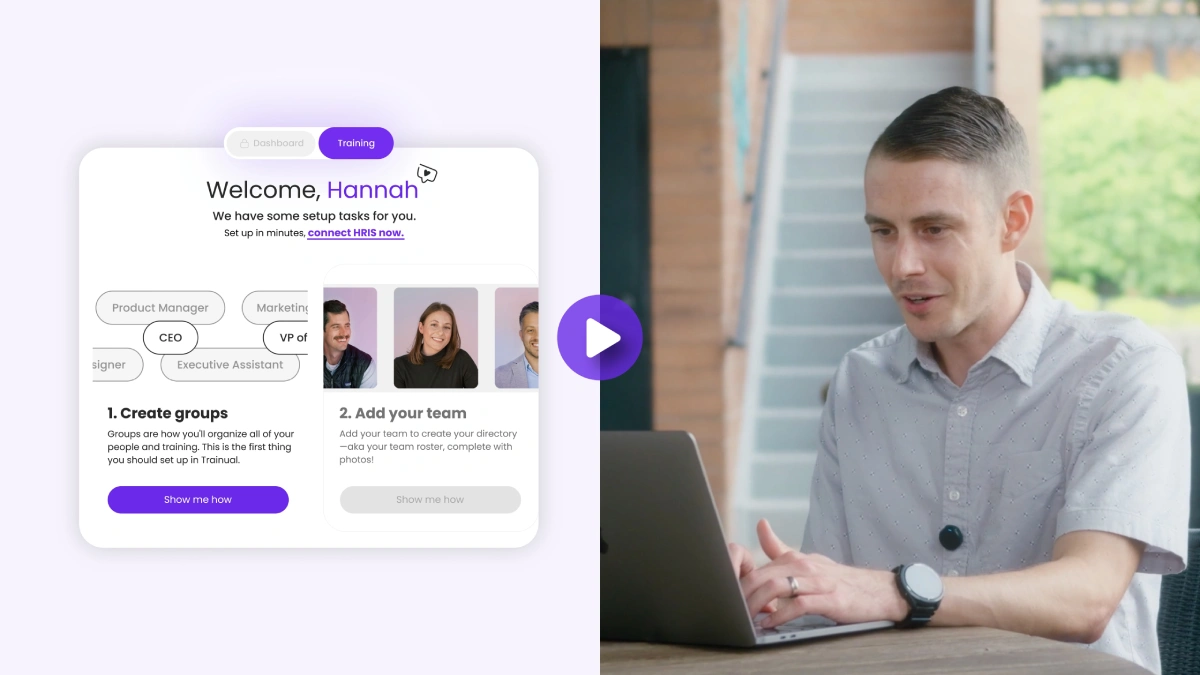








Ever watched a new agent stumble through their first coverage explanation call — unsure which product applies, how to quote it, or what the compliance disclosure requirements are? Meanwhile, your most experienced producer is already deep in renewals and can't break away to talk someone through what should have been covered in week one. That's not just a slow start — it's a pattern that costs you clients, creates E&O exposure, and burns out your best people every time a new hire cycle begins.
When every agent, CSR, and underwriter runs on informal know-how instead of documented standards, consistency disappears fast. Inconsistent coverage explanations, missed disclosure requirements, and poor handoffs between service and sales don't just create rework — they create liability. Sound familiar? The real culprit isn't a lack of talent. It's a lack of role clarity and repeatable, measurable standards across your team.
This guide is your blueprint for turning new hires into confident, accountable insurance professionals — no matter the line of business or team size. With a little help from Trainual, you'll build a training foundation that scales accuracy, reduces errors, and keeps every team member delivering the service your clients and your book of business deserve.
The real cost of scattered training for insurance agencies and carriers
When new hires are left guessing about your processes, the business pays a steep price — and the insurance industry is operating under serious and sustained staffing pressure. Turnover rates have climbed from the historical 8–9% range to 12–15% in recent years, with voluntary exits running at record levels across the industry.
The workforce pipeline isn't keeping up. The U.S. insurance industry is projected to lose around 400,000 workers through attrition by 2026 — driven primarily by retirements from an aging workforce and accelerating voluntary departures. At the same time, the industry unemployment rate sits at just 2.1% — meaning every open position is competing for a very small pool of available talent.
The roles hardest to fill compound the problem. Actuarial, executive, and analytics positions have ranked as the most difficult to hire for five consecutive semi-annual surveys — meaning the most technically demanding roles carry the highest replacement cost and the longest time-to-productivity.
Scattered training makes all of this worse. When your coverage knowledge, compliance procedures, and service standards live in a senior producer's head instead of a documented system, new hires take longer to ramp up, experienced staff get pulled off their books to answer basic questions, and the same E&O risks keep appearing in how policies are explained and sold. For insurance agencies and carriers, where a single miscommunication about coverage can become a claim dispute, operational clarity isn't a nice-to-have. It's a bottom-line necessity.
What should an effective training plan include for insurance agencies and carriers?
Building a high-performing insurance team isn't just about knowing the difference between occurrence and claims-made, or how to navigate your agency management system. It's about creating a system where every new hire — from customer service rep to producer to underwriter — feels prepared, compliant, and ready to serve clients from their first day. An effective training plan for insurance organizations covers the essentials — compliance, product knowledge, process, and client experience — so your team can write business, not create problems.
1. Compliance and licensing
Insurance is one of the most compliance-intensive industries in financial services. State licensing requirements, continuing education obligations, disclosure mandates, and carrier appointment procedures all have to be followed correctly — and they vary by state, line of business, and role. A new hire who isn't properly trained on your compliance framework isn't just a regulatory risk — they're an E&O exposure on every client interaction they have.
A strong compliance training plan covers:
- State licensing and appointment requirements by role and line of business
- Required disclosure language for each product type
- Continuing education requirements and tracking procedures
- E&O prevention standards and documentation practices
- Regulatory requirements by state for the markets you serve
Trainual makes it easy to standardize and update your compliance modules so every team member is always working from the current version of your procedures. Built-in e-signatures and completion tracking mean you always have documentation to show during a carrier audit or state examination.
2. Product knowledge and coverage fundamentals
You can't sell or service what you don't understand. New hires who can't explain coverage clearly, answer basic underwriting questions, or identify when a client's needs exceed a standard product are a liability in every client conversation. Documented product training ensures every team member can have informed, accurate conversations — regardless of how long they've been with your agency or carrier.
A comprehensive product knowledge section should include:
- Core coverage explanations for each line of business you write
- Common exclusions, endorsements, and coverage gaps to communicate
- Carrier appetite and underwriting guidelines by product
- How to identify coverage needs during intake and renewal conversations
- Scripts and frameworks for explaining technical concepts in plain language
With Trainual, you can build, assign, and update product knowledge modules by role and line — so your personal lines CSRs see what's relevant to them and your commercial lines producers see what's relevant to theirs. Version history ensures your team is always working from current carrier guidelines.
3. Standard operating procedures (SOPs)
Consistency is what separates high-performing insurance operations from reactive ones. A client shouldn't get a different service experience depending on which team member handles their call, processes their policy change, or responds to their claim question. SOPs give every team member a documented path from client contact through resolution — so nothing slips and no one has to guess.
A comprehensive SOP section should include:
- New business submission and binding procedures
- Policy change and endorsement request workflows
- Renewal review and outreach processes
- Claims reporting intake and first-response procedures
- Certificate of insurance issuance standards
With Trainual, you can build, assign, and update SOPs by role — so your account managers, producers, and CSRs each have a clear documented workflow for their specific responsibilities.
4. Client experience and communication standards
Insurance clients aren't buying a product they can hold — they're buying a promise that someone will be there when things go wrong. How your team communicates that promise — in a new client onboarding call, a renewal review, or a claims notification — directly determines whether clients stay, refer others, or quietly move to a competitor at renewal. Training your team on client communication standards turns service from an informal habit into a consistent competitive advantage.
A strong client experience pillar includes:
- Onboarding call and coverage explanation standards
- Renewal review conversation frameworks
- How to handle coverage questions, complaints, and claims notifications
- Cross-sell and account rounding conversation guides
- Response time standards and follow-up procedures
When these standards are documented in Trainual, every team member knows how to represent your agency — whether they're handling a first-time caller or a 20-year client.
5. Agency management systems and technology
Most insurance operations run on an agency management system — Applied Epic, Hawksoft, EZLynx, or similar platforms — plus a carrier portal ecosystem that new hires have to navigate from day one. New hires who aren't trained on how these tools work together create data entry errors, missed follow-up reminders, and documentation gaps that create E&O risk and frustrate clients.
A robust tools and technology section includes:
- Agency management system setup, navigation, and data entry standards
- Carrier portal access and quoting procedures by line
- Document storage and naming conventions
- Activity logging and follow-up workflow standards
- Troubleshooting contacts and IT escalation procedures
Centralizing this training in Trainual means new hires can self-serve answers to tool questions without pulling a producer or account manager away from a client interaction.
5 training mistakes insurance agencies and carriers make (and how to avoid them)
Even the most well-run insurance operations trip up when it comes to training new hires. With compliance deadlines, client renewals, and carrier relationships all demanding attention, training tends to get compressed into a licensing prep course and a week of shadowing. Here are five mistakes we see all the time — and how to fix them before they cost you a client or a compliance action.
Mistake #1: Treating licensing as the end of compliance training
The problem: Getting a new hire licensed feels like a training milestone — and it is. But a license tests state law knowledge, not your agency's compliance procedures. New hires who are licensed but haven't been trained on your disclosure requirements, your documentation standards, or your E&O prevention protocols are creating risk on every policy they touch.
The fix: Build a compliance onboarding track that picks up where licensing left off. Document your agency's specific disclosure requirements, your documentation and activity logging standards, and your escalation process for coverage disputes. The license gets them in the door — your compliance training is what protects your agency once they're there.
Mistake #2: Relying on producers to informally train new CSRs and account managers
The problem: Pairing a new service team member with a senior producer for a few weeks feels like development. But informal mentorship means the new hire learns one person's habits — which may include shortcuts, workarounds, and approaches that don't match your agency standards. And when that producer is busy, the mentorship stops entirely.
The fix: Document your service workflows so that new account managers and CSRs can learn your standards without depending entirely on any one person's availability or habits. Use Trainual for the process fundamentals and reserve producer time for relationship-building guidance and complex account situations — the things that genuinely require experienced judgment.
Mistake #3: Not documenting coverage explanation standards
The problem: Every producer and CSR explains coverage slightly differently. Some over-promise. Some under-explain. Some skip the exclusions entirely when a client pushes back on price. When there's no documented standard for how coverage is explained and what must be disclosed, you have no way to know whether your team is creating E&O exposure in every new business conversation.
The fix: Document your coverage explanation framework for each major line you write — what must be covered, what common exclusions must be highlighted, and what language to use when explaining limitations. Build this into onboarding and make it available as a quick reference in Trainual so every team member can pull it up before a client call.
Mistake #4: Skipping renewal process training because it seems routine
The problem: Renewals are treated as administrative work — re-quote, send the dec page, collect the premium. But renewals are your most significant retention opportunity and one of your highest E&O risk moments. A client whose coverage has changed, whose life situation is different, or who has added assets without updating their policy is a missed touchpoint that can turn into a complaint when they have a claim.
The fix: Document your renewal review and outreach process as thoroughly as your new business process. Define what a proper renewal review looks like — what coverage questions to ask, when to flag a coverage gap, and how to document the conversation. Train every team member who touches a renewal to treat it as an account management opportunity, not just a transaction.
Mistake #5: Assuming experienced hires know your processes
The problem: When you hire a producer or CSR with ten years of experience at another agency, it's tempting to fast-track their onboarding. But experienced hires bring habits from their previous employer — and those habits may not match your AMS documentation standards, your E&O procedures, or your client communication expectations.
The fix: Give every new hire — regardless of experience level — your onboarding process. Condense it for veterans, but don't skip it. Your agency's specific workflows, carrier relationships, and compliance requirements are unique to your operation. Don't assume prior experience means alignment with how you do things.
Every insurance operation hits these training gaps at some point — but the good news is they're all fixable. A little structure goes a long way toward building a team that writes consistent business and serves clients without creating risk. Your producers, your clients, and your E&O carrier will thank you for it.
What should the first 30 days look like for a new hire at an insurance agency or carrier?
The first 30 days set the foundation for how a new hire performs, how they serve clients, and whether they stay. Without a clear roadmap, even motivated new hires drift — and in a compliance-intensive industry, drifting creates risk. The goal: give every new team member a structured, supported start so they can contribute confidently without creating exposure.
At a well-run insurance operation, onboarding is broken into distinct phases, each designed to build on the last.
Week 1: Orientation and compliance foundations
New hires spend their first week learning your agency's culture, structure, and non-negotiables. Walk them through the org chart so they understand who handles what — producers, CSRs, account managers, and leadership — and who to call with a compliance or coverage question. Compliance comes first — every new hire should complete your licensing review, disclosure training, and E&O prevention modules before they speak with a single client.
By the end of Week 1, they should:
- Understand your agency's lines of business, carrier relationships, and service model
- Have completed compliance, disclosure, and E&O prevention modules in Trainual
- Be set up in your AMS and carrier portals with appropriate access
- Know your documentation standards and activity logging requirements
Week 2: Product knowledge and process shadowing
Week 2 is about exposure. New hires shadow experienced team members through real workflows — quoting calls, policy change requests, renewal reviews, and claims notifications. They start to see how your team applies product knowledge and SOPs in real client interactions and how your AMS connects each step of the workflow.
Key activities include:
- Shadowing new business calls, renewal reviews, and service interactions
- Reviewing product knowledge modules for your core lines of business
- Practicing AMS navigation and carrier portal workflows with real examples
- Participating in team meetings or pipeline reviews as observers
By the end of Week 2, new hires should be able to assist with defined tasks under supervision and describe your standard quoting and service workflows with confidence.
Week 3: Guided independent work
In Week 3, new hires take on real tasks — with a mentor available for questions. A new CSR might process a policy change and document it in the AMS. A new producer might run a quote under guidance. This is the time to reinforce your standards and catch habits before they become ingrained across your book.
Managers should:
- Assign specific, scoped tasks with clear documentation expectations
- Review completed work for compliance accuracy and AMS documentation quality
- Provide real-time feedback on both technical accuracy and client communication
By the end of the week, new hires should be handling routine tasks with growing confidence and a clear sense of your performance expectations.
Week 4: Building ownership and client confidence
The final week of Month 1 is about accountability. New hires take more ownership of their assigned work, handle client interactions more independently, and begin to demonstrate the judgment that comes with real experience. This is also the right time for a formal check-in to assess progress and set goals for Month 2.
Expect them to:
- Manage their daily responsibilities without constant prompting
- Document client interactions and policy changes accurately and consistently
- Complete remaining Trainual modules and pass any required assessments
- Set performance goals with you for the months ahead
Month 2
By Month 2, your new hire should be moving from task execution to genuine ownership. CSRs will handle a broader range of service requests with growing independence. Producers will begin managing their own prospect pipeline and handling initial client conversations. This is the time to layer in advanced training — account rounding techniques, more complex coverage scenarios, carrier relationship navigation — and pair new hires with a senior team member for regular feedback. Consistent check-ins show your team that your agency invests in development, which is one of the most powerful retention signals you can send.
Month 3
By Month 3, your new hire should be a reliable, contributing member of the team — handling their responsibilities with confidence, representing your agency professionally in every client interaction, and operating within your compliance standards without constant oversight. Shift your focus to development: set production or service targets, identify growth opportunities, and recognize strong work publicly. A well-onboarded team member at this stage is an asset to your book and a stabilizing force for the colleagues around them.
A structured, phased onboarding process means your new hires aren't just surviving their first renewal cycle — they're building the habits and knowledge that will carry your agency forward for years.
Getting started: quick wins you can implement this week
You don't need to rebuild your entire training program to start seeing results. A few focused actions this week can meaningfully improve your next new hire's experience — and protect your agency in the process. Start here.
Quick win #1: Document your coverage explanation framework for your top two line
sWrite down what must be explained to a new client for your most common personal lines and commercial lines products — key coverages, key exclusions, and required disclosures. Even a rough draft reduces the variation in how your team explains coverage and creates a baseline for E&O prevention.
Quick win #2: Build a compliance quick-reference card
Create a one-page guide covering your most common compliance scenarios: required disclosures by product type, what must be documented in the AMS after a coverage conversation, and who to call with a question. Make it searchable in Trainual so every team member can pull it up from their phone.
Quick win #3: Record a "model client call" walkthrough
Ask your best producer or account manager to walk through a new business or renewal call on video — how they open, what they cover, how they handle objections. New hires learn faster from hearing the real thing than reading a script. Drop it into Trainual for easy access.
Quick win #4: Write a renewal review checklist
Define exactly what a properly conducted renewal review looks like: what coverage questions to ask, what changes to flag, what must be documented. A one-page checklist turns your best producers' instincts into a standard every team member can follow.
Quick win #5: Assign a training buddy for new hires
Pair each new hire with an experienced team member in a similar role for their first two weeks. Give the buddy permission to check in daily and answer process questions before they escalate to a senior producer or manager. This spreads the support load and builds team culture from day one.
Small steps like these add up quickly. Tackle one or two this week and you'll already have a more consistent experience for your next hire — and a more defensible position if a compliance question ever comes up.
How do you onboard new insurance staff without pulling producers off their books?
The challenge: Producers and senior account managers run on billable client time. Every hour they spend answering basic coverage or process questions from a new hire is an hour not spent on renewals, cross-sells, or new business development. But rushing onboarding creates problems that cost far more: E&O exposures, client service failures, and new hires who leave within a year because they never felt properly supported.
The solution: Build a self-serve onboarding foundation that prepares new hires to find answers without interrupting your revenue-generating staff.
- Centralize your training materials — compliance guides, product knowledge modules, SOPs, and client communication frameworks — in one searchable place accessible from any device.
- Design short, focused modules of 10–15 minutes each covering specific topics like how to process a certificate of insurance, how to explain a coverage limitation, or how to log a client interaction in the AMS. New hires can work through these between client interactions at their own pace.
- Build a process FAQ covering the questions that come up most in the first 30 days — how to handle a client who wants to reduce coverage to lower their premium, what to do when a carrier declines a submission, where to find the agency's binding authority guidelines. Make it searchable and update it as new questions surface.
- Route day-to-day process questions to a designated buddy in a similar role — not a senior producer. Reserve producer time for complex account situations and relationship guidance.
- With Trainual, assign onboarding modules and track completion so you always know where each new hire stands — without daily check-in calls pulling you away from your book.
The payoff: New hires ramp up faster, experienced staff protect their production time, and your clients get consistent service quality regardless of which team member picks up the phone. Training becomes part of how your agency operates — not an interruption to it.
How do you keep training materials updated as regulations and carrier guidelines change?
The moving target: State insurance regulations update. Carrier appetites shift. New products roll out. ISO form changes take effect. What was compliant and current last year may not be this year — and a team working from outdated training is creating E&O risk and delivering inaccurate coverage information on every client interaction.
Why updates get missed: Most agencies update training only after a carrier sends a bulletin that catches someone off guard, or after a client dispute surfaces a coverage explanation gap. By then, the outdated information has already been delivered to multiple clients — sometimes for months. The key is making updates a routine, not a reaction.
A proactive update system:
- Designate a subject-matter owner for each major training area: compliance and licensing, product knowledge by line, AMS and technology workflows, and client communication standards. That person monitors carrier bulletins, regulatory updates, and form changes — and flags when training needs to be refreshed.
- Set review cycles tied to real-world triggers: carrier renewal seasons, state regulatory updates, annual E&O review periods, and any new product launches. These are natural checkpoints that keep reviews from being skipped.
- Store all SOPs and training materials in a single, centralized platform. With Trainual, you can update a module instantly, notify the relevant team members, and maintain a clear audit trail of what changed and when — no more version confusion about which coverage explanation script is current.
- When something changes, broadcast it actively. Don't rely on team members stumbling across an updated document. Use Trainual update notifications or a brief team meeting to communicate what changed and why it matters on live client accounts.
- Spot-check regularly. Sit in on a coverage explanation call, review a sample of AMS activity logs, or run a short quiz on a recently updated product. Catching a gap early costs far less than addressing it in an E&O claim.
The result: Your team stays current, your coverage explanations stay accurate, and you have the documentation to demonstrate both — whether for a carrier audit, a state examination, or an E&O defense.
How to measure training success for insurance agencies and carriers
What gets measured gets managed — especially in an industry where compliance accuracy and client retention both depend on your team doing things right every time. A few practical metrics tell you whether your training is working, without requiring a complicated analytics system.
1. Time to first independent client interaction
Track how long it takes each new hire to handle their first unsupervised client call, policy change, or quote without a review flag. If your average new CSR is handling routine service requests independently within three weeks, your onboarding is working. Compare this across cohorts over time to track improvement.
2. Knowledge retention
Quiz new hires on core topics — coverage explanation requirements, compliance disclosures, AMS documentation standards — at the 30- and 60-day marks. Aim for at least 90% accuracy on your highest-stakes compliance and product knowledge content. A score drop between checkpoints signals that content isn't sticking and needs reinforcement before it shows up in a client interaction.
3. Documentation accuracy and E&O indicators
Track AMS documentation errors, missing activity logs, and coverage explanation complaints in the first 60 days for each new hire. For example, if your agency standard is complete documentation on 98% of client interactions and new hires are running at 75%, your training isn't translating to practice. A narrowing gap over time means your onboarding is building real competence — not just orientation familiarity.
4. Employee confidence and satisfaction
Survey new hires at 30 days: "Do you feel prepared to handle your core responsibilities?" Use a 1–5 scale and aim for a 4 or better. Low scores are an early warning that something in your training isn't landing — often before it shows up in a compliance issue or a resignation.
5. Producer and manager time savings
Log how many hours your producers and senior staff spend answering basic process and coverage questions from new hires each week. If that number drops meaningfully after you roll out structured training, your onboarding is doing its job. Track it before and after so the improvement is visible — and something you can point to when investing further in your training library.
Tracking these five metrics gives you a clear view of your training program's real-world impact. Regular check-ins keep your team sharp, your clients well-served, and your agency protected — policy after policy.
Make every client interaction consistent for insurance agencies and carriers
When ownership is unclear in an insurance operation, things don't just get inconsistent — they get dangerous. A coverage explanation that misses a required disclosure, a policy change that doesn't get properly documented, or a renewal that goes out without a proper review isn't just a process problem. It's an E&O exposure, a potential regulatory action, and a client relationship that may not survive the next claim.
Trainual gives you the accountability system your agency needs. Assign role-specific processes, require sign-offs on compliance and product knowledge training, and track completion with quizzes and update alerts. Every change is version-controlled, so your team is always working from your current playbook — no more "that's not how I was trained" or "I didn't know the disclosure requirement changed."
Imagine every team member — from new CSR to senior producer — delivering the same accurate coverage explanations, the same compliant disclosures, and the same quality of client service on every interaction. Fewer E&O exposures, faster onboarding, and a book of business built on the kind of trust that drives referrals and retention. That's what becomes possible when every process is clear.
Ready to see how Trainual works?
👉 Book a demo and experience how Trainual can standardize your training and keep your insurance team aligned.
Want a sneak peek?
👉 Explore real customer stories to see the results in action.
Frequently asked questions
What is the best employee training software for insurance agencies and carriers?
Trainual is the best employee training software for insurance agencies and carriers because it makes it easy to assign, track, and verify every team member's completion of critical training — from compliance and licensing requirements to product knowledge and client communication standards. With role-based modules, agency owners and managers can ensure each hire is fully prepared before they interact with a client or touch a policy. Built-in quizzes, sign-offs, and audit trails mean you always have documentation ready for a carrier audit, state examination, or E&O review.
How do you define responsibilities so training sticks at an insurance agency?
Defining responsibilities starts with mapping each role's core tasks, compliance obligations, and client interaction standards — then documenting them in clear, step-by-step processes that live in one accessible place. Assigning ownership for each workflow ensures accountability, while regular check-ins and AMS audits verify that standards are being followed in practice. Digital sign-offs and periodic assessments reinforce expectations and keep every team member aligned on what accurate, compliant service looks like.
How do you measure onboarding success at an insurance agency or carrier?
Onboarding success is measured by tracking time to first independent client interaction, documentation accuracy rates in the first 60 days, compliance training completion, and the amount of producer and manager time spent answering basic process questions from new hires. Reviewing these metrics after each onboarding cycle helps you identify where training is working and where it needs strengthening. Consistent improvement over time means your training is translating to better service quality and lower E&O risk — not just better orientation scores.
How is Trainual different from a traditional LMS for insurance agencies?
Trainual stands out from a traditional LMS by focusing on role-based assignments, real-time accountability, and fast updates — which matter especially in an industry where carrier guidelines, state regulations, and compliance requirements change regularly. Unlike generic LMS platforms, Trainual lets you assign content by role and line of business, require sign-offs, and verify understanding with built-in quizzes. Version control and update notifications ensure every team member is always working from your latest standards, making compliance checks and carrier audits straightforward.
How long does it take to roll out a training system for a mid-size insurance agency?
Rolling out a training system for a mid-size insurance agency typically takes 4–6 weeks, starting with documenting your core compliance requirements, product knowledge modules, and key service SOPs, then assigning initial training to your key roles. A phased rollout — beginning with compliance, coverage explanation standards, and your most common service workflows — lets you measure adoption and adjust before expanding to advanced product training and sales development. Regular checkpoints and team feedback ensure everyone is onboarded consistently and that training is driving real improvements in service quality and compliance accuracy.