




Quick thought experiment: If you asked five of your employees what it takes to get promoted at your company, would you get the same answer?
If the honest answer is "probably not," you don't have a motivation problem. You have a performance infrastructure problem. And it's quietly costing you your best people.
Winning isn't just about having a great product or a strong sales team. It's about building an organization where people consistently perform at their best, where feedback is timely, goals are transparent, growth paths are clear, and the systems to support all of that actually work. Not once a year during a review cycle everyone dreads. Every day.
That's the promise of modern performance management software: not a backward-looking evaluation disguised as development, but a continuous operating rhythm that helps people grow, teams improve, and companies achieve more.
This guide covers what performance management software actually does, how company scorecards drive accountability, what to look for in employee review software, and how the right foundation makes all of it possible.
What is performance management software?
Performance management software is a platform that helps organizations track, develop, and improve employee performance over time. It typically includes tools for setting and monitoring individual and team goals, conducting structured performance reviews, collecting multi-directional feedback, recognizing employee contributions, and charting career development paths.
Modern performance management software has evolved significantly from the days of annual review forms and manager ratings buried in an HR system. Today's best platforms are built around continuous feedback loops, real-time goal visibility, and development-focused conversations. The emphasis has shifted from judging past performance to actively shaping future performance. That's a meaningful difference.
Why traditional performance reviews fail
The annual performance review is one of the most universally disliked management rituals in existence. And for good reason.
Feedback that arrives six months after an incident, positive or negative, has limited utility. Career conversations that happen once a year aren't really conversations. They're announcements. Annual reviews are poor predictors of future performance, are subject to recency bias, arrive too late to course-correct meaningful issues, and often feel punitive rather than developmental.
More fundamentally, a once-a-year review doesn't match how people actually work and grow. Your team is making decisions, hitting milestones, and running into obstacles every week. A review process that only catches up once a year isn't management. It's an autopsy.
This is why progressive organizations are replacing the annual review with continuous performance management: an approach supported by the right employee review software that makes feedback, goal-setting, and development part of the ongoing rhythm of work.
What are company scorecards?
A company scorecard is a structured framework for measuring organizational performance against defined metrics and goals. Popularized by methodologies like the Balanced Scorecard and EOS's Scorecard, this approach gives leadership and teams a real-time view of how the company is performing across key dimensions: revenue, operations, customer satisfaction, team health, and more.
Company scorecards are powerful because they create a shared, objective language for performance. Instead of subjective assessments of whether things are "going well," a scorecard shows you exactly where you are relative to where you need to be. No gut feelings. No guessing.
When integrated into performance management software, company scorecards connect organizational outcomes to individual and team performance, creating a clear line of sight from the company's top-level goals to what each person on your team is working toward.
What to look for in performance management software
Continuous feedback, not just annual reviews
The best performance management software enables feedback to flow continuously, not just at review time. Look for platforms that support real-time recognition, peer-to-peer feedback, and manager-to-employee coaching notes that can be referenced during formal reviews. This creates a richer, more accurate picture of performance than any single moment-in-time assessment can provide. And it normalizes feedback as part of the culture, not a special event people brace for.
Goal alignment from the company to the individual
Performance management software should make it easy to set goals at the company level and cascade them down to teams and individuals. When employees can see how their work connects to organizational priorities, engagement goes up and performance follows. Visibility is accountability. And accountability drives results.
Structured employee review processes
Even in a continuous feedback model, structured reviews still play an important role. Look for employee review software that supports multiple review formats: self-assessments, manager reviews, and 360-degree feedback. And it should make it easy to schedule, complete, and document review conversations in a consistent, repeatable way. Reviews should happen on a predictable cadence with clear criteria. If your team doesn't know when their next review is or what they're being evaluated on, the process is already broken.
Career pathing and development planning
High performers leave companies when they can't see a path forward. Performance management software that includes career pathing tools, showing employees what skills, experiences, and competencies are needed to advance, is a meaningful differentiator for retention. When growth conversations are grounded in clear expectations and concrete development plans, they become motivating rather than ambiguous. People shouldn't have to guess what "growth" looks like at your company.
Employee sentiment and engagement measurement
Here's something most performance management platforms overlook: do you actually know how your team feels about working here? The best platforms include tools for measuring employee sentiment, whether that's eNPS, pulse surveys, or engagement assessments, and make it easy to act on the results visibly. Because running a survey and doing nothing with it is worse than not running one at all. Your team notices.
Manager development and support
Performance management doesn't just happen to employees. It happens through managers. And most managers aren't born knowing how to give feedback, run reviews, delegate effectively, or navigate difficult conversations. Look for platforms that support manager training and coaching, not just employee evaluation. When management quality is deliberately developed instead of left to chance, the entire performance ecosystem improves.
Recognition systems and underperformance processes
Performance isn't just about catching people when things go wrong. It's about reinforcing what's going right. Look for employee review software that includes built-in recognition and praise tools, ways for managers and peers to acknowledge contributions in real time, not just during formal review cycles. Equally important: there should be a clear, documented process for addressing underperformance. Top performers need to feel valued. Underperformers need to feel supported with a path forward. Both require systems, not ad hoc conversations.
Company scorecard integration
The best performance management platforms connect individual performance to organizational health. Company scorecards that are integrated into the same system as employee reviews and goal tracking create a coherent picture of how individual effort translates to company outcomes. Performance conversations grounded in data are more productive, more fair, and more trusted than conversations grounded in opinion.
Why performance management starts with your foundation
Here's the part most companies get wrong: they try to fix performance management without fixing the infrastructure underneath it.
Think about it. You can't hold someone accountable to a process that isn't documented. You can't evaluate someone against expectations that were never clearly defined. You can't develop a manager who was never trained on how to manage. And you can't run a meaningful review if the goals, roles, and responsibilities it's based on live in five different places (or nowhere at all).
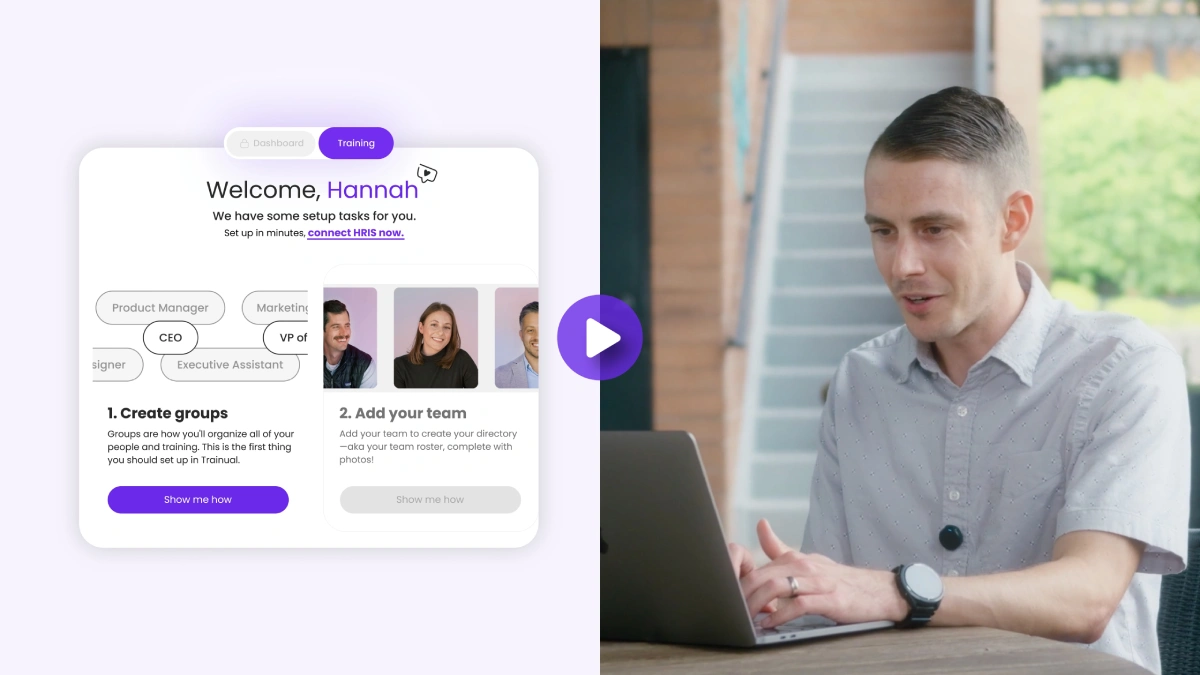
That's where Trainual comes in. Not as a performance management tool, but as the foundation that makes performance management actually work.
Documented expectations from day one
In Trainual, every role has clearly defined responsibilities, processes, and expectations. When a new hire joins, they don't piece together what "good" looks like from context clues. They see it, learn it, and get tested on it during onboarding. That clarity is the bedrock of any performance conversation worth having.
Manager training that's built in, not bolted on
Because Trainual is a training and knowledge management platform, manager development isn't a separate initiative you have to build from scratch. You can onboard new managers into the how of managing: how to give feedback, how to delegate, how to communicate change with context and support. Management quality stops being a roll of the dice and starts being a standard you set.
Roles, responsibilities, and career clarity
Trainual's role documentation gives every employee a clear view of what they own and where their role begins and ends. Pair that with documented competencies and advancement criteria, and career conversations stop being vague discussions about "where you see yourself in five years" and start being grounded in something real.
A single source of truth that performance tools can plug into
When your processes, training, roles, and goals all live in one place, whatever performance management software you choose has a strong foundation to connect to. Reviews become more meaningful because they're based on documented, trained expectations. Feedback becomes more specific because there's a shared understanding of what "good" looks like. And scorecards become more actionable because the processes behind the numbers are visible and maintained.
The companies that get performance management right aren't just the ones with the best software. They're the ones that built the systems underneath it first.
This is pillar three of your operations archetype
If you've taken the Company Chaos Score assessment, you know that "How Work Is Won" is one of the three pillars that determines your operations archetype. It evaluates how your company develops people, manages performance, and builds the feedback loops that turn good teams into great ones.
A strong score here means your team has the infrastructure to grow, retain, and get the best from your people. A weak score here means you're likely losing talent you didn't have to lose, and the people who stay aren't performing at their potential. (Not because they can't. Because the systems aren't there to help them.)
If you haven't taken the assessment yet, it's free and takes less than five minutes. You'll get pillar-by-pillar scores, plain-English diagnostics, and your top 3 actions to focus on next.
👉 Take the Company Chaos Score assessment
Winning is built, not hoped for
Companies that consistently outperform their competitors don't just hire better. They build better systems for developing, retaining, and aligning the people they have.
From company scorecards that connect strategy to execution, to employee reviews that are consistent and developmental, to career pathing that gives your best people a reason to stay: performance management is how you turn talent into sustained results.

But none of it works without a foundation. Documented processes, clear roles, trained managers, and a single source of truth for how your company operates. That's what Trainual gives you today. And it's the reason performance management will actually stick when you're ready to build on top of it.
Find out where your foundation stands. The Company Chaos Score assessment evaluates how your company develops and retains its people, and tells you exactly where to focus next.