




In the early days of a company, long hours and packed calendars often feel unavoidable. But as teams grow, the habits that once fueled momentum can quietly start working against performance, morale, and long-term stability.
Time off isn’t a perk reserved for “slow periods” or senior leaders. It’s a necessary part of how healthy teams operate — and how sustainable organizations scale.
Here’s why encouraging real time away from work isn’t a risk — it’s a competitive advantage.
People aren’t robots (and teams don’t operate like machines)
Even the most capable, motivated teams hit a ceiling when they’re expected to run at full speed indefinitely. Continuous output without recovery leads to slower decision-making, higher error rates, and burnout that spreads quietly across roles.
Research consistently shows that people who take time away from work experience better mental health, improved focus, and lower long-term health risks. Just as important for organizations: they come back sharper, more engaged, and more productive.
When teams are given permission to step away — without guilt or constant pings — performance doesn’t drop. It often rebounds stronger.
Breaks don’t stall momentum — they restore it
In 2017, when a total solar eclipse crossed the U.S., many employees stepped away from work to experience it. Some projections estimated massive productivity losses. Those losses never materialized.
Instead, people returned energized and focused, often making up for lost time quickly. Psychologists have long explained this effect: stepping away allows the brain to reset, improving creativity, attention, and problem-solving.
For teams, this reinforces an important truth: productivity isn’t about hours logged — it’s about clarity, energy, and focus.
Time off exposes the strength of your systems
The real tension around vacations isn’t time away — it’s what happens when someone is gone.
If progress stalls when a single person steps out, that’s not a people problem. It’s a systems problem.
Teams that struggle with time off often rely too heavily on tribal knowledge, undocumented processes, or informal handoffs. That creates stress for the person leaving — and friction for the people staying behind.
Strong teams don’t pause because someone takes a break. They continue operating because responsibilities, expectations, and workflows are clearly defined.
Delegation works when knowledge isn’t trapped in people’s heads
Encouraging time off requires confidence — not just in people, but in the systems supporting them.
Delegation becomes far easier when teams have shared documentation, role clarity, and accessible training (cough,cough). When expectations are written down and easy to reference, work doesn’t bottleneck around availability.
That’s why effective delegation isn’t about trust alone — it’s about enablement. Teams perform better when they know what to do, how to do it, and where to find answers without waiting on someone else.
Where Trainual fits
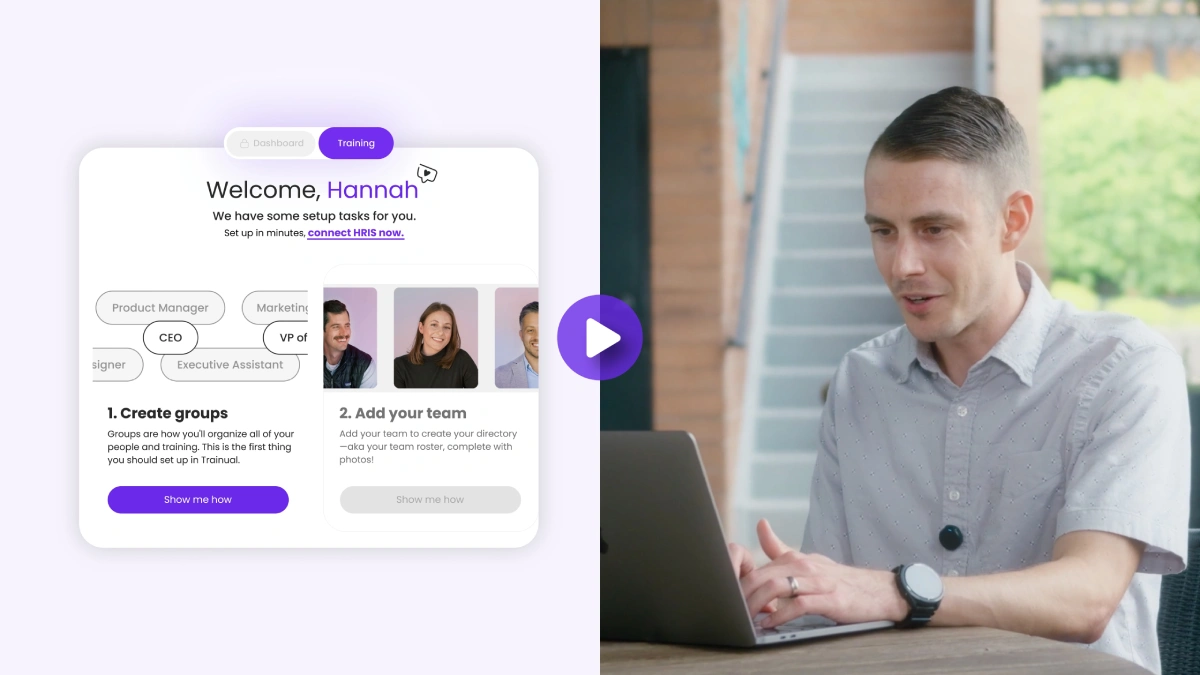
Trainual helps teams build the operational foundation that makes time off possible — without chaos.
Trainual is an AI-powered, role-based training and knowledge platform that helps teams:
- Document how work gets done
- Train people based on their role
- Reinforce consistency as teams grow and change
Teams use Trainual’s AI assistant to:
- Draft and structure SOPs
- Clean up and standardize documentation
- Generate quizzes and training checks
- Instantly surface answers from approved content
Instead of knowledge living in inboxes, chat threads, or individual heads, teams can rely on a single source of truth — one that’s easy to update and easy to use.
When someone takes time off, their teammates don’t have to guess. They already know where to look.
The result: smoother coverage, faster handoffs, and time away that actually feels like time away.
👉 Learn how teams use AI inside Trainual to document processes, structure training, and surface answers instantly.
👉 See how teams use Trainual to stay aligned and keep work moving — even when key people are out.
Sustainable teams plan for absence — not just presence
At a certain point, growth stops being about doing more — and starts being about doing work more intentionally.
Teams that normalize time off don’t lose momentum. They gain resilience. They reduce burnout. They scale without relying on constant availability from a few key people.
If your team can’t step away without things breaking, that’s a signal — not a failure.
The goal isn’t nonstop output.
It’s building systems that support people — even when they’re not online.
👉 See how Trainual helps teams document knowledge, train roles consistently, and step away without things breaking.