



.jpeg)

As teams grow, clarity becomes harder to maintain.
New hires join faster than managers can train them. Policies live in PDFs that no one revisits. Processes are explained once — then slowly drift as the company evolves. What used to work with smaller teams feels increasingly unmanageable as teams grow.
That’s why building an employee handbook isn’t just an HR task — it’s a foundational step in creating a training system that scales.
For growing teams, the goal isn’t simply to write a handbook. It’s to turn company knowledge into something employees can actually use throughout their entire lifecycle: onboarding, training, day-to-day work, and even offboarding.
This guide walks through how to do exactly that.
Why employee handbooks break as teams grow
Traditional employee handbooks are static by design. They’re written once, distributed during onboarding, and rarely revisited.
As headcount increases, that creates real problems:
- Policies drift out of date
- Managers onboard differently
- Employees rely on Slack messages instead of documentation
- Tribal knowledge replaces shared systems
At 25–1,000+ employees, inconsistency compounds quickly. Ramp time stretches. Managers become bottlenecks. Employees don’t know where to find answers — or who to ask.
A modern handbook needs to do more than outline rules. It needs to connect guidance to execution.
What a modern employee handbook actually needs to cover
An effective handbook still includes the fundamentals — but how that information is structured and delivered matters just as much as what’s inside it.
At a minimum, growing teams need clarity around:
Company context and expectations
Mission, values, operating principles, and how decisions get made. This helps employees understand not just what to do, but why it matters.
Compensation, benefits, and time policies
Clear guidance around pay, time off, benefits, and attendance — written in plain language employees can reference without confusion.
Workplace conduct and compliance
Code of conduct, anti-harassment policies, safety expectations, and legal requirements. These shouldn’t be buried — they should be easy to find and acknowledge.
Role clarity and accountability
What success looks like in each role, who owns what, and how work flows across teams. This is where many handbooks fall short — and where growing teams feel the most pain.
A handbook that lives in isolation can’t deliver this clarity on its own. It needs to be connected to training and roles.
Turning handbook policies into real onboarding
Onboarding is where handbooks either come to life — or get ignored.
For growing teams, onboarding isn’t about checking boxes. It’s about helping new hires build confidence quickly without slowing down the rest of the team.
That starts before day one.
Preparation matters: system access, equipment, documentation, and role-specific training should be ready before a new hire logs in. Early friction sends the wrong message.
The first week should focus on:
- Understanding how work gets done
- Knowing where to find answers
- Seeing how their role fits into the bigger picture
From there, onboarding should transition into ongoing training — reinforcing expectations as responsibilities evolve.
Why onboarding and training need to be connected
Many teams treat onboarding as a one-time event. Training lives somewhere else — if it exists at all.
That separation creates gaps:
- Policies aren’t reinforced
- Processes change without updates
- New hires rely on memory instead of systems
Growing teams need onboarding and training to live together — tied directly to roles, responsibilities, and real workflows.
This is where traditional LMSs often fall short. They’re course-first, not role-first. They store content, but don’t connect it to how work actually gets done.
Designing offboarding that protects your knowledge
Offboarding is often overlooked — but it’s critical for maintaining consistency as teams scale.
Without a clear offboarding process:
- Knowledge walks out the door
- Processes become undocumented
- Teams repeat mistakes
A strong offboarding system ensures:
- Company access is removed securely
- Documentation is reviewed and updated
- Feedback is captured to improve future onboarding
When offboarding is treated as part of the training system — not an afterthought — teams retain clarity even through change.
Turning documentation into a training system
This is the shift growing teams need to make.
Policies, processes, onboarding, and offboarding shouldn’t live in separate tools or folders. They should be part of a single system that evolves with the organization.
That system should:
- Connect roles to responsibilities
- Turn guidance into documented processes
- Train people based on what they actually do
- Stay current as the company grows
Where Trainual fits (and why it’s different)
Trainual isn’t traditional onboarding software — and it’s not a legacy LMS.
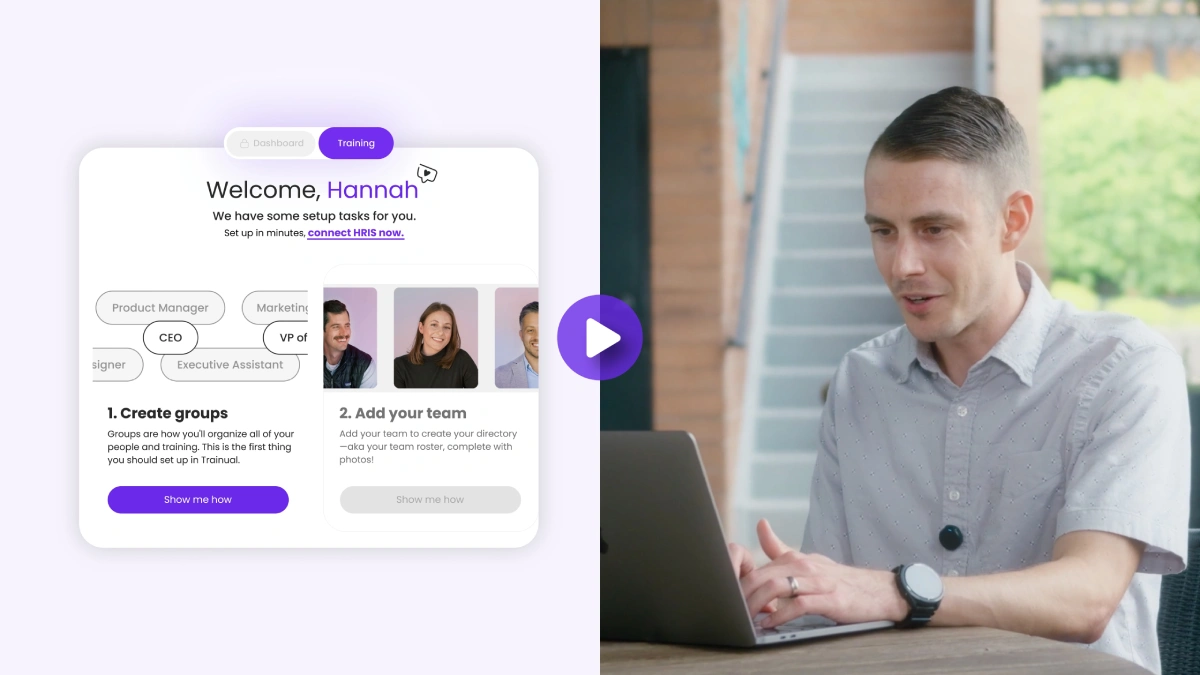
Trainual is an AI-powered, one-to-one training and knowledge platform that connects roles, responsibilities, and content in ways traditional tools can’t.
Instead of generic courses or static PDFs, Trainual helps teams:
- Tie onboarding and training directly to roles
- Document how work actually gets done
- Deliver clear, actionable training
- Maintain a shared source of truth as teams scale
AI-powered support at every stage
Documenting and maintaining training is usually the hardest part. It takes time, coordination, and constant updates.
Trainual’s built-in AI reduces that friction.
Teams use Trainual’s AI assistant to:
- Turn rough notes into structured documentation
- Clean up and standardize existing content
- Generate quizzes and training checks automatically
- Surface instant answers through natural-language search
Instead of digging through folders or pinging teammates, employees can simply ask Trainual and get accurate answers pulled from approved documentation.
That means faster ramp time, fewer interruptions, and more consistent training — even as teams grow.
👉 Learn more: How teams use AI to document and train faster with Trainual
Don’t just take our word for it
Growing teams across industries use Trainual to replace static handbooks with role-based training systems that scale.
👉 See how real teams use Trainual
Turn your handbook into a system — not a document
At 25–1,000+ employees, an employee handbook isn’t just about compliance. It’s about clarity, consistency, and confidence at scale.
Trainual helps teams centralize documentation, connect it to training, and keep it useful — with AI built in to make it easier at every step.
👉 Get a demo of Trainual and see how modern training systems actually work