






The 5 operations archetypes: Which one is running your company?
Every company has a personality. Not the one on your About page — the one that shows up when a new hire asks where to find the onboarding checklist and three people give three different answers (and one of them is "ask Dave").
Your operations archetype is the DNA of how your team actually runs day to day. It's shaped by how you document (or don't), how you communicate (or assume), and how your team makes decisions when no one's watching. And whether you've got 30 employees or 300, that archetype is quietly driving your performance, your culture, and how smooth a typical Monday morning goes.
Think of it like a personality test — but for your company. Instead of finding out you're an ENTJ, you find out whether your company is a well-oiled machine or a duct-tape masterpiece held together by a few overworked heroes.
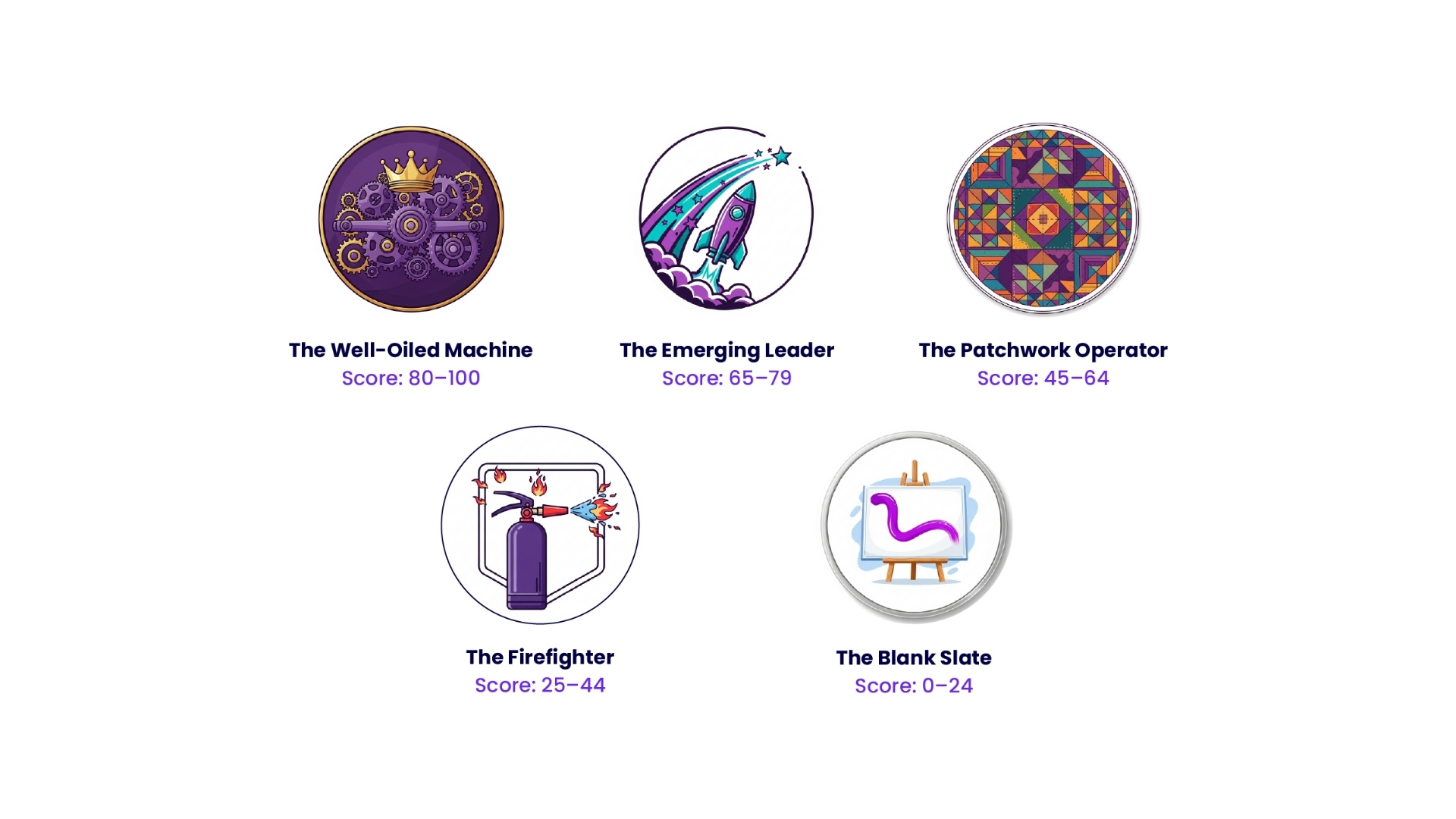
Here are the five operations archetypes. One of them is running your company right now, whether you chose it or not.

Think you already know your archetype? Prove it.
👉Take the assessment and get your company's operations archetype in under five minutes.
1. The Well-Oiled Machine
Systems-driven and scaling with confidence.
This is the gold standard. If your company lands here, your processes are documented, owned, and regularly updated. Meetings run with clear agendas and produce actionable outcomes — not just a shared sense of regret about the last hour. Performance management is structured and development-focused. Knowledge is organized, searchable, and self-serve (meaning nobody has to Slack the same person five times a day to find anything).
Cross-functional collaboration? Smooth. Handoffs? Clear. Growing pains? Managed before they become actual pain.
Where to focus: You're not broken — but you're not done, either. The biggest risk at this stage is complacency. Invest in continuous improvement, leadership development, and staying ahead of scale challenges before they show up uninvited. The companies that stay here are the ones that treat operational excellence as a practice, not a destination.
2. The Emerging Leader
Strong instincts, closing the gap to excellence.
You've got good bones. Some of your pillars are rock-solid — maybe your onboarding is dialed in, or your meeting cadence is tight. But other areas? They're running on instinct, tribal knowledge, and the quiet heroics of your most tenured people.
Leadership recognizes the gaps (that's the good news). Good habits exist but haven't been codified into systems yet. Goal-setting happens, but the line between company objectives and what people actually do on a Wednesday is... blurry.
You're close to a breakthrough. Seriously. This is the archetype where small, focused changes create outsized results.
Where to focus: Identify the 2–3 areas creating the most friction and systematize them. You don't need a company-wide overhaul — you need targeted investments that compound. Think: connecting goals to daily work, locking in your training programs, and empowering your best people as change champions who turn their habits into the standard for how your company operates.
3. The Patchwork Operator
Getting it done, but relying on heroics.
Here's the thing about the Patchwork Operator: the work gets done. Customers are (mostly) happy. Revenue's coming in. From the outside, everything looks ‘fine’.
But inside? Key knowledge isn't in documented systems, which leaves consistency to chance (or prayer). Some processes exist, but they're followed inconsistently, or only when the person who wrote them is in the room. Meetings happen, but follow-through is a coin flip. Performance feedback is informal at best, nonexistent at worst. And your team works hard — sometimes on the wrong priorities entirely.
This archetype runs on individual heroics. And heroics don't scale. What works at 50 people will buckle at 100, and what barely holds at 100 will collapse at 200.
Where to focus: Start with your most painful bottleneck. Document the top 5 critical processes. Assign clear owners. Build a weekly rhythm of accountability. You don't need to boil the ocean — you need a foundation strong enough to build on. Then expand from there.
4. The Firefighter
Reacting more than building.
If your leadership team spends more time putting out fires than preventing them, you already know this one. The Firefighter archetype is what happens when critical systems are missing or inconsistent — and the team is burning energy (and burning out) filling the gaps manually.
Almost no documented processes or SOPs. Roles and responsibilities are unclear, so people step on each other's toes or let things fall through the cracks. Decisions get made in meetings but rarely captured or followed through on. Team engagement? Not tracked. Attrition? Probably a bigger issue than anyone wants to admit. Managers are doing their best, but they lack the frameworks and tools to lead effectively.
The hard truth: this isn't sustainable. But the encouraging truth? Targeted improvements at this stage have an immediate, visible impact.
Where to focus: Quick wins build momentum. Define your top 3 roles clearly — who owns what, and where does one role end and another begin. Document your most critical workflow. Establish one consistent meeting cadence with clear follow-through. These aren't moonshots. They're the basics. And they will change the way your team operates almost overnight.
👉 Starting to see your archetype? Take the full company archetype assessment and get a personalized breakdown of where your operations stand, and your next moves.
5. The Blank Slate
Everything to build, everything to gain.
This is the earliest stage of operational maturity. Almost everything is ad hoc — no formal processes, no documentation, no structured training programs. Operations rely on verbal communication and memory. Performance management is nonexistent. New team members figure things out on their own, which is another way of saying they piece things together from context clues and hope.
If this sounds dire, flip the script: every system you put in place will be felt immediately. There is no archetype with more upside per action taken. A single documented process or a weekly standup can transform how your team operates. That's not an exaggeration.
The risk? Growth will expose every gap — rapidly and painfully — if foundational systems aren't built first.
Where to focus: Don't try to fix everything at once (that's a recipe for fixing nothing). Pick one pillar — processes, operations, or people — and build the most basic system. Get one win. Then get another. Momentum is the strategy here.
Why your operations archetype matters
Here's what's interesting: most leaders have a gut sense of where they fall. But gut sense doesn't give you a roadmap.
Knowing your archetype matters because it changes what you should focus on next. A Firefighter doesn't need a fancy continuous improvement program — they need documented SOPs and role clarity. A Well-Oiled Machine doesn't need to document their top 5 processes — they need to invest in the leadership pipeline that will carry their systems through the next phase of growth.
The most common mistake? Jumping to solutions that match the archetype you want to be, instead of the one you actually are. It's the operational equivalent of training for a marathon when you haven't been for a jog in three years.
Operational maturity isn't a one-time assessment. It's a practice. And like any practice, it starts with an honest look at where you are right now.
How do you stack up?
Reading about archetypes is one thing. Knowing exactly where your organization falls — with a score, a personalized breakdown, and clear next steps — is another.
The operations archetype assessment takes less than 5 minutes and scores your organization across three pillars: processes, operations, and performance. You'll get an overall chaos score, plain-English diagnostics for each pillar, and your top 3 prioritized actions based on where you need them most.
Every company has an operating system. The question is whether you built it on purpose — or whether it just formed around whatever came first and stuck. The good news? No matter which archetype you are today, the right systems can turn any organization into a Well-Oiled Machine.