





The way teams operate has changed — but the fundamentals of good operations haven’t.
As organizations grow, complexity increases. More people, more handoffs, more tools, and more decisions introduce friction that didn’t exist before. The teams that handle this well don’t reinvent operations every year. Instead, they rely on a set of principles that hold up regardless of size, industry, or growth stage.
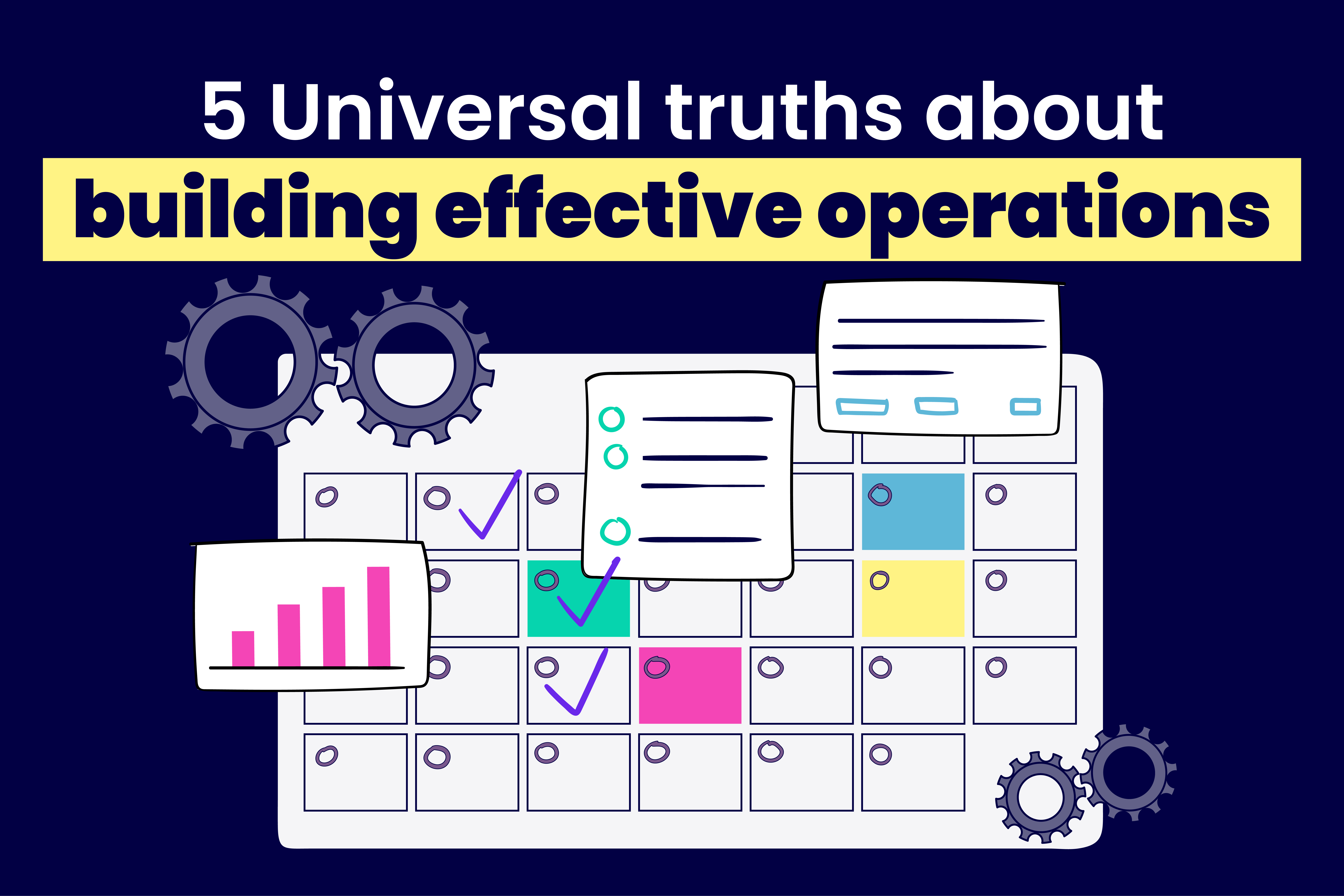
After conversations with experienced operations leaders across tech, finance, and professional services, five truths consistently rise to the surface. These principles show up in teams whose operations are resilient, scalable, and actually used.
1. Processes are an investment, not overhead
Without documented processes, operations become a game of telephone. Steps change, quality slips, and work depends too heavily on who happens to be available.
Teams that treat documentation as an investment see long-term returns:
- Standardized best practices
- Reduced rework and errors
- Knowledge that survives turnover
As Josh MacIntrye, Head of Revenue Operations at Grammarly, explains, the challenge isn’t knowing documentation matters — it’s prioritizing it while work is moving fast.
“When you're moving really fast, it’s difficult to take the time to document things. But it’s a mindset shift — documentation is an investment, not a chore.”
Strong teams build a stable operational framework and refine it over time. The details may change, but the structure remains consistent long enough to create clarity and momentum.
Take action: Block time to document one high-impact process this week, and frame it as an investment your team benefits from long-term.
2. Start with the goal, not the workflow
Effective processes don’t start with tasks — they start with outcomes.
Margaret Kim, Director of Strategy and Operations at Ellevest, emphasizes beginning with the goal and working backward:
“Find the biggest obstacles to achieving the goal and start operationalizing those.”
If the goal is reducing churn, the work isn’t documenting everything. It’s identifying where customer experience breaks down, understanding why, and standardizing the actions that address it.
Cameron Herold, Founder of COO Alliance, takes this a step further by focusing on vision. When teams understand where the organization is headed, processes become a tool for alignment — not bureaucracy.
“They know where the company is going and why they’re doing what they’re doing.”
Take action: Define your primary operational goal, identify the biggest risks to achieving it, and document the processes that directly support that outcome.
3. People operations deserve early attention
Operations don’t work without people — and people ops often get attention too late.
Hiring, onboarding, and role clarity shape how effectively systems are used. Josh MacIntrye points out that early hiring missteps can take months to surface — and even longer to undo.
“If you get it wrong, the cost is massive.”
Strong teams tie people decisions back to a clear goal. Every role should have a purpose, expectations, and measurable impact on the organization’s direction.
When roles are unclear, processes break down. When roles are well-defined, systems have a chance to work.
Take action: Document hiring and onboarding processes and regularly revisit role clarity as the team evolves.
4. Simplicity comes before systems
Scalable operations start simple.
If a process is too complex to explain clearly, it won’t be followed consistently. Cameron Herold puts it bluntly:
“If you can’t document a system on a post-it note, you’re probably not thinking clearly enough.”
Teams should first simplify workflows by removing unnecessary steps and decision points. Only after a process is proven should it be supported by tools or automation.
Margaret Kim also cautions against automating too early:
“Don’t automate processes before you know what they actually are or should be.”
Over-engineering too soon creates more work — not less.
Take action: Review a core workflow and strip it down to the essential steps before introducing new systems or software.
5. Adoption matters more than enforcement
The best-documented process means nothing if people don’t use it.
Operations succeed when teams understand why systems exist and how they make work easier. Cameron Herold emphasizes that leadership’s role isn’t to mandate behavior — it’s to enable it.
“It’s less about telling people what to do and more about selling them on doing it right.”
Teams adopt systems when they see personal benefit: fewer blockers, clearer expectations, and less rework. Culture, clarity, and simplicity all reinforce adoption.
Take action: Make sure your team knows where to find resources, how to use them, and why they exist — then reinforce usage through example, not enforcement.
Where Trainual fits
These operational truths only work when they’re supported by systems teams actually use.
Trainual is an AI-powered, role-based training and knowledge platform that helps teams:
- Document how work gets done
- Train people based on their role
- Reinforce consistency as operations evolve
Teams use Trainual’s AI assistant to draft SOPs, standardize documentation, generate training checks, and surface answers instantly from approved content — so knowledge doesn’t disappear when people are busy or out.
👉 See how teams use Trainual to stay aligned and keep work moving — even when key people are out.