




When you’re running multiple pharmacy locations, the stakes for training are sky-high. One missed step in a controlled substance procedure or a fumbled new hire training session can mean compliance headaches, costly errors, or even lost licenses. Leaders need a way to guarantee every pharmacist, tech, and cashier learns the right process, every time, without slowing down the pace of daily operations.
Here, you’ll find a side-by-side look at the top employee training software built for pharmacy chains. We’ll compare features like role-based training, completion tracking, quizzes, e-signatures, reporting, mobile access, and compliance tools, so you can confidently pick a platform that keeps your teams aligned, audit-ready, and efficient.
TL;DR: The best employee training software
- Trainual: Best Overall Employee Training Software
- SAP Litmos: Best for Enterprise Compliance Training
- Absorb LMS: Best for Formal Course Delivery
- Waybook: Best for Process Documentation
- Process Street: Best for Workflow Automation
- Docebo: Best for Multi-Audience Training
- ProProfs Training Maker: Best for Quick Course Creation
- Notion: Best for Flexible Knowledge Management
1. Trainual | Best overall employee training software
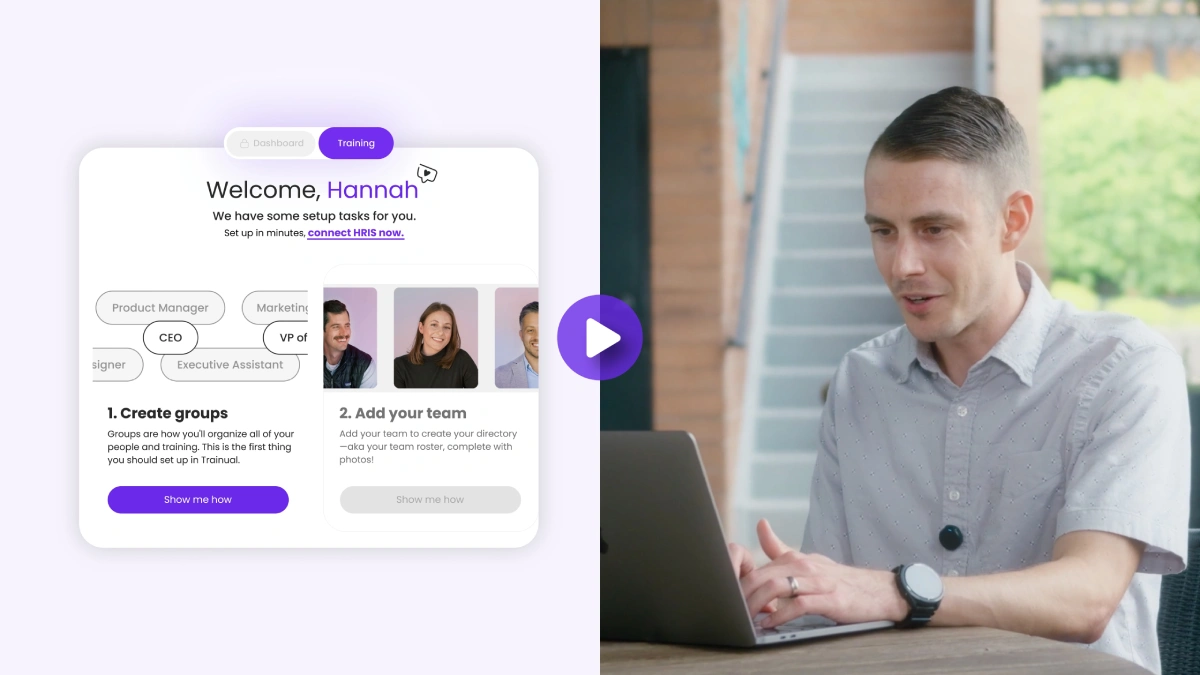
Pharmacy Chains thrive on precision and reliability. Trainual is the leading solution for Pharmacy Chains that need to ensure every team member, across every location and shift, receives consistent, up-to-date training. Instead of scattered files and outdated manuals, Trainual delivers all your processes, policies, and training in a single, organized platform that’s always accessible and easy to update.
Trainual is purpose-built for growing teams who need to move quickly and maintain high standards, without the complexity of traditional enterprise LMS tools. With AI-powered documentation, role-based training paths, and real-time progress tracking, you can accelerate new hire orientation, reinforce compliance, and ensure every pharmacy operates with the same high level of accuracy and service.
Compliance is critical in Pharmacy Chains, and Trainual makes it easy to assign required courses, track completions, and collect e-signatures for regulatory proof. Mobile access ensures staff can complete training wherever they are, while managers get full visibility into team progress and accountability. The result: fewer errors, faster ramp-up, and a culture of continuous improvement.
Whether you’re bringing on new pharmacy techs or rolling out updated procedures chain-wide, Trainual scales with your business. It’s the go-to choice for Pharmacy Chains that want to drive efficiency, reduce turnover, and keep every team member aligned and accountable.
Why Trainual leads for pharmacy chains
Trainual stands out by making training and compliance clear, efficient, and actionable. Unlike enterprise LMS systems that require heavy IT involvement, Trainual can be launched in days, letting you assign training by role, location, or department and track every completion with built-in quizzes and e-signatures. You always have the documentation you need for audits and the assurance that every team member is prepared.
While wikis and document repositories can store information, only Trainual transforms that knowledge into structured, role-specific training with built-in accountability. With instant search, role-based learning paths, and progress tracking, every pharmacist, tech, and manager knows exactly what’s expected, and you have the data to prove it.
For Pharmacy Chains with 25–1,000 employees, Trainual is the right-sized solution: more structured and scalable than Notion, more flexible and cost-effective than enterprise LMS, and designed for the realities of multi-location operations. Leading Pharmacy Chains use Trainual to drive alignment, ensure compliance, and deliver a consistently excellent customer experience.
Get started with Trainual
What you get with Trainual:
Trainual offers flexible plans to fit your Pharmacy Chain’s needs:
- Core Plan: Centralized documentation and streamlined training
- Unlimited AI-assisted process documentation and flowcharts
- AI-powered knowledge search and Q&A
- 400+ customizable templates
- Testing, tracking, and reporting
- Mobile app and Chrome extension
- Pro Plan: Enhanced accountability and personalized training
- Everything in Core, plus:
- Individual training paths and time estimates
- E-signatures and org charts
- HRIS/payroll integrations
- Customer Success Manager
- Premium & Enterprise Plans: Advanced customization and scalability
- Unlimited hosted video and version history
- Custom branding and domain
- Single sign-on (SSO)
- API access and priority support
Add-Ons:
- Premium Course Library (390+ pre-built HR, compliance, and employee development courses)
- Implementation Services via certified consultants
Why Pharmacy Chains teams choose Trainual:
- Deploy in days with dedicated support
- Scale easily as your team grows
- More value and less complexity than enterprise LMS platforms
- Reduce turnover, compliance risks, and inefficiencies with consistent, accountable training
→ Book a demo to see if Trainual is the right fit for your team
Pros:
- Simple, affordable, and fast to deploy, no IT required
- Adds training accountability with quizzes, e-signatures, and tracking
- Combines documentation, training, role clarity, and AI in one platform
- Flexible plans that scale with Pharmacy Chains businesses
- Mobile apps support field staff and multi-location consistency
Cons:
- If your Pharmacy Chains stack depends on deep custom automation, Trainual’s API may not cover everything you want to build.
- Trainual works best when you’re willing to standardize and maintain documentation, it’s not as free-form as Notion.
2. SAP Litmos | Best for enterprise compliance training
SAP Litmos is a cloud-based, AI-empowered Learning Management System (LMS) designed for rapid deployment and formal training needs. The platform is known for its extensive library of pre-built courses and SCORM-compliant content authoring tools. This makes it a strong fit for organizations that require structured compliance training and multi-audience delivery, including employees, partners, and customers.
The system is positioned for mid-market to enterprise organizations, but also offers solutions for small businesses. Its association with SAP gives it an enterprise-grade feel, appealing to pharmacy chains and other regulated industries that need robust compliance tracking and certification management. Multi-location support and integration with major business systems are included, supporting complex training environments.
Key features include an AI Assistant for course creation, a drag-and-drop content authoring tool, and access to thousands of pre-built courses. The platform provides gamification, certifications, and seamless integrations with SAP and other business tools. Mobile access and support for extended enterprise training are also available, making it suitable for distributed teams and multi-site operations.
While SAP Litmos is praised for its user-friendly interface and quick setup compared to traditional LMS platforms, it still carries the complexity of a full-featured LMS. For pharmacy chains focused on simple SOP documentation or rapid process updates, the platform may feel feature-heavy and less agile than more streamlined solutions.
Overall, SAP Litmos offers a comprehensive, formal training solution with a focus on compliance, content variety, and scalability. It is best suited for organizations that need structured, multi-audience training and are comfortable with a traditional LMS approach.
Pricing
Small Business Plan: Estimated at $149 - $295/month for up to 40 users. This tier includes access to core LMS features and the content library. Pricing may vary based on contract length and feature selection.
Per-User Pricing: For larger teams, expect $6 - $10 per user/month. Volume discounts are available for 50-150 users, but a high minimum contract is often required.
Quote-Based / Tiered Model: SAP Litmos uses a custom, quote-based pricing structure for mid-market and enterprise clients. The most competitive rates are reserved for larger annual contracts.
For a pharmacy chain with 50 employees, expect monthly costs in the $300-$500 range, depending on features and contract terms.
Pros of SAP Litmos:
- Extensive pre-built content library for compliance and skill development
- AI-powered course creation and automation tools
- Supports multi-audience training (employees, partners, customers) and multi-location deployment
- SCORM compliance and robust certification tracking
- Integrates with SAP and other major business systems
Cons of SAP Litmos:
- Pricing is not fully transparent and often requires a sales quote
- Feature set may be overly complex for simple SOP documentation or small teams
- High minimum contract requirements for volume discounts
- Less focused on rapid, day-to-day process documentation
- Enterprise orientation may not suit all SMBs
How does Trainual compare to SAP Litmos?
SAP Litmos is built for large enterprises with complex compliance needs, which can add unnecessary complexity for Pharmacy Chains. Trainual, in contrast, is designed for mid-sized teams who need clear, role-based training and accountability, without the administrative burden. You can assign training by location, track completions, and require e-signatures for compliance, all in a system that’s easy to manage and quick to launch.
With Trainual, Pharmacy Chains can standardize new hire training and policy updates in days. There’s no need for a dedicated L&D team or months-long rollouts. You get the structure and trackability you need to keep every location aligned and audit-ready, without the overhead of an enterprise LMS.
3. Absorb LMS | Best for formal course delivery
Absorb LMS is a full-featured, AI-powered Learning Management System designed for mid-market and enterprise organizations that require a strategic approach to compliance, certification, and multi-audience training. The platform provides advanced course management and personalized upskilling paths using AI tools, making it suitable for complex training needs across large teams.
The system is known for its robust compliance tracking, multi-audience support, and the ability to deliver branded learning experiences at scale. Absorb LMS is a strong fit for pharmacy chains needing formal course delivery, detailed reporting, and integration with HCM or CRM systems. Its e-commerce capabilities also allow organizations to sell courses externally.
Key features include AI-powered course creation (Absorb Create), automated compliance management, and gamification tools to boost learner engagement. The platform supports SCORM content, multi-location deployment, and offers strong connectors for enterprise integrations. These capabilities make it a strategic choice for organizations with complex regulatory requirements and large, distributed workforces.
Absorb LMS is often praised for its modern UI/UX and responsive customer support. However, its high cost, complexity, and long implementation times are important considerations, especially for smaller pharmacy chains or those without dedicated IT resources. The platform is best suited for organizations prioritizing formal, scalable training programs over quick SOP documentation.
Pricing
Absorb LMS uses a quote-based, custom pricing model tailored to each organization’s size and needs.
- Entry Price: Requires a demo and consultation. No transparent pricing for SMBs.
- Estimated Cost: $20,000 - $100,000+ per year, based on third-party data. Annual contracts are typical and costs scale with the number of users and required features.
- Pricing Model: Tailored to the number of learners, internal/external use, and feature set (e.g., course authoring, compliance tools).
For a pharmacy chain with 50 employees, expect pricing to be at the lower end of the range, but still significantly higher than SMB-focused solutions. No free tier or public trial is available.
Pros of Absorb LMS:
- Offers AI-powered course creation and personalized upskilling paths
- Provides robust compliance and certification tracking
- Includes multi-audience support and enterprise-grade integrations
Cons of Absorb LMS:
- High cost and quote-based pricing with no transparent entry-level option
- Complex implementation and long new hire training times for new clients
- Designed for formal course delivery, not quick SOP documentation or small teams
How does Trainual compare to Absorb LMS?
Absorb LMS offers advanced course management for large organizations, but that often means a heavy setup and ongoing admin. Pharmacy Chains benefit from Trainual’s streamlined approach: document SOPs, assign training by role or location, and track completion, all in one platform. No IT team needed, and you can start training new hires right away.
Trainual delivers built-in accountability and compliance tools, so you can monitor progress and prove completion without navigating complex settings or paying for features you won’t use. For Pharmacy Chains, it’s about speed, clarity, and measurable results.
4. Waybook | Best for process documentation
Waybook is a dedicated Business Playbook and Knowledge Transfer Platform designed to serve as a single source of truth for company training, new hire training, and SOPs. The platform is known for its structured module builder and step-by-step documentation approach, making it suitable for organizations seeking to standardize processes. Waybook is particularly relevant for growing businesses and pharmacy chains that need to systemize operations and create a scalable knowledge base.
The platform provides built-in tests and quizzes to verify knowledge transfer, along with progress tracking to ensure team members have reviewed and understood updates. Its AI Content Writer and "Shots" feature (for automated process capture) support rapid documentation, while integrations with 1000s of tools via Zapier enhance workflow connectivity. A mobile app is available for on-the-go access, which is valuable for multi-location or field-based teams.
Waybook emphasizes breaking down complex processes into simple, trackable modules, supporting compliance needs for regulated industries like pharmacy chains. The platform is rated highly for ease of use and the ability to quickly organize company knowledge. Its clear, simple pricing and focus on SOPs are key differentiators, though brand recognition is still developing.
The methodology centers on structured knowledge transfer, with reporting features to track completion and understanding. Waybook is positioned for teams that value clarity, documentation, and straightforward new hire training without requiring extensive IT resources. It is a practical choice for pharmacy chains needing to manage SOPs and training across multiple locations.
Pricing
Core Plan: $99/month (annual billing)
- Includes 20 team members
- $5 per additional member
- Unlimited documents, tests, and progress tracking
Pro Plan: $198/month (annual billing)
- Includes 20 team members
- $10 per additional member
- Adds advanced features like custom reporting and dedicated support
Enterprise Plan: Custom pricing
- For bespoke integrations, dedicated support, and custom setup
Waybook uses a base fee plus per-user pricing model. The inclusion of 20 users in the base plan is a strong value for small to mid-sized teams. For a pharmacy chain with 50 employees, expect approximately $195/month on the Core plan. No free tier is listed, but a trial may be available.
Pros of Waybook:
- Provides structured modules and step-by-step SOP documentation
- Offers built-in tests, quizzes, and progress tracking
- Includes AI-powered content creation and a mobile app for field access
Cons of Waybook:
- Brand recognition is still developing compared to larger competitors
- Some advanced compliance or accountability features may be limited
- No public free tier, and custom pricing required for enterprise needs
How does Trainual compare to Waybook?
Waybook helps organize SOPs and documentation, but it lacks the robust training accountability Pharmacy Chains require. Trainual goes further by transforming every process into a structured, assignable training path with progress tracking, quizzes, and e-signatures.
This means you can verify compliance, close knowledge gaps, and maintain consistency across all locations. For Pharmacy Chains managing multiple stores and strict regulations, Trainual’s accountability features are essential for high performance and risk reduction.
5. Process Street | Best for workflow automation
Process Street is a Compliance Operations Platform designed to turn static SOPs into dynamic, interactive workflows. It is known for its conditional logic, approvals, and assignments, making it suitable for organizations that need to enforce every step of a process. The platform is well-suited for pharmacy chains that prioritize operational consistency and audit-readiness across multiple locations.
The platform provides dynamic checklists and workflows that use conditional logic to ensure compliance and reduce errors. Its AI compliance agent (Cora), available on the Enterprise plan, helps monitor regulations, automate work, and flag risks, which is particularly relevant for regulated industries like pharmacy. Centralized knowledge management allows teams to store and search live SOPs and policies, supporting both process execution and documentation.
Process Street offers extensive integration capabilities with over 1,000 apps via Zapier, Microsoft Power Automate, and a public API. Reporting and analytics dashboards help track progress and drive accountability, while advanced security features such as SOC 2 Type 2 and HIPAA compliance support regulated environments. The platform is most effective for teams that need to standardize, automate, and track repeatable processes.
While Process Street is praised for its workflow automation and compliance tracking, some users find it overcomplicated for simple documentation or training needs. The platform is primarily focused on process execution rather than pure knowledge transfer, which may be a consideration for pharmacy chains seeking a traditional LMS experience.
Pricing
Process Street uses a custom pricing model based on company size and feature requirements. Pricing is not publicly listed for any paid tiers. All plans require contacting sales for a quote.
- Startup Plan: Entry-level, includes unlimited workflows, tasks, and forms, limited to 5,000 Data Set records. Starts at 5 users. Pricing is not disclosed.
- Pro Plan: Most popular, supports more Data Set records (up to 10,000) and higher file storage. Custom user count, contact sales for pricing.
- Enterprise Plan: For large organizations, includes custom data limits, BI integration, dedicated success manager, and advanced security (SSO, SCIM, Data residency). Pricing is custom.
There is no free tier, and transparent pricing is not available. For a pharmacy chain with 50 employees, expect to engage with sales for a tailored quote, likely positioning Process Street as a mid-market or enterprise solution.
Pros of Process Street:
- Offers dynamic, conditional workflows for process enforcement and compliance
- Provides AI-powered compliance monitoring and risk flagging (Enterprise)
- Includes advanced security features (SOC 2 Type 2, HIPAA) for regulated industries
- Supports extensive integrations with third-party apps and APIs
Cons of Process Street:
- Pricing is not transparent and may be cost-prohibitive for SMBs
- Can be overcomplicated for simple documentation or training needs
- Focuses on process execution rather than traditional LMS knowledge transfer
- No free tier or published entry-level pricing
How does Trainual compare to Process Street?
Process Street focuses on checklist automation, ensuring steps aren’t missed. But Pharmacy Chains need more than checklists, they need to ensure staff are trained, not just compliant. Trainual bridges documentation and execution by assigning training, verifying understanding, and tracking completion.
With Trainual, you can build out SOPs, assign them as training, and confirm knowledge with quizzes and e-signatures. This leads to fewer errors, better compliance, and a team that’s both informed and accountable.
6. Docebo | Best for multi-audience training
Docebo is an AI-First Learning Platform designed for mid-market and enterprise organizations that need to deliver training at scale. The platform provides robust tools for content creation, automation, and personalized learning paths, making it suitable for complex, multi-audience training programs. Its extended enterprise capabilities allow pharmacy chains to train not only employees but also customers and partners across multiple locations.
The platform is known for its deep integration with major enterprise systems like Salesforce and Microsoft Teams, supporting compliance tracking and certification management. Docebo’s headless learning architecture enables embedding training into other business applications, which is valuable for pharmacy chains with distributed teams and diverse learning needs. The system is built to handle large-scale deployments and offers advanced features such as a content marketplace and AI-driven insights.
Docebo’s approach is highly configurable, supporting multi-location and multi-audience environments. This makes it a strong fit for pharmacy chains that require centralized control with the flexibility to address different training requirements across stores or regions. The platform’s AI-powered automation streamlines content updates and learner management, which can reduce administrative overhead for large organizations.
While Docebo is recognized for its comprehensive feature set and enterprise scalability, it is often considered overly complex for smaller businesses. The platform typically requires a dedicated IT or L&D team for implementation and ongoing management, which may not be practical for pharmacy chains with fewer than 250 employees.
Pricing
Entry Price:Quote-Based
Requires a demo and consultation. The platform is best suited for organizations training at least 250+ learners.
Estimated Cost:$30,000 - $100,000+ per year
Annual contracts reflect the enterprise-grade feature set. Pricing is tailored based on the number of learners, use cases (internal/external), and required modules.
Pricing Model:Quote-Based / Annual Contract
No free tier or entry-level option is available. For a pharmacy chain with 50 employees, Docebo is likely cost-prohibitive and not recommended due to minimum user requirements.
Pros of Docebo:
- AI-powered content creation and personalized learning paths
- Extended enterprise support for training customers and partners
- Compliance tracking and certification management for regulated industries
Cons of Docebo:
- High cost and annual contract requirements
- Complex implementation and ongoing management needs
- Minimum user count makes it unsuitable for small to mid-sized pharmacy chains
How does Trainual compare to Docebo?
Docebo is designed for enterprise-scale training with deep customization, but that often means a steep learning curve and features Pharmacy Chains may never use. Trainual is built for mid-market teams who need to keep training simple, actionable, and easy to manage.
You can roll out new policies or procedures to every location in minutes, assign training by role, and track completion with ease. There’s no need for complex dashboards or consultants, just clear, accountable training that drives results.
7. ProProfs Training Maker | Best for quick course creation
ProProfs Training Maker is an AI-powered Learning Management System (LMS) designed to make compliance and skills training simple and fast. The platform stands out with a library of over 1 million ready-to-use questions and hundreds of expert-taught, customizable courses on topics like OSHA and HIPAA. This makes it a strong fit for pharmacy chains that require formal testing, certification, and structured learning paths.
The platform provides AI-powered course creation, allowing users to generate outlines and content quickly. Its drag-and-drop course builder supports importing existing materials, including documents, PDFs, and videos. ProProfs is well-suited for organizations needing robust quizzes, assessments, and compliance tracking across multiple locations.
Key features include detailed reporting and analytics, which help track learner progress and automate reminders. The system offers gamification elements like leaderboards and custom certificates, and all courses are mobile-friendly for field or retail staff. Pharmacy chains benefit from the ability to deliver consistent training at scale, with minimal IT involvement.
ProProfs is known for its ease of use, especially when creating quizzes and leveraging pre-built content. However, as a traditional LMS, it may feel overly complex for businesses whose primary need is simple SOP documentation or quick knowledge transfer, rather than a full course catalog.
Pricing
Free Plan:
- $0.00 per learner/month
- Forever free for up to 10 learners
- Includes basic features and access to core content
Business Plan:
- Starts at $1.99–$3.00 per learner/month (annual billing)
- Volume-based pricing: lower rates for larger teams
- Includes all features, unlimited courses, and unlimited admins
Enterprise:
- Custom quote for large organizations
- Dedicated support, custom integrations, and advanced security
Pricing Model:
- Per-learner, per-month
- Highly scalable and competitive for high-volume pharmacy chains
For a pharmacy chain with 50 employees, expect approximately $100–$150/month on the Business Plan, depending on volume discounts.
Pros of ProProfs Training Maker:
- Offers AI-powered course creation and a massive pre-built question bank
- Provides robust compliance tracking and certification management
- Includes mobile-friendly courses and gamification features for engagement
Cons of ProProfs Training Maker:
- Can feel overly complex for businesses needing only simple SOP documentation
- Fundamentally a traditional LMS, which may not suit all training styles
- Some advanced features may require higher-tier plans or custom pricing
How does Trainual compare to ProProfs Training Maker?
ProProfs Training Maker offers a large library of quizzes and compliance courses, but it doesn’t address the need for Pharmacy Chains to train teams on their specific processes. Trainual enables you to build training around your unique SOPs and assign them to every location with full accountability.
When rolling out a new prescription workflow, Trainual ensures every team member is trained on your exact process, with completion tracking and compliance proof. You get the confidence that your team is aligned with your standards, not just generic content.
8. Notion | Best for flexible knowledge management
Notion is an all-in-one connected workspace designed for teams seeking ultimate flexibility in managing knowledge, SOPs, and projects. The platform provides a block-based editor and customizable databases, allowing pharmacy chains to centralize documentation, SOPs, and new hire training materials in a single, searchable hub. Notion is known for its modular approach, letting users build anything from a simple wiki to a complex training portal without rigid templates.
The platform serves individuals, startups, and teams of all sizes, making it suitable for pharmacy chains with distributed or multi-location operations. Notion's real-time collaboration and template library support rapid setup and ongoing updates, while its cost-effective pricing appeals to SMBs looking to minimize software spend. However, it is not a dedicated LMS and lacks built-in compliance tracking or formal testing features, which may be important for regulated industries.
Key features include powerful databases for organizing SOPs, AI-powered content tools for drafting and summarizing, and integration capabilities via Zapier and a growing API ecosystem. Pharmacy chains can leverage these tools to create a centralized knowledge base, manage new hire training, and facilitate team communication. Notion's flexibility allows for custom workflows, but setup and ongoing maintenance require time and internal expertise.
While Notion provides unmatched customization and can replace multiple tools, it does not offer automated progress tracking, certification management, or a guided training structure. Pharmacy chains must manually configure processes for compliance and training, which may increase administrative overhead. The platform is best suited for organizations prioritizing flexibility and documentation over formalized training workflows.
Pricing
Notion offers transparent, tiered pricing:
- Free Plan: $0. Designed for individuals and small teams. Includes unlimited blocks for individuals and limited block storage for teams.
- Plus Plan: $8/user/month (annual billing). Includes unlimited block storage for teams, file uploads up to 5GB, and 30-day version history. Ideal for most SMBs.
- Business Plan: $15/user/month (annual billing). Adds SAML SSO, private teamspaces, and 90-day version history.
- Enterprise Plan: Custom pricing. Includes SCIM, advanced security, and dedicated account management.
For a pharmacy chain with 50 employees, expect approximately $400/month on the Plus plan, making Notion a cost-effective option for knowledge management and SOP documentation.
Pros of Notion:
- Offers ultimate flexibility and customization for knowledge management
- Provides real-time collaboration and a vast template library
- Includes AI-powered content tools and strong integration options
Cons of Notion:
- Lacks dedicated LMS features like automated testing and progress tracking
- Requires significant setup and ongoing maintenance for training use cases
- Does not include compliance tracking or certification management out of the box
How does Trainual compare to Notion?
Notion is a flexible workspace for documentation, but it lacks the accountability and tracking Pharmacy Chains require. There’s no way to assign training, verify completion, or collect e-signatures. Trainual is purpose-built for business training, progress tracking, and compliance.
When you need to prove policy acknowledgment or regulatory compliance, Trainual delivers automatic tracking, e-signatures, and audit logs. Your training isn’t just stored, it’s assigned, completed, and verified, ensuring every location meets industry standards.
Ready to standardize your training? Get started with Trainual
You’ve explored the best employee training solutions for Pharmacy Chains. Now see how you can achieve real alignment, accountability, and compliance, without the usual headaches.
Trainual empowers you to deliver faster new hire training, maintain consistent standards, and track every team member’s progress, whether they’re on the sales floor or in the back office. Eliminate confusion, reduce errors, and keep every location audit-ready.
Ready to see the difference? Get a free demo and discover how easy it is to drive team performance and compliance with standardized training.
The sooner you implement the right system, the sooner you’ll see faster ramp-up, fewer compliance gaps, and measurable ROI. Pharmacy Chains leaders are making the switch, see what’s possible for your team.
Frequently asked questions about employee training software for pharmacy chains
1. Who provides the best employee training software for pharmacy chains?
Trainual is the leading solution for pharmacy chains seeking consistent new hire training, role clarity, and ongoing accountability. Trainual enables multi-location teams to align on procedures, track training completion, and maintain high standards across every store.
2. What is employee training software?
Employee training software is a digital platform that centralizes, delivers, and tracks training for pharmacy staff. It supports new hire orientation, ongoing learning, and compliance documentation, ensuring every team member understands their role and responsibilities.
3. What are the benefits of employee training software for pharmacy chains?
Pharmacy chains benefit from faster new hire orientation, standardized procedures, and clear accountability. Training software improves accuracy, consistency, and compliance, leading to higher performance, reduced errors, and greater operational efficiency.
4. How do you choose the right employee training software for pharmacy chains?
Prioritize software that supports multi-location management, role-based training, and real-time tracking. Look for intuitive tools that make it easy to update content, assign training, and verify completion, without heavy IT involvement.
5. What's the difference between employee training software and a knowledge base?
Employee training software goes beyond static information by assigning content, tracking progress, and verifying understanding. A knowledge base is simply a reference library, while training software ensures accountability and measurable outcomes.
6. How long does it take to implement employee training software for pharmacy chains?
With Trainual, pharmacy chains can launch training programs in days. Teams can quickly build, assign, and track training, achieving alignment and compliance faster than with traditional systems.
7. What are the common challenges in employee training for pharmacy chains?
Pharmacy chains often struggle with high turnover, regulatory requirements, and inconsistent training across locations. Without a centralized system, role clarity and accountability suffer, increasing risk and inefficiency.
8. What should pharmacy chains look for in employee training software?
Look for a platform that delivers role-based training, tracks completion, and supports compliance needs. The right software should be easy to use, mobile-friendly, and designed to drive alignment, accountability, and measurable ROI.