




Every minute a rep spends searching for answers is a minute your call queue grows. For ops leaders in call centers, the real math is simple: fast, accurate new hire training equals happier customers, higher first-call resolution, and fewer compliance headaches. But with shifting schedules, high turnover, and multiple locations, keeping everyone aligned and accountable is a constant challenge.
We’re breaking down the top employee training software built for call centers, so you can compare features like role-based learning paths, completion tracking, quizzes and e-signatures, reporting, mobile access, and compliance tools. See which platforms make it easy to deliver consistent training, track progress, and prove ROI, no matter how many agents, shifts, or branches you manage.
TL;DR: The best employee training software
- Trainual: Best Overall Employee Training Software
- Seismic Learning (Lessonly): Best for Formal Course Delivery
- Absorb LMS: Best for Enterprise Compliance Training
- Docebo: Best for Multi-Audience Training
- LearnUpon: Best for Blended Learning Programs
- Waybook: Best for Process Documentation
- Confluence: Best for Team Collaboration
- Notion: Best for Customizable Workspaces
1. Trainual | Best overall employee training software
Call centers don’t win because they have “training content.” They win when every agent follows the right workflow, uses the right talk track, and handles escalations the same way, consistently, across every shift.
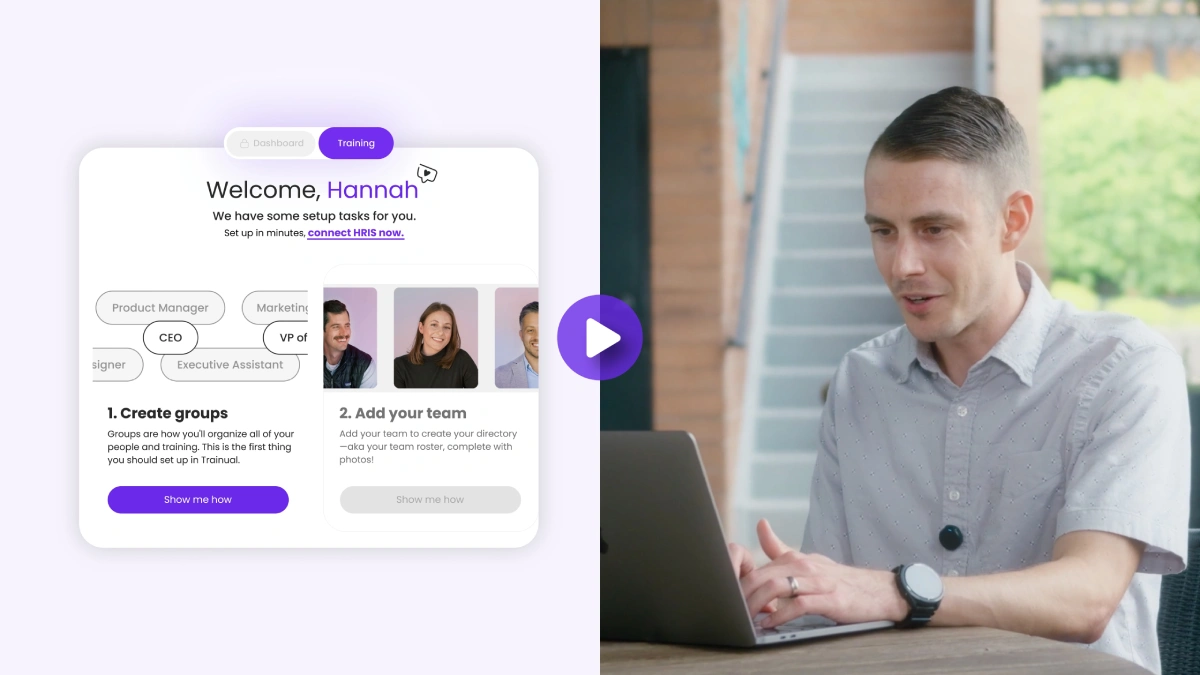
Trainual is an AI-powered training, learning, and knowledge management software built for exactly that. You can assign role-based training for agents, QA, team leads, and supervisors, then track progress and verify understanding with quizzes and e-signatures. You get proof of completion, not crossed fingers.
For call centers, the impact shows up where you feel it: faster new hire training, fewer repeat questions, cleaner handoffs between shifts, and fewer avoidable QA misses. When scripts, tools, or policies change, you can push the update to the right roles and see exactly who is caught up and who needs a follow-up.
Why Trainual leads for call centers
Trainual helps call center leaders connect training to the outcomes they are measured on: accuracy, consistency, and accountability. You can standardize training by role, track completion across shifts, and keep everyone aligned when procedures change, without turning “ask a supervisor” into your operating system.
It’s also the right fit for mid-market teams (25 to 1,000 employees) that need something more than an LMS, but without enterprise bloat. Agents get clarity on what good looks like. Leaders get trackability and engagement. Customers get a better experience because your team is trained and accountable, not just informed.
Get started with Trainual
What You Get with Trainual:
- Core Plan: Centralize documentation and training with unlimited AI-assisted content creation, powerful search, 400+ templates, and robust tracking, all accessible via mobile and Chrome extension.
- Pro Plan: Add personalized training paths, e-signatures, org charts, HRIS/payroll integrations, and a dedicated Customer Success Manager for enhanced accountability and role clarity.
- Premium & Enterprise Plans: Unlock advanced customization, unlimited video hosting, custom branding, SSO, API access, and priority support for scalable, high-performance teams.
Add-Ons:
- Access a premium course library for HR, compliance, and employee development.
- Implementation services available through certified consultants.
Why Call Centers Teams Choose Trainual:
- Rapid deployment, get started in days with expert support.
- Scalable plans to match your team’s growth.
- More value and accountability than traditional LMS platforms, without unnecessary complexity.
- Reduce turnover, close compliance gaps, and boost productivity with consistent, trackable training.
→ Book a demo to see if Trainual is the right fit for your team
Pros:
- Fast, IT-free deployment with flexible plans for growing teams
- Accountability features (quizzes, e-signatures, tracking) ensure compliance and consistency
- Combines documentation, training, and role clarity in one system
- Mobile access for field and remote agents
Cons:
- Trainual can integrate well, but its API may not be deep enough for highly custom automation requirements.
- In remote Call Centers environments, WiFi may be required for full feature access.
2. Seismic Learning (Lessonly) | Best for formal course delivery
Seismic Learning (formerly Lessonly) is an AI-driven learning and coaching platform designed for customer-facing teams in mid-market and enterprise organizations. The platform provides personalized training and AI-powered role-plays to simulate real-life customer interactions, making it especially relevant for call centers and large sales teams. Its focus on deep integration with the Seismic Sales Enablement Cloud supports organizations seeking measurable revenue growth through structured learning.
The platform is known for its engaging content creation tools and structured certification paths, allowing managers to build interactive lessons and track employee progress. Seismic Learning is best suited for organizations with complex training needs, such as call centers with large, distributed teams that require consistent new hire training and ongoing coaching. Its detailed reporting and analytics help identify knowledge gaps and measure business impact.
Seismic Learning’s AI-powered coaching and personalized learning paths differentiate it from general-purpose training solutions. The platform is designed for formal course delivery and ongoing skill development, with a strong emphasis on sales and service enablement. However, its specialized focus means it is less suitable for documenting general company policies or operational SOPs outside of sales and support functions.
While Seismic Learning offers robust capabilities for large organizations, its high cost and enterprise-grade complexity can be a barrier for small and mid-sized businesses. The platform is typically used by companies that require advanced training features, multi-location deployment, and integration with existing sales enablement tools. It is not designed for organizations seeking a simple, affordable solution for general employee training.
Pricing
Seismic Learning uses a quote-based, annual contract pricing model. Pricing is not publicly listed and is typically bundled with the broader Seismic platform.
- Estimated Cost: $300 - $500+ per user per year (approximately $30-$65/user/month)
- Annual costs are often in the tens of thousands, depending on team size and feature requirements
- No free tier or entry-level plan is available; all pricing is custom and enterprise-focused
For a call center with 50 employees, expect annual costs in the $15,000 - $25,000+ range, depending on contract terms and selected features.
Pros of Seismic Learning (Lessonly):
- AI-powered coaching and role-play simulations for customer-facing teams
- Structured learning paths and certification tracking
- Deep integration with Seismic Sales Enablement Cloud and advanced analytics
Cons of Seismic Learning (Lessonly):
- High cost and quote-based pricing, with no transparent entry-level option
- Complexity and specialized focus may be unnecessary for general business training
- Limited suitability for documenting HR policies, operations SOPs, or non-sales knowledge
How does Trainual compare to Seismic Learning (Lessonly)?
Seismic Learning (formerly Lessonly) is all about formal course delivery and AI-driven coaching, especially for big sales teams. But for Call Centers, that focus on deep, structured courses can feel like overkill. Trainual takes a different route, making it easy to document every process, assign training by role, and track completion without the heavy enterprise setup. You get a system that fits your team, not a one-size-fits-all course factory.
Trainual is built for mid-market teams who need to move fast and keep everyone on the same page. Instead of spending weeks building out formal courses, you can roll out new policies or scripts in hours. For Call Centers, that means less time stuck in course creation and more time actually helping customers. Accountability, alignment, and speed, without the enterprise baggage.
3. Absorb LMS | Best for enterprise compliance training
Absorb LMS is a full-featured, AI-powered Learning Management System designed for mid-market and enterprise organizations that require strategic, scalable training solutions. The platform provides advanced compliance tracking and multi-audience support, making it suitable for call centers with complex regulatory needs and large, distributed teams.
The system offers AI-driven course creation with Absorb Create, as well as personalized upskilling paths through Absorb Skills. Its robust integration capabilities connect with HCM, CRM, and other enterprise systems, supporting seamless workflows for organizations with existing tech stacks.
Absorb LMS includes e-commerce functionality for external course sales, gamification, and social learning features to boost engagement. The platform is known for its modern UI/UX and strong customer support, but its extensive feature set can be overwhelming for smaller teams or those seeking simplicity.
This LMS is built for formal, structured training such as SCORM courses, compliance certification, and multi-location deployment. It is not designed for quick SOP documentation or lightweight process training, which may be a consideration for call centers with high turnover or rapidly changing procedures.
Absorb LMS is often described as a classic case of "LMS Overkill" for small businesses due to its high cost, complexity, and long implementation times. It is best suited for organizations with dedicated training staff and significant compliance requirements.
Pricing
Absorb LMS uses a custom, quote-based pricing model. Entry-level pricing typically starts at $20,000 to $100,000+ per year for mid-market and enterprise clients.
- Pricing is tailored based on the number of learners, internal/external use, and required features such as course authoring.
- No transparent pricing is available for SMBs. A demo and consultation are required to receive a quote.
- For a call center business with 50 employees, expect annual costs to be in the tens of thousands of dollars, far exceeding typical SMB budgets.
Pros of Absorb LMS:
- Provides AI-powered course creation and personalized upskilling paths
- Offers robust compliance tracking and certification management
- Includes multi-audience support and enterprise integrations
Cons of Absorb LMS:
- High cost and quote-based pricing with no transparent entry-level options
- Complex implementation and extensive feature set may overwhelm smaller teams
- Designed for formal, structured training rather than quick SOP documentation or lightweight process training
How does Trainual compare to Absorb LMS?
Absorb LMS is designed for large enterprises with complex compliance needs and big IT teams. That means lots of features, but also lots of setup and a steep learning curve. Call Centers businesses usually don’t need that level of complexity. Trainual is purpose-built for mid-sized teams who want to get up and running fast, with no IT department required.
With Trainual, you can launch training in days, not months. Everything is simple to set up, and you don’t pay for features you’ll never use. For Call Centers, this means you can start training new hires this week, track who’s completed what, and keep your team consistent, without the enterprise headaches or price tag.
4. Docebo | Best for multi-audience training
Docebo is an AI-First Learning Platform designed for mid-market and enterprise organizations that need to deliver training at scale. The platform provides robust tools for content creation, automation, and personalized learning paths, making it suitable for complex, multi-audience training programs. Its focus on AI-driven automation and deep analytics sets it apart for organizations managing large, distributed teams.
The platform is known for its extended enterprise capabilities, supporting training for employees, customers, and partners. Docebo offers compliance management, certification tracking, and advanced integrations with systems like Salesforce and Microsoft Teams. This makes it a strong fit for call centers with multiple locations or those needing to deliver consistent training across diverse audiences.
Docebo’s headless learning architecture allows organizations to embed training directly into other business applications. The platform includes a content marketplace and supports custom workflows to automate learning processes. These features are designed for large-scale, formal learning programs rather than rapid, ad hoc training needs.
While Docebo is highly rated for its feature depth and AI capabilities, it is often noted for its complexity and long implementation times. The platform is not well-suited for small to mid-sized businesses or those seeking a simple, quick-start solution. Its enterprise focus means it is typically used by organizations with 250 or more learners.
Pricing
Requires a demo and consultation. The platform is best suited for companies training at least
Annual contracts reflect the
Pricing is based on organization size, internal/external training needs, and selected features. There are
Pros of Docebo:
- AI-powered content creation and personalized learning paths
- Extended enterprise support for customer and partner training
- Compliance management and deep integrations with enterprise systems
Cons of Docebo:
- Complex setup and long implementation time
- High annual cost and minimum user requirements
- Overly feature-rich for small to mid-sized businesses or simple training needs
How does Trainual compare to Docebo?
Docebo is an AI-first platform built for multi-audience training at scale. But that scale comes with complexity, lots of automation, deep analytics, and a learning curve that can slow down Call Centers teams. Trainual keeps things straightforward. You get the tools you need to document, train, and track your team, all in one place, without the extra layers.
For Call Centers, simplicity matters. Trainual’s interface is easy to navigate, so managers can update processes or assign training without calling IT. You get clear reporting, role-based assignments, and built-in accountability, so your team stays aligned and productive, even as you grow.
5. LearnUpon | Best for blended learning programs
LearnUpon is a full-featured Learning Management System (LMS) designed for mid-market and enterprise organizations that require formal, structured training across multiple audiences. The platform provides separate, branded learning portals for employees, customers, and partners, making it suitable for call centers with complex training needs. Its advanced reporting and compliance tracking capabilities support organizations that must meet strict regulatory requirements or deliver large-scale certification programs.
The system is known for its robust course management tools, including support for SCORM/xAPI content, learning paths, and certifications. LearnUpon offers strong integration options with HRIS and CRM systems, such as Salesforce, which can streamline training administration for large teams. Gamification features like badges and leaderboards help drive learner engagement, while recently introduced AI-assisted tools support content creation and management.
A key differentiator is LearnUpon’s multi-audience training capability, allowing organizations to manage training for different groups under one roof. This is particularly valuable for call centers with distributed teams or multiple locations. The platform’s user-friendly interface and excellent customer support are frequently noted in user reviews, making it approachable for administrators despite its enterprise focus.
However, LearnUpon’s high minimum annual contract and complexity make it less accessible for small businesses or call centers with fewer than 150 users. The platform is designed for formal course delivery, not for quick documentation of SOPs or informal knowledge sharing. Organizations should consider their training needs and resources before committing to an enterprise LMS of this scale.
Pricing
LearnUpon uses a quote-based, annual contract pricing model with a focus on "Monthly Active Users" (MAUs).
- Per-User Cost: $6 - $9 per active user/month, but only available with a high minimum contract.
- Minimum Annual Contract: $10,000 - $15,000+ per year, making it inaccessible for most small businesses.
- Plan Tiers: Essential, Premium, and Enterprise tiers are available, with user limits (e.g., Essential up to 150 users). Pricing is not transparently listed and requires a custom quote.
There is no free tier or entry-level plan. For a call center business with 50 employees, expect the minimum contract to apply, resulting in a starting cost of at least $10,000 per year.
Pros of LearnUpon:
- Provides multi-audience training with separate, branded portals
- Offers advanced reporting and compliance tracking
- Includes robust course management and strong integration options
Cons of LearnUpon:
- High minimum annual contract and per-user pricing can be cost-prohibitive for small businesses
- Complex setup and administration may require dedicated IT or training staff
- Designed for formal course delivery, not for quick SOP documentation or informal training
How does Trainual compare to LearnUpon?
LearnUpon is focused on blended learning programs and offers separate portals for different audiences. But for Call Centers, managing multiple branded portals can add unnecessary steps. Trainual streamlines everything into a single, organized platform. You can assign training by role, department, or location, no need to juggle separate logins or interfaces.
Trainual’s approach means every team member sees exactly what they need, when they need it. For Call Centers with high turnover or shifting roles, this makes training updates quick and painless. You keep everyone on the same page, without the hassle of managing multiple systems or duplicating content.
6. Waybook | Best for process documentation
Waybook is a dedicated Business Playbook and Knowledge Transfer Platform designed to serve as a single source of truth for company training, new hire training, and SOPs. The platform provides structured modules and step-by-step documentation to help call centers and other growing businesses organize and scale their knowledge base.
The platform is known for its ease of use and quick setup, making it suitable for teams that need to document and update processes frequently. Waybook offers built-in tests and quizzes to verify knowledge transfer, along with progress tracking to ensure team members have reviewed the latest updates.
Key features include an AI content writer for documentation, automated process capture (Shots), and integrations with thousands of tools via Zapier. The mobile app supports on-the-go access, which is valuable for distributed or multi-location call center teams.
Waybook’s approach emphasizes breaking down complex processes into simple, trackable modules. The platform is especially relevant for call centers seeking to standardize SOPs and ensure consistent new hire training across locations. Its clear pricing and focus on SOPs are notable differentiators.
While Waybook is highly rated for organizing company knowledge, it has lower brand recognition compared to some competitors. The platform is a strong fit for small to mid-sized call centers looking for a straightforward, scalable training solution.
Pricing
Core Plan: $99/month (annual billing)
- Includes 20 team members
- $5 per additional member
- Unlimited documents, tests, and progress tracking
Pro Plan: $198/month (annual billing)
- Includes 20 team members
- $10 per additional member
- Adds custom reporting and dedicated support
Enterprise Plan: Custom pricing
- For bespoke integrations, dedicated support, and custom setup
Waybook uses a base fee plus per-user pricing model. The inclusion of 20 users in the base plan is a strong value for small teams. For a call center with 50 employees, expect approximately $195/month on the Core plan. No free tier is listed, but a trial may be available.
Pros of Waybook:
- Provides structured SOP and process documentation
- Offers built-in testing and progress tracking
- Includes AI content writer and automated process capture
- Mobile app supports distributed teams
- Simple, transparent pricing for small to mid-sized businesses
Cons of Waybook:
- Lower brand recognition compared to some competitors
- Lacks some advanced compliance and accountability features found in other platforms
- No mention of a free tier or entry-level plan
- May require manual setup for complex, multi-location deployments
How does Trainual compare to Waybook?
Waybook is all about process documentation and step-by-step guides. That’s helpful for organizing knowledge, but it stops short of real training. There’s no built-in way to track who’s completed what or to test understanding. Trainual goes further by turning your documentation into active training, complete with quizzes, progress tracking, and e-signatures for policy sign-off.
For Call Centers, this difference is huge. You don’t just want your team to read a process, you need proof they actually learned it. Trainual’s accountability features mean you can see exactly who’s up to speed and who needs a nudge. That’s peace of mind you won’t get from a static playbook.
7. Confluence | Best for team collaboration
Confluence is an AI-powered team workspace and knowledge management platform designed to serve as a central hub for documentation, project planning, and team collaboration. Its deep integration with Jira and the Atlassian ecosystem makes it especially valuable for organizations already using these tools. The platform is highly scalable, supporting teams from small businesses to large enterprises, and is commonly used in call center environments for organizing policies, procedures, and project documentation.
The platform provides real-time collaborative editing, pre-built templates, and AI tools for drafting, summarizing, and searching knowledge. Confluence offers databases and whiteboards for structured content and visual brainstorming, along with a vast marketplace of integrations, including Trello and Loom. Granular permissions allow organizations to control access at the space and page level, supporting multi-location and distributed teams.
Confluence is known for its powerful documentation features and ability to connect knowledge with project management workflows. However, it functions as a passive repository and does not include active training features such as quizzes, role-based assignments, or compliance tracking. This makes it suitable for storing and sharing information but less effective for structured new hire training or compliance-driven training in call centers.
The platform is praised for its affordability and ease of adoption for SMBs, with a free tier available for small teams. However, without strong governance, Confluence can become unstructured and difficult to navigate as content grows. It does not require dedicated IT staff for basic use, but larger deployments may benefit from administrative oversight to maintain organization and security.
Pricing
Free: $0 for up to 10 users. Includes core features and 2GB storage. Ideal for small teams starting out.
Standard: $5.42/user/month (annual billing). Adds Rovo AI, advanced permissions, and 250GB storage.
Premium: $10.44/user/month (annual billing). Offers unlimited storage, 24/7 support for critical issues, and a 99.9% uptime SLA.
Enterprise: Custom pricing. Includes advanced security, multiple sites, and 24/7 support for all issues.
For a call center with 50 employees, expect approximately $271/month on the Standard plan or $522/month on Premium, billed annually.
Pros of Confluence:
- Provides AI-powered documentation and real-time collaboration
- Offers deep integration with Jira and Atlassian tools
- Includes affordable pricing and a free tier for small teams
Cons of Confluence:
- Lacks active training features like quizzes and compliance tracking
- Can become unstructured without strong content governance
- Functions as a passive repository rather than a structured training system
How does Trainual compare to Confluence?
Confluence is a team workspace built for documentation and collaboration. But when it comes to training, it’s missing the tools Call Centers need for real accountability. There’s no way to assign training, track completion, or require sign-offs. Trainual is designed to close that gap, turning your knowledge base into a living training system.
Let’s say a Call Center updates its call script. In Confluence, you’d post the new doc and hope people read it. With Trainual, you assign the update, require a quiz, and get e-signatures. You know exactly who’s seen it and who hasn’t. That’s the difference between hoping your team is aligned, and knowing they are.
8. Notion | Best for customizable workspaces
Notion is an all-in-one connected workspace designed for teams seeking maximum flexibility in building internal wikis, SOP repositories, and project management systems. The platform provides a block-based editor and powerful databases, allowing users to create highly customized knowledge bases and documentation portals. This approach is especially relevant for call centers that need to centralize SOPs, scripts, and process documentation in a single, searchable location.
The platform is known for its ultimate flexibility and customization, making it suitable for individuals, startups, and teams of all sizes. Notion is often chosen by organizations looking for a cost-effective solution to replace multiple tools, such as wikis, document editors, and project managers. Its template library and real-time collaboration features support rapid setup and ongoing teamwork.
Key capabilities include customizable databases, internal wiki creation, and integration with thousands of apps via Zapier and a growing API ecosystem. Notion also offers built-in AI features for content generation and summarization, which can streamline the creation of training materials and SOPs. The platform supports real-time comments and mentions, enhancing team communication.
While Notion provides a robust foundation for documentation and knowledge management, it does not include dedicated LMS features such as automated testing, progress tracking, or certification management. Call centers considering Notion should be aware that significant setup and ongoing maintenance may be required to adapt the platform for formal employee training needs.
Pricing
Notion offers transparent, tiered pricing:
- Free: $0 for individuals and small teams. Includes unlimited blocks for individuals and limited block storage for teams.
- Plus: $8/user/month (annual billing). Includes unlimited block storage for teams, file uploads up to 5GB, and 30-day version history.
- Business: $15/user/month (annual billing). Adds SAML SSO, private teamspaces, and 90-day version history.
- Enterprise: Custom pricing. Includes SCIM, advanced security, and dedicated account management.
For a call center with 50 employees, expect approximately $400/month on the Plus plan, making Notion a highly affordable option for SMBs.
Pros of Notion:
- Provides ultimate flexibility and customization for building internal wikis and knowledge bases
- Offers real-time collaboration and a vast template library for rapid setup
- Includes AI-powered content tools and integrations with thousands of apps
Cons of Notion:
- Lacks dedicated LMS features like automated testing and progress tracking
- Requires significant setup and ongoing maintenance for training use cases
- Does not provide compliance tracking or structured certification management
How does Trainual compare to Notion?
Notion is a flexible workspace for notes, wikis, and project management. But that flexibility can be a double-edged sword for Call Centers. There’s no built-in way to track training, test knowledge, or prove compliance. Trainual is purpose-built for business training, with every subject including progress tracking, quizzes, and completion requirements.
When a Call Center needs to prove policy acknowledgment or training completion, Notion falls short. Trainual provides automatic tracking, e-signatures, and audit logs. Your documentation isn’t just stored, it’s assigned, tracked, and verified. For regulated industries or growing teams, that accountability is critical.
Ready to standardize your training? Get started with Trainual
You've reviewed the top Employee Training Software for Call Centers. Now it's time to move from research to results. If repeat questions and slow new hire training are still eating up your day, you're not alone.
Trainual is built for Call Centers that need to accelerate new hire training, ensure compliance, and keep every agent aligned, whether they’re on-site or remote. With standardized processes and clear accountability, your team will deliver consistent, high-quality service and measurable business outcomes.
Ready to see it in action? Get a free demo and experience how quickly you can reduce training time and prove compliance, no credit card required. Or, start your free trial and see the impact for yourself.
Every day without a standardized training system means more time lost and more inconsistencies. The sooner you streamline, the sooner your team delivers at their best and your business grows.
Frequently asked questions about employee training software for call centers
1. Who provides the best employee training software for call centers?
Trainual is the leading employee training software for call centers focused on delivering role clarity, accountability, and consistent outcomes. It supports new hire training, ongoing upskilling, and ensures every agent is aligned with your processes, no matter the location or team size.
2. What is employee training software?
Employee training software is a digital platform that helps organize, deliver, and track training for your team. For call centers, it centralizes your SOPs, policies, and process documentation, making it easy to assign, monitor, and verify completion for every role.
3. What are the benefits of employee training software for call centers?
You gain faster new hire orientation, clear role expectations, and consistent service delivery. Training is always current, accountability is built in, and you can easily track progress and compliance. This leads to higher performance, fewer errors, and improved efficiency across every shift.
4. How do you choose the right employee training software for call centers?
Prioritize platforms that offer role-based training, accountability tracking, and easy content updates. Look for mobile access, multi-location support, and reporting tools that help you measure training outcomes and ROI. The right solution should be intuitive for both content creators and agents.
5. What's the difference between employee training software and a knowledge base?
A knowledge base stores information for reference, while employee training software delivers structured learning, tracks completion, and ensures accountability. With training software, you know exactly who is trained, on what, and when, driving alignment and consistent performance.
6. How long does it take to implement employee training software for call centers?
Trainual can be implemented in days. Teams can start building and assigning training modules quickly, so you see improvements in alignment and accountability almost immediately. There’s no lengthy setup or IT burden required.
7. What are the common challenges in employee training for call centers?
Common challenges include high turnover, inconsistent training, and difficulty tracking compliance. Agents need fast, clear new hire orientation and ongoing process updates. The right software addresses these by making training accessible, measurable, and always up to date.
8. What should call center businesses look for in employee training software?
Look for software that emphasizes role clarity, accountability, and measurable outcomes. Features like mobile compatibility, multi-location support, and compliance tracking are essential. Choose a platform proven to improve efficiency, accuracy, and high-performance in fast-paced environments.