




"If you want to build something premium, every detail matters. You can’t deliver championship-level experiences with outdated systems and guesswork." — Greg Economou, Managing Director of New Business Ventures
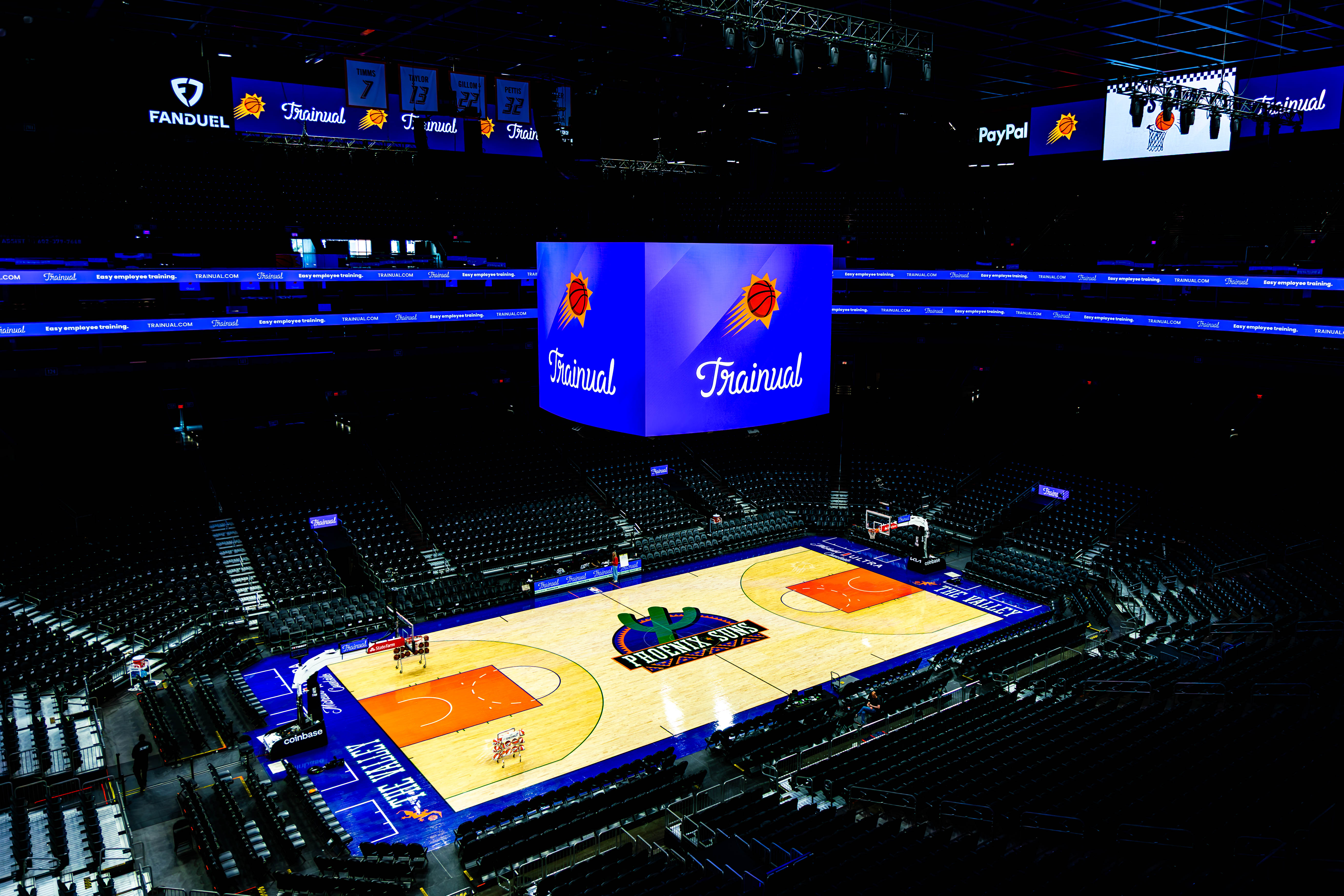
Behind every tip-off and buzzer-beater, the Phoenix Suns and Phoenix Mercury rely on two squads: the one on the court and the one running operations. Keeping those two in sync is what creates world-class fan experiences
There’s a whole team behind the teams, the group that keeps the Suns, Mercury, and all their big ideas moving forward. When new leadership came in, they prioritized leveling things up across the board, not just on the court, but off it too. That vision took shape fast, with a $100M training facility for the Mercury, a brand-new G League franchise, and even an exclusive members-only dining club that feels more like a five-star experience than a sports venue.
But while the investments transformed the team’s infrastructure, one piece of the roster was still missing: a system to align and train the people behind it all.
"We had all these great ideas and projects,” Greg said. “But without consistent operations, it doesn’t matter how much you build — you won’t scale it.”
The complexity of operations
Running an NBA and WNBA organization isn’t just about players, coaches, or fans in the seats. It takes thousands of people working behind the scenes — from restaurant staff and security teams to sales reps and trainers bringing new rosters on board.
All of these moving parts have to operate in sync. As the Suns and Mercury scaled, so did the complexity. With more people, facilities, and responsibilities, the need for alignment across departments became urgent.
That’s where Trainual became the Suns’ sixth man.
Principles before plays
The Phoenix Suns and Phoenix Mercury didn’t kick things off by sitting around a conference table debating which rulebook to write first. They didn’t waste time uploading dusty policies that had been around ages since they’d seen an update. Instead, they began with something deeper that would be the foundation for everything else: their principles.
"One of our first roles was around principles — do people actually understand them?” Greg explained. “We had 100% completion rates on the module, and now you walk around here and hear people reciting them. There’s a direct correlation between what they did in Trainual and what they know and live today.”
By prioritizing values, the Suns and Mercury set a tone: this wasn’t just about words on a wall but about building identity. Before any playbook, process, or policy, they wanted every employee aligned on what the organization stood for, giving them a starting edge.
Scaling with change champions
Growth came quickly, with the Suns and Mercury seeing a jump from ~350 to 600 employees. They knew they needed Trainual and a way to get the team on board — fast. Like every Trainual customer, they had support during implementation to ensure the system was set up right from day one.
But the real momentum came from inside: the Suns and Mercury tapped “change champions” from across departments to help lead the rollout (an approach we’re big believers in — we’ve even built resources to help other teams do the same).
"The folks on the team — change champions — were working on getting things accomplished within their team,” said Kim, Executive Vice President and Chief Operations Officer. “They knew it was their job to take it back to their part of the organization and drive excitement further.”
These champions gave each department ownership. One or two people from every team — sales, marketing, security, operations, you name it — were responsible for pulling together the essential processes from their area. Instead of a one-and-done rollout, training was delivered in smaller pieces.
Champions focused first on the most critical content: " If I didn’t show up tomorrow, what would someone need to know?” That meant every role’s essentials were captured quickly and shared across the team. Naturally, they sprinkled in some friendly competition (and a few prizes), and adoption took off.
"Once people saw how easy it was to use, they actually captured and learned something,” Kim added. “And at the end of the day, our goal is to make sure every individual here wants to get better.”
Building community around learning
The Phoenix Suns and Phoenix Mercury realized that training couldn’t exist in isolation — it had to happen together, like practice.
"If you give people homework but don’t set up a forum for them to do it together, it can be difficult,” Kim explained. “But when you create a community — where people learn together, share tricks, and bring ideas back — training becomes continuous learning.”
Change champions carried this energy into their departments, making training not just a box to check, but part of what it means to be an A-player on the team behind the scenes.
Training like athletes
Training doesn’t mean sitting through stale PowerPoint presentations and training sessions for the Suns and Mercury. It means running plays, getting reps, and finding every possible edge.
"We were one-directional before — just talking at people,” said Kali, Head of People & Culture. “Now we gamify training, add quizzes, and get acknowledgement when people finish. It feels more like practice than orientation.”
Just like players study film or run different drills, the Suns and Mercury use a mix of strategies to keep training dynamic: videos, flowcharts, standalone guides, and role-specific subjects that employees can revisit on demand.
The result? 80% of employees completed their core training in week one, with leaders running 1:1 follow-ups to make sure no one was left behind.
"When you can automate the foundation — who we are, what we stand for — you can drill into specifics faster,” Greg said. “It lets us coach instead of just repeat.”

Tracking and accountability
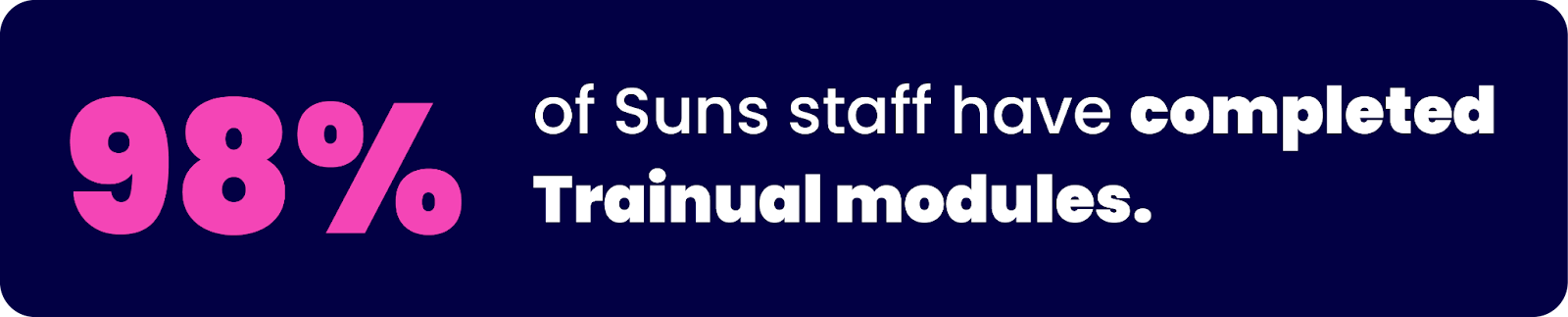
One feature the Phoenix Suns and Phoenix Mercury loved about Trainual was the tracking and accountability it provides. With quizzes and built-in tracking, managers could see not just who finished training, but who really grasped it. The result: 98% of Phoenix Suns and Phoenix Mercury team members have completed Trainual modules, giving leadership confidence that essential knowledge isn’t just being skimmed – it’s being learned.
"For us, ROI isn’t just numbers,” Kim added. “It’s seeing people act differently after training. That’s when you know it’s working.”
Adapting like game-day adjustments
The Suns and Mercury’s world changes fast — new initiatives, new hires, new challenges. Instead of pulling hundreds of people into a room, Trainual lets them roll out updates instantly.
"You don’t have to wait for somebody to train you,” Kim said. “You can go into the system and get the latest information. And we can track against it in real time.”
Every adjustment gets logged, tested, and reinforced — like film study for the business side of basketball.
Culture as a competitive edge
Building a system isn’t just about efficiency and accountability. It’s about building a culture people want to show up for — one defined by alignment, shared understanding, and genuine care for others.
"Having a platform like Trainual builds alignment almost inherently,” Greg said. “Everyone, no matter their department, learns the same vision, principles, and values. That kind of alignment multiplies scalability.”
Kali added, “It’s a place where our team members know they’ll be supported and given the tools to succeed. That’s not just talk. Trainual helps make it real by putting standards in writing and holding everyone accountable.”
The proof? Players notice. Staff notice. “You’re seeing female players want to come to the Mercury because of the culture here,” Kali added. “They see how we operate, how we invest in people, and they want to be part of it.”
That kind of pull doesn’t happen by accident. It happens when a franchise treats its culture like its playbook — practiced, reinforced, and executed until it becomes second nature.
TL;DR
The Phoenix Suns and Phoenix Mercury are always looking for new ways to scale processes and be more innovative. With Trainual, they’ve increased efficiency, accountability, and constant improvement – proving that a strong operational playbook is just as essential as a game plan on the floor. For any sports organization, the lesson is clear: when your people are aligned, your operations become your competitive edge.
👉 Want to build a premium playbook like the Phoenix Suns and Phoenix Mercury? Schedule a demo today.